Table of Contents
- Background and Necessity of the Suyeong Wastewater Treatment Facility Modernization Project
- Selection Process of Busan Envairo as the Preferred Negotiation Partner
- Reduction of Total Project Cost and Substantive Improvement of Project Structure
- Strengthening Odor Reduction Measures and Transition to Urban Facilities
- Upper Space Utilization Plan and Changes in Urban Spatial Value
- Goal of Starting Construction in 2026 and Future Implementation Direction
- Frequently Asked Questions (FAQ)
Background and Necessity of the Suyeong Wastewater Treatment Facility Modernization Project
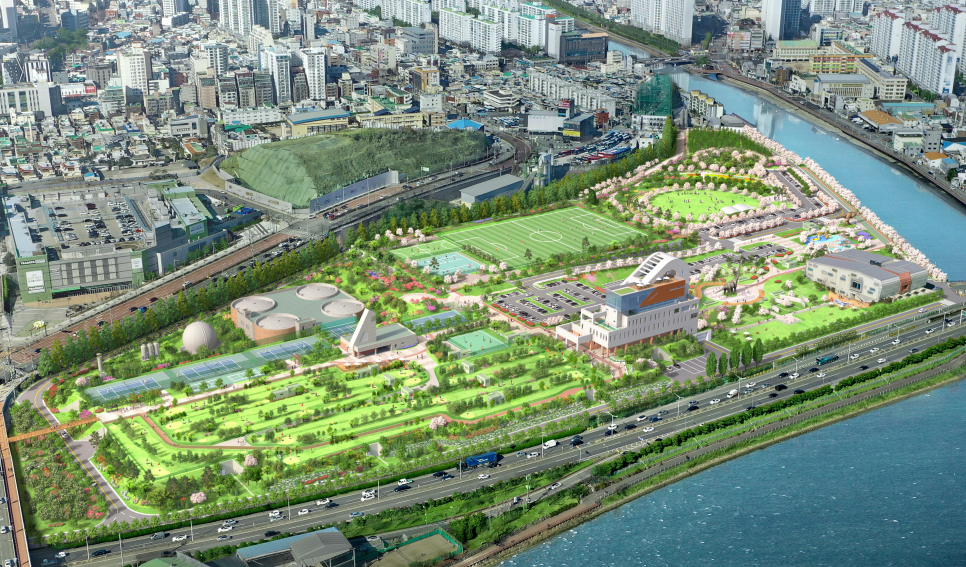
The Suyeong wastewater treatment facility, located in the heart of Busan, has become significantly outdated after 37 years since its completion in 1988. The degradation of this facility's performance, coupled with issues related to urban landscape damage and odor, has been consistently pointed out, leading to a growing call for fundamental improvements.
In response, the city of Busan is currently undertaking the Suyeong wastewater treatment facility modernization project, which involves relocating the treatment facility underground and transforming the space above it into a citizen-friendly area.
This project is noted as a significant urban regeneration initiative that goes beyond mere infrastructure improvements to renew the urban structure around Centum and the Suyeong River.

Selection Process of Busan Envairo as the Preferred Negotiation Partner
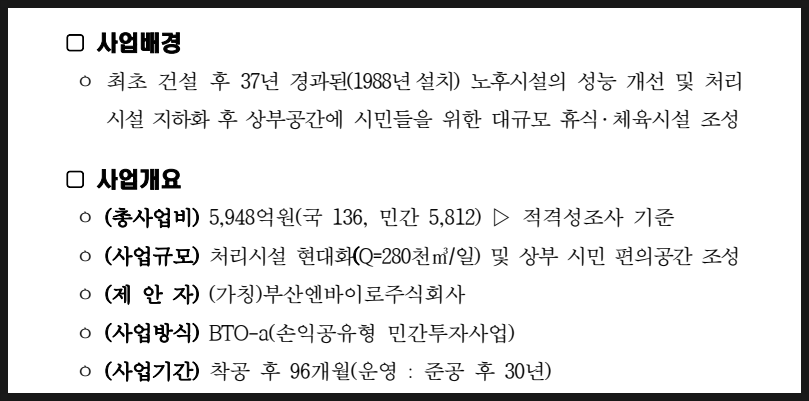
On December 16, 2025, the city of Busan selected Busan Envairo Co., Ltd. as the preferred negotiation partner through an evaluation of project proposal submissions. After the first submission of proposals in 2023, the project underwent a qualifying examination by the Korea Development Institute (KDI) in 2024, and passed the Ministry of Economy and Finance’s review and the Busan City Council’s agreement procedures in 2025.
Additionally, a third-party proposal announcement and pre-qualification assessments (PQ), as well as technical and price evaluations by specialized institutions, were conducted. During this process, a panel of experts from various fields conducted evaluations, ultimately selecting the company that received a high score of over 700 as the preferred negotiation partner.
This project is anticipated to have a positive impact on Busan's economy and investment environment and is expected to further enhance future development potential.
Reduction of Total Project Cost and Substantive Improvement of Project Structure
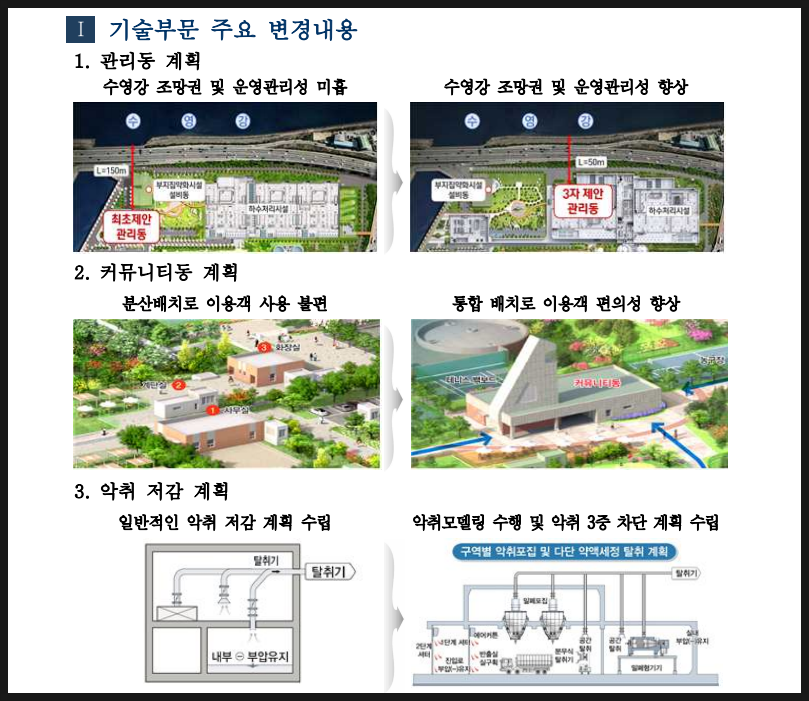
Supplementation of the overall project structure was conducted during the third-party proposal process.
The key improvements are as follows.
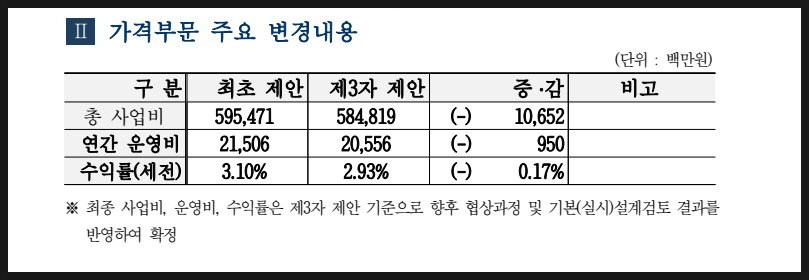
First, the total project cost has decreased by more than 10 billion won compared to the initial proposal, resulting in cost savings.
Second, adjustments to annual operating costs and pre-tax profit margins reduced the city's financial burden.
Third, the participation ratio of local businesses was increased from 40% to 45%, contributing to the revitalization of the local construction industry.
Furthermore, to enhance operational efficiency, the layout of the management and community buildings was readjusted, and the flow between users and managers was separated to strengthen operational stability.
This will promote better facility operation and invigorate the local economy.
Strengthening Odor Reduction Measures and Transition to Urban Facilities
Reflecting the characteristics of the treatment plant's central urban location, the odor reduction measures have been significantly improved. Moving beyond previous reduction plans, a three-tier barrier system based on odor modeling has been introduced, establishing a goal to significantly reduce odor levels even at the facility's boundary.
These measures are designed to ensure that citizens do not perceive any odors in their daily lives. Furthermore, the design of the management building, taking into account the view of the Suyeong River, is expected to enhance harmony with the urban landscape.
Upper Space Utilization Plan and Changes in Urban Spatial Value
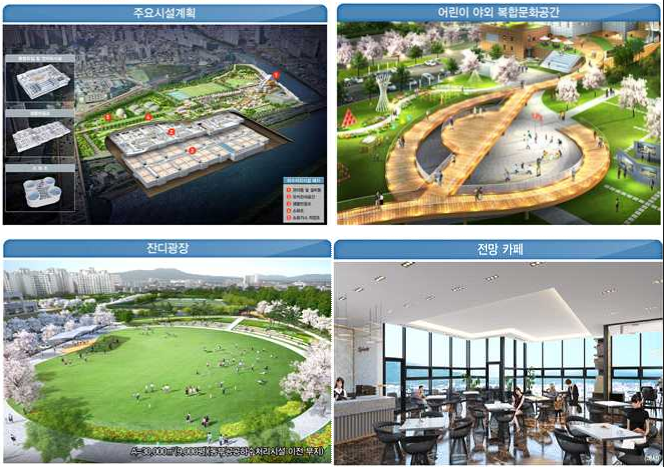
As the wastewater treatment facility is relocated underground, a multi-functional space for citizen use will be created above it.
The primary plans for this space include the establishment of a park golf course reflecting the needs of the middle-aged and elderly, as well as the introduction of a children's cultural complex considering family use, which will enable various experiences and cultural activities. Finally, an urban-themed park connecting the Suyeong River and the Centum area will also be developed, expanding green spaces.
This conceptualization of spaces is expected to enhance the value of the nearby Centum area and upscale residential regions, as well as interaction effects with Leel Centum.
Goal of Starting Construction in 2026 and Future Implementation Direction

The city of Busan plans to expedite subsequent procedures such as the execution agreement and designation of the project executor, based on the selection of the preferred negotiation partner. The goal is to start construction in 2026, and this project will be pursued as a privately funded project under the BTO-a method. An approximately 96-month construction period is expected after the construction starts, with 30 years of operation planned post-completion.
During the negotiation process, efforts will also be made to minimize concerns over increases in sewer charges and reduce the financial burden on the city. The modernization project of the Suyeong wastewater treatment facility is expected to emerge as a prime example of simultaneously improving the urban environment and enhancing the city's competitiveness.
#SuyeongWastewaterTreatmentFacilityModernizationProject, #BusanEnvairo, #BusanWastewaterTreatmentFacility, #ConstructionIn2026, #SuyeongRiverDevelopment, #CentumCity, #LeelCentum, #UrbanParkCreation, #ParkGolfCourse, #Children'sCulturalComplex, #BusanUrbanDevelopment, #BusanPrivateInvestmentProject, #BTOaMethod, #WastewaterTreatmentFacilityUnderground, #UrbanEnvironmentalImprovement, #BusanFinancialProject, #SuyeongRiverWaterfront, #CentumDevelopmentGoodNews, #BusanInfrastructure, #BusanPublicProject, #BusanUrbanRegeneration, #BusanEnvironmentalProject, #SuyeongDistrictDevelopment, #AdjacentToHaeundae, #BusanRealEstateIssues, #BusanUrbanPolicy, #BusanLivingInfrastructure, #BusanThemedPark
Frequently Asked Questions (FAQ)
Q. What is the background and necessity of the Suyeong Wastewater Treatment Facility Modernization Project?
The Suyeong wastewater treatment facility requires improvement due to aging and odor issues, which have severely damaged the urban landscape.
The Suyeong wastewater treatment facility, completed in 1988, has significantly deteriorated after 37 years, and issues of odor and urban landscape damage have been continuously raised. In response, the city of Busan is undertaking a modernization project that relocates the treatment facility underground and creates a citizen-friendly space above it. This project goes beyond simple facility improvements to revitalize the urban structure around Centum and the Suyeong River.
Q. What is the process of Busan Envairo being selected as the preferred negotiation partner?
Busan Envairo was selected as the preferred negotiation partner due to a high score in the evaluation and review process in 2025.
On December 16, 2025, Busan Envairo Co., Ltd. was selected as the preferred negotiation partner following the evaluation of project proposals. After the proposal submission in 2023, the project underwent a qualifying examination by KDI in 2024, the Ministry of Economy and Finance’s review in 2025, and the agreement process with the Busan City Council, along with a third-party announcement and evaluation by experts. The company that scored over 700 was ultimately selected.
Q. How were project cost savings and improvements in project structure achieved?
Total project costs reduced by approximately 10 billion won, adjustments made to operating costs, and increased participation from local businesses.
During the third-party proposal process, the total project costs decreased by over 10 billion won from the initial proposal, and adjustments to annual operating costs and pre-tax profit margins reduced the financial burden on the city. The participation ratio of local businesses increased from 40% to 45%, contributing to revitalizing the local economy. The management and community buildings' layouts were also readjusted to enhance operational efficiency and separate user and manager flows, thereby improving stability.
Q. How have odor reduction measures been strengthened?
A three-tier barrier system based on odor modeling was introduced to significantly lower legal standards.
Odor reduction measures have been significantly improved to reflect the treatment plant's central urban characteristics. A three-tier barrier system based on odor modeling was implemented, establishing targets well below legal limits for odors at the facility's borders. This design ensures that citizens do not perceive odors in their daily lives and includes plans for the management building that enhance harmony with the urban landscape while considering views of the Suyeong River.
Q. What are the plans for utilizing the upper space and the expected effects?
A park golf course, children's cultural facilities, and an urban-themed park will be created above the underground facility.
With the facility relocated underground, a citizen-friendly multi-functional space will be constructed above, which includes a park golf course for middle-aged and elderly groups, a children's cultural complex for families, and an urban-themed park connecting the Suyeong River and Centum area. These spaces are expected to enhance the value of nearby Centum and upscale residential areas while promoting interaction with facilities such as Leel Centum.
Q. What is the construction schedule and future direction of the project?
The goal is to start construction in 2026, with plans for approximately 96 months of construction and 30 years of operation post-completion.
After selecting the preferred negotiation partner, Busan plans to expedite subsequent procedures like signing execution agreements and designating project executors. The target is to start construction in 2026, and the project will be pursued as a privately funded BTO-a method project, with an estimated construction duration of around 96 months and operations planned for 30 years post-completion, alongside efforts to minimize concerns over sewer rate increases and financial burdens on the city, expected to improve the urban environment and enhance the city's competitiveness.
