Table of Contents
Core Analysis of EOSE

Eos Energy Enterprises, Inc. (NASDAQ: EOSE) is a U.S. company moving in a different direction from the traditional ESS market centered on lithium-ion batteries. The company targets the market for devices that can store energy for 6 to 16 hours.

The key product is the Z3 battery, which uses zinc and water-soluble electrolytes, capitalizing on fire safety and the domestic supply chain to target areas such as the power grid, data centers, and military facilities.

What to note about investing in EOSE is not just the safety of its zinc batteries; it is crucial whether the company can profitably mass-produce its technology.
Currently, sales and order volumes are rising sharply, but significant losses are occurring in the manufacturing process, putting it closer to a high-risk growth stock focused on normalizing production rather than a finished battery company.
Technical Moat of Zinc Batteries

The Z3 from Eos adopts a unique method of storing electricity. This battery collects zinc on the electrode surface during charging and dissolves it again during discharge to recover energy. Unlike typical lithium-ion batteries, Eos uses a water-based aqueous electrolyte, which results in a relatively lower risk of thermal runaway and fire.
However, zinc batteries have a problem known as dendrites that occurs during the charging and discharging processes. If zinc accumulates unevenly, it can lead to internal short circuits or performance degradation. To address this, Eos has developed technology that combines unique halide electrolytes, additives, electrode structures, and charging control algorithms to stabilize the zinc deposition process. These innovations contribute to the reliability of zinc batteries.
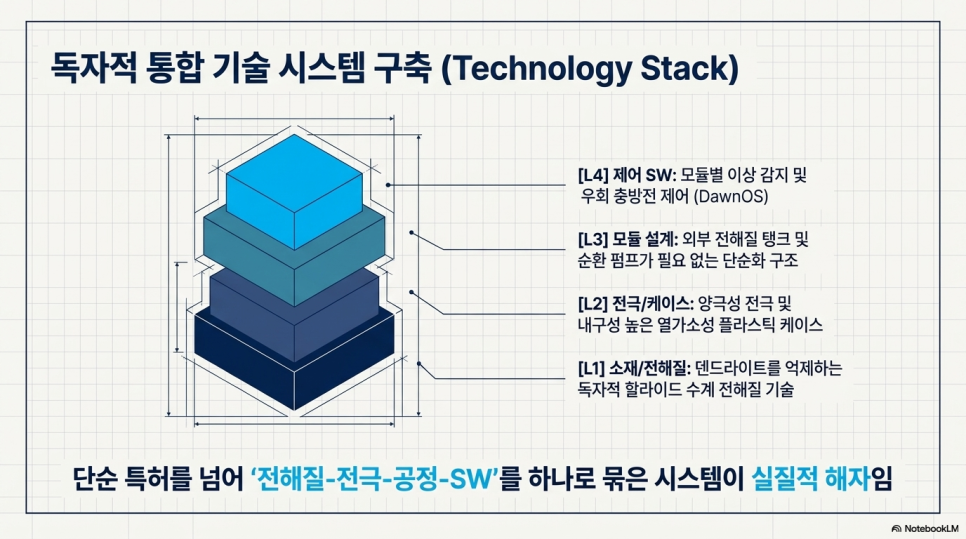
The technical moats can be summarized in the following elements.
Independent aqueous electrolytes and zinc plating and stripping technologies are important parts. Additionally, bipolar electrodes and thermoplastic plastic case structures enhance stability.
The module design maximizes efficiency as it does not require an external electrolyte tank and circulation pump. The DawnOS control software provides the ability to detect and bypass anomalies per module.
Along with this, the long-term accumulation of charge-discharge tests and field operation data supports reliability.
It is the integrated system technology of electrolytes, electrodes, manufacturing processes, and software, rather than the patents themselves, that constitutes the core of Eos’s competitiveness.
Competitiveness in Long-Duration ESS Market

Currently, in the global ESS market, LFP batteries have established a strong position in terms of price and production volume. As a result, Eos faces challenges in directly competing with lithium-ion batteries in the 2 to 4-hour storage market.
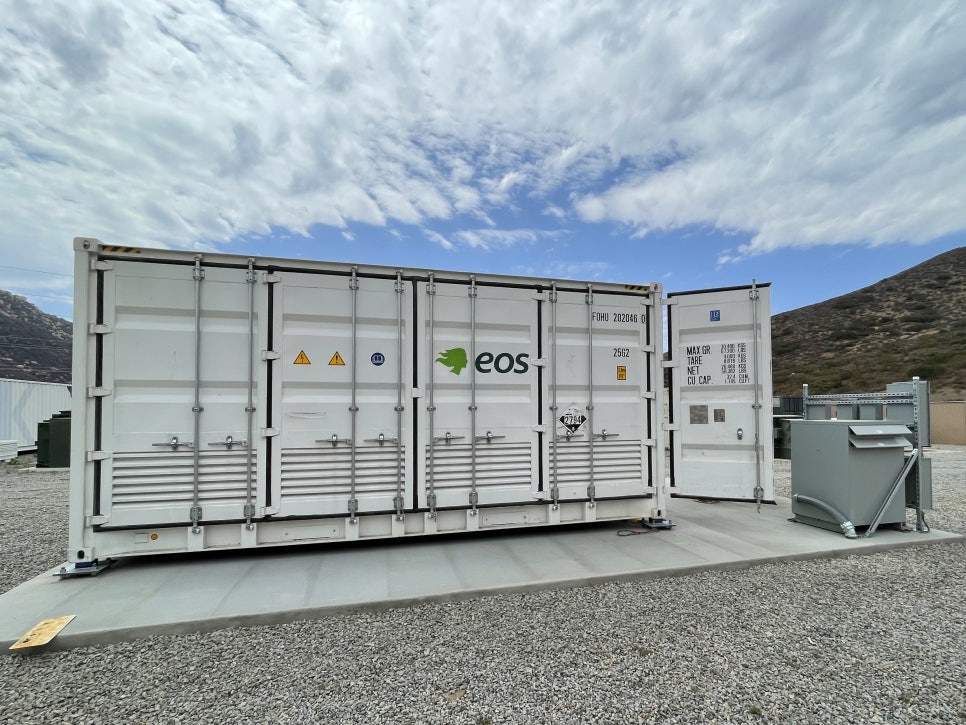
EOSE is likely to stand out in fields that require energy storage of more than 6 hours, where fire spacing, cooling costs, high-temperature environments, and local procurement conditions are important projects. In data centers, factories, military facilities, and urban ESS, the risk of battery fires and land utilization are crucial, making the advantages of aqueous zinc batteries more pronounced. Thanks to these characteristics, EOSE is expected to have competitiveness across various industries.

The company has introduced a new high-density platform called Indensity, following the Eos Cube. This platform is designed to vertically position storage capacity in limited spaces to address the increasing power demands of data centers.
However, design goals and actual business viability must be clearly distinguished. Thus, verification of costs, installation costs, and ease of maintenance of the structure is necessary, and these factors must be met for economic competitiveness to be proven.
EOSE's Performance and Financial Risks

In the first quarter of 2026, Eos recorded approximately $56.96 million in sales, achieving significant growth compared to the same period last year. Additionally, the order backlog amounts to approximately $644.6 million, and the potential project pipeline totals $24.3 billion. These figures suggest that Eos has officially entered the commercialization stage.
However, profitability issues remain a challenge to be addressed. In the first quarter of 2026, the cost of goods sold was approximately $10.09 million, and the gross loss reached around $44.43 million. As a result, the gross profit margin stayed low at about -78%. As production increases, the burden of losses and working capital is likely to grow.
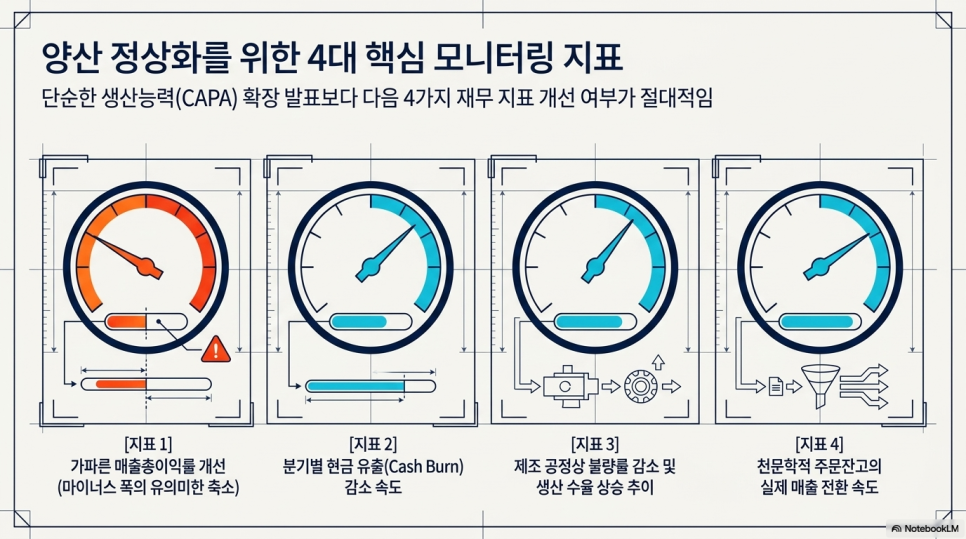
The company has set a revenue target of $300 to $400 million by 2026. To achieve this, sales over the remaining quarters must increase significantly compared to the first quarter.
Moving forward, improving the gross profit margin, reducing quarterly cash outflows, enhancing production yields, and the actual conversion speed of the order backlog to sales will become increasingly important.
EOSE's Stock Price Outlook and Investment Strategy

One of the main investment risks for EOSE is the issue of stock dilution. In addition to common shares, various potential shares exist, such as preferred shares, warrants, and convertible bonds, which increase the likelihood of their conversion as the stock price rises. Even if the company's value increases, if the number of shares issued rises, the increase in value per share may be limited.

The stock price outlook can fluctuate significantly depending on production profitability. If the company fails to meet sales targets and needs significant fundraising, the stock price could fall to the $2 to $4 range. Conversely, if the gross profit margin approaches breakeven, there is a possibility of maintaining corporate value in the $5 to $9 range.
If the possibility of profitability in 2027 is confirmed and sales reach the upper guidance, there might be a reevaluation to levels of $12 to $18. However, if losses and cash depletion continue despite increasing sales, the stock price will likely struggle to maintain upward momentum. Considering these factors is critical at this time.

In conclusion, Eos Energy is a company with proven technological differentiation, but its economic advantage has yet to be established.
It is more advisable to approach it as part of a portfolio of high-volatility growth stocks rather than as a core long-term holding.
New investors should cautiously approach by checking improvements in quarterly gross profit margins and cash flows rather than the announcement of new orders.
#EosEnergy, #EOSE, #EosEnergyStock, #EOSEStockOutlook, #USStocks, #USSmallCap, #LongDurationESS, #EnergyStorageDevices, #ESSRelatedStocks, #ZincBatteries, #AqueousBatteries, #NonLithiumBatteries, #BatteryRelatedStocks, #RenewableEnergy, #PowerGridInvestment, #DataCenterPower, #DataCenterESS, #USEnergyStocks, #GreenEnergy, #EnergyTransition, #Z3Battery, #DawnOS, #EosCube, #Indensity, #USManufacturing, #GrowthStockInvesting, #SmallCapInvesting, #StockPriceOutlook, #CompanyAnalysis
Frequently Asked Questions (FAQ)
Q. What are the key products and technical features of Eos Energy (EOSE)?
EOSE supplies the Z3 battery using zinc and water-soluble electrolytes, possessing long-duration energy storage technology with strengths in fire safety and domestic supply chains.
Eos Energy Enterprises focuses on the market for devices capable of long-duration energy storage of 6 to 16 hours. The main product, the Z3 battery, uses zinc and aqueous electrolytes, resulting in a low fire risk and high safety. This battery adopts a unique method of collecting zinc on the electrode surface during charging and dissolving it during discharge to recover energy, differentiating it from existing lithium-ion batteries. Additionally, it possesses the technology to reliably solve the zinc dendrite issue by integrating halide electrolytes, additives, electrode structures, and charging control algorithms.
Q. What is EOSE's technological competitiveness (moat)?
Independent aqueous electrolytes, stable zinc plating technology, and an integrated software system are core elements of EOSE's technological competitiveness.
EOSE's technological moat lies in the system technology that integrates electrolytes, electrodes, manufacturing processes, and control software. Zinc plating and stripping technologies, bipolar electrodes, and thermoplastic plastic case structures enhance the product's safety and durability. The module design maximizes efficiency without the need for external electrolyte tanks and circulation pumps, while the control software called DawnOS provides features to detect and bypass anomalies. Reliability is also assured through years of accumulated charge-discharge tests and field data.
Q. In which markets does EOSE hold competitiveness compared to existing lithium-ion batteries?
EOSE is expected to be competitive in data centers and military facilities requiring long-duration ESS of more than 6 hours, driven by safety and land efficiency.
The current global ESS market is dominated by LFP batteries in terms of price and production volume, making direct competition in the 2 to 4-hour storage market difficult for EOSE. However, in projects that require long-duration storage of over 6 hours, where reducing fire risks and cooling costs, adapting to high-temperature environments, and meeting local procurement conditions are critical, the safety and space efficiency of aqueous zinc batteries can secure competitiveness.
Q. What is EOSE's recent financial performance and profitability status?
Despite a surge in sales in the first quarter of 2026, profitability is still an issue due to gross losses and a low gross profit margin.
In the first quarter of 2026, EOSE recorded approximately $56.96 million in sales, showing significant growth year-over-year. The order backlog stands at approximately $644.6 million, with potential project pipelines reaching $24.3 billion. However, the cost of goods sold was about $10.09 million, and the gross loss was around $44.43 million, leading to a gross profit margin of -78%, indicating that profitability remains a challenge. As production increases, the burden of losses and working capital is also likely to grow.
Q. What are the stock price outlook and investment risks to consider for EOSE?
The stock price outlook is highly influenced by production profitability, and care should be taken regarding dilution risks and improvements in cash flow.
The stock price of EOSE exhibits significant volatility depending on improvements in the gross profit margin. If sales targets are missed, the stock price may fall to the $2 to $4 range due to funding needs, while reaching breakeven could lead to a valuation range of $5 to $9, and confirmation of profitability in 2027 could lead to a reevaluation to levels of $12 to $18. However, ongoing losses and cash depletion limit the potential for stock price increases. Also, the potential dilution from preferred shares, warrants, and convertible bonds negatively affects shareholder value. New investors should carefully check for improvements in quarterly gross profit margins and cash flow.