Table of Contents
- The Rise of Space AI Infrastructure
- The Reality of Space Data Centers
- Core Demand Areas
- MCHP Stable Core Stock
- GSIT Technology Option Stock
- MRAM Performance Small Cap
- QUIK High Risk High Leverage
- Comparison of Four Stocks
- Key Investment Strategies
- Conclusion on Space Semiconductors
- Frequently Asked Questions (FAQ)
The Rise of Space AI Infrastructure
Space data centers and space semiconductors are investment items gaining attention due to the increased power consumption of the AI industry, the lack of space in terrestrial data centers, the limitations of power grids, and the need for real-time processing of satellite data. These changes are likely to become significant factors in future investment strategies.

The space environment has cold characteristics, but if one simply views the heat generation issues of AI chips as a result of this, they may miss the real causes.
Space exists in a vacuum, making it difficult to effectively dissipate heat using air or coolant like on Earth. Therefore, most of the power consumed by high-performance AI chips is converted into heat.

The core of space data centers is not just about reducing cooling costs, but actively utilizing solar power, alleviating the burden on ground power grids, and enabling the real-time processing of satellite data.
The Reality of Space Data Centers

Space data centers are no longer a mere fantasy. Google is experimenting with satellite cluster machine learning operations through its Project Suncatcher, utilizing TPU and free-space optical communication.
Additionally, NVIDIA is targeting the market for orbital data centers and geographic information analysis and autonomous space operations through its Space-1 Vera Rubin Module.
Starcloud has launched satellites equipped with H100 GPUs to verify AI calculations in orbit.
These innovations are paving the way for a new era of data processing and analysis in space.
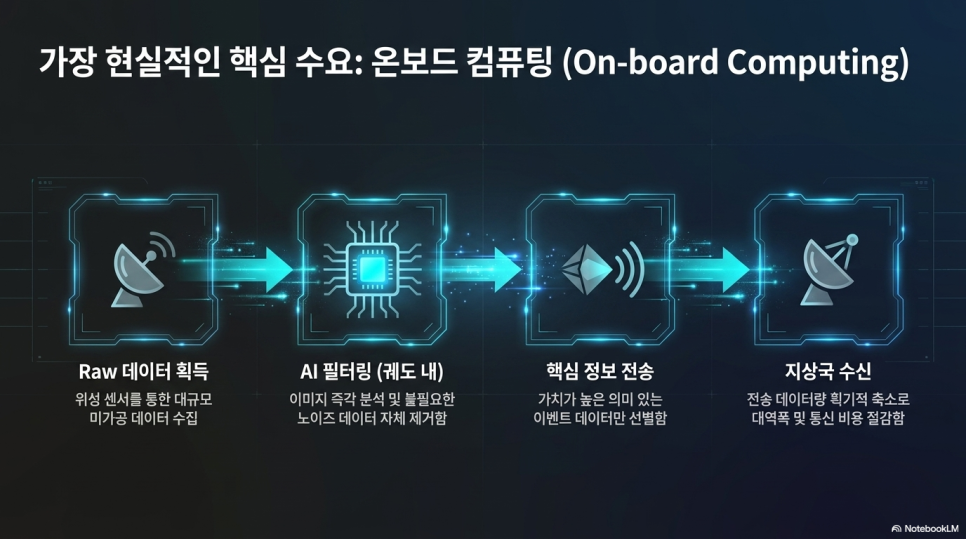
Currently, we are in a phase of experiments and technology validation rather than commercialization. The stage where thousands of AI chips are sold repeatedly generating stable service revenue has not yet been reached.
The current demand is more focused on onboard computing, which analyzes images within satellites, filters out unnecessary data, and transmits only important events to the ground rather than large-scale AI training. Technologies like these are receiving more interest in practical terms.
Core Demand Areas

The areas in the space semiconductor industry that are most likely to be commercialized first are diverse. Among these, radiation-hardened processors and high-reliability SRAM and MRAM memories are gaining attention.
Moreover, reconfigurable FPGAs and low-power AI inference chips are expected to play important roles as well. Power management semiconductors, optical communication interfaces between satellites, and high-reliability boot, control, and storage devices are also key elements in this market.
In these areas, more than simple performance, radiation resistance, long-term supply stability, error correction capabilities, power efficiency, and certification history are considered much more important.

MCHP Stable Core Stock
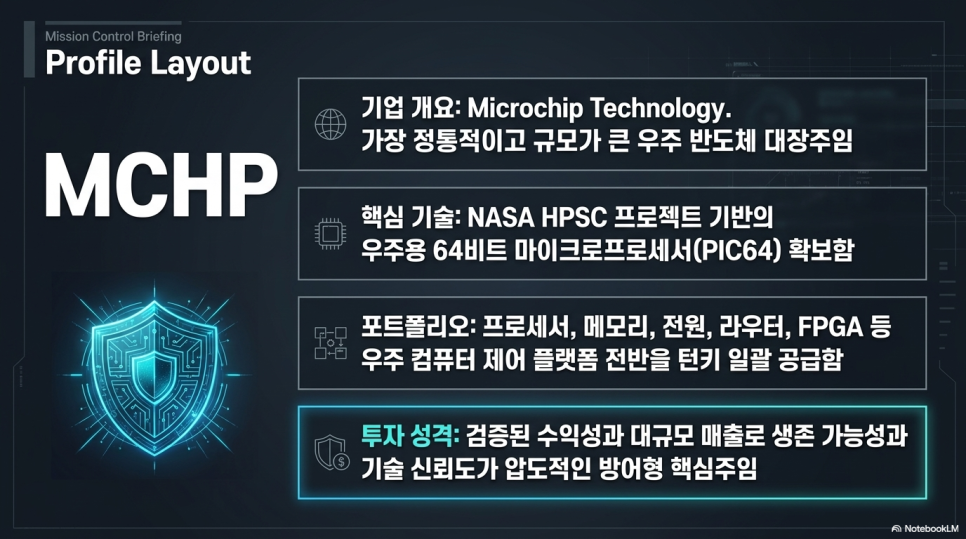
Microchip Technology, known as MCHP, is recognized as a company with a long history in the space semiconductor field. The company's main products are 64-bit microprocessors of the PIC64-HPSC series linked to NASA's HPSC project. This product line is divided into radiation-hardened and radiation-tolerant types, designed for various missions ranging from low Earth orbit satellites to deep space exploration.
A strong point of MCHP is that it does not just stop at supplying processors. The company also offers a wide range of components such as space NOR Flash, SRAM, power regulators, DC-DC converters, clocks, Ethernet PHY, SpaceWire routers, FPGA, and mixed-signal products. In short, it can be said that it provides a comprehensive supply of core control platforms for space computers and the necessary peripherals.
From a financial perspective, MCHP is also stable. As a well-established large semiconductor company, it has solid sales and profitability, although its potential for a rapid ascent due to the space data center theme may be limited. However, the company is highly regarded in terms of survival prospects and technological reliability. These characteristics position MCHP as a trusted company in the market.
GSIT Technology Option Stock
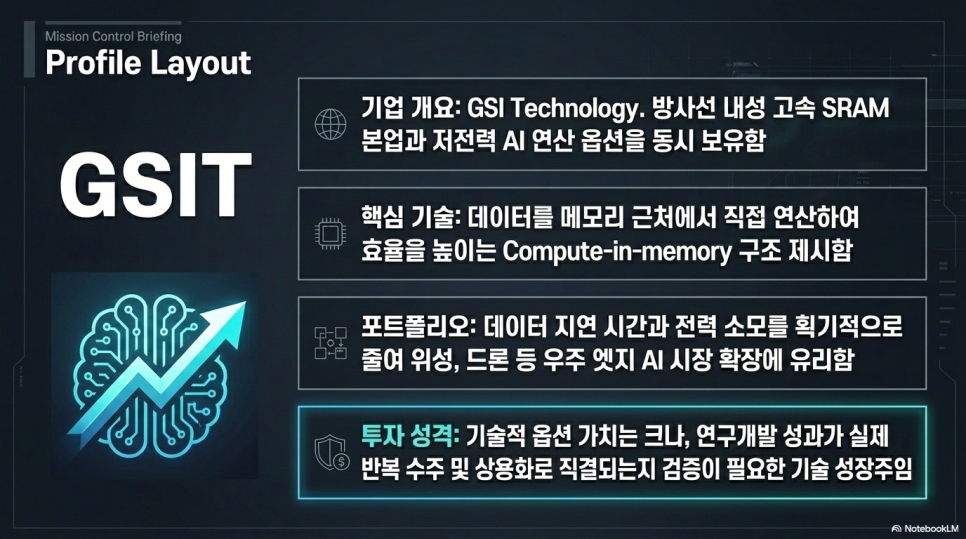
GSI Technology, ticker GSIT, is a company equipped with high-speed SRAM and low-power AI computation capabilities, mainly dealing with radiation-hardened SRAM. Unlike DRAM, SRAM does not serve as large-scale main memory but excels in fast read and write operations due to its short latency. This makes it suitable for satellites, radars, defense equipment, and signal processing systems.
One of the main investment attractions of GSIT is the compute-in-memory architecture implemented in Gemini-II and Plato. This architecture presents an innovative approach that reduces power consumption and latency by conducting calculations close to where the data resides in memory. This technology has the potential to enable expansion into drone, defense vehicles, robotics, and future space edge AI markets.
However, GSIT still needs validation for commercialization. Currently, the potential of the technology is more prominent than its sales, and how research and development results translate into actual orders and recurring revenues will be a crucial variable for future growth.
MRAM Performance Small Cap
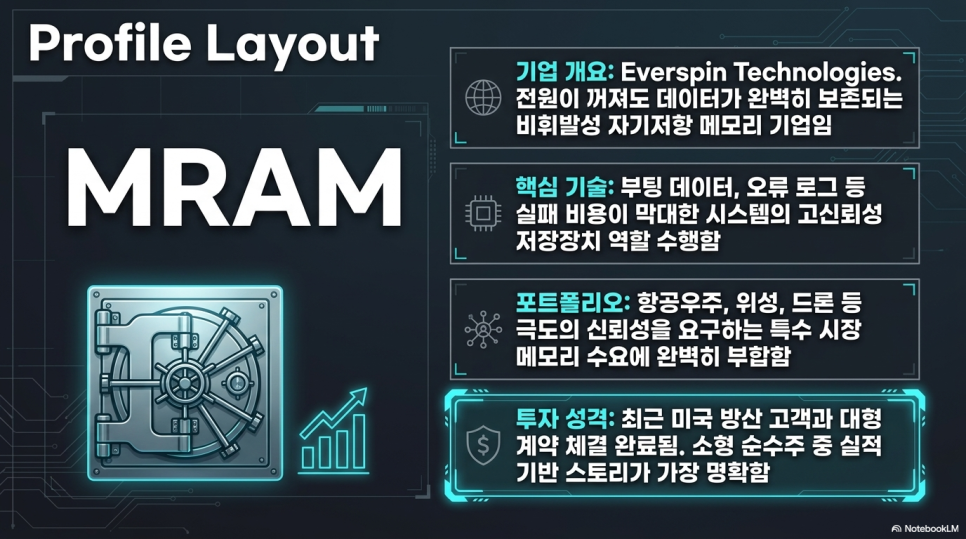
Everspin Technologies, ticker MRAM, is considered a highly attractive company in the field of space and defense memory investments. MRAM is a non-volatile memory that stores data in magnetoresistive states rather than charges, ensuring data is preserved even when the power is off, boasting excellent write speeds and durability.
In space systems, storage for boot data, error logs, essential data for mission execution, and control state is essential. In this field, MRAM does not completely replace NAND or SRAM but instead serves as a high-reliability storage device in systems where failure costs are high.
Notably, Everspin is developing high-reliability MRAM products targeted at the aerospace, satellite, and drone markets, and has a compelling investment story backed by large contract agreements with US defense customers. Among the four stocks, it offers the most balanced investment logic as a small pure stock, making it an attractive option for investors.
QUIK High Risk High Leverage

QuickLogic, ticker QUIK, is a company specializing in FPGA and eFPGA IP rather than a memory manufacturer. FPGA significance is profound in space systems. Once a satellite is launched, it is physically difficult to repair, so semiconductor technology that allows for function modifications post-launch is essential.
QuickLogic offers radiation-hardened FPGAs, eFPGA Hard IP, Antifuse FPGAs, and robust programmable logic solutions. Particularly, its ties to the strategic radiation-hardened FPGA program of the US government are a positive factor for investors.
However, QUIK possesses a relatively aggressive nature compared to other stocks. While the technological direction is appealing, the small revenue size necessitates confirmation of whether contracts translate into actual production sales. Although expectations are high, the associated valuation pressures can be quite substantial.
Comparison of Four Stocks
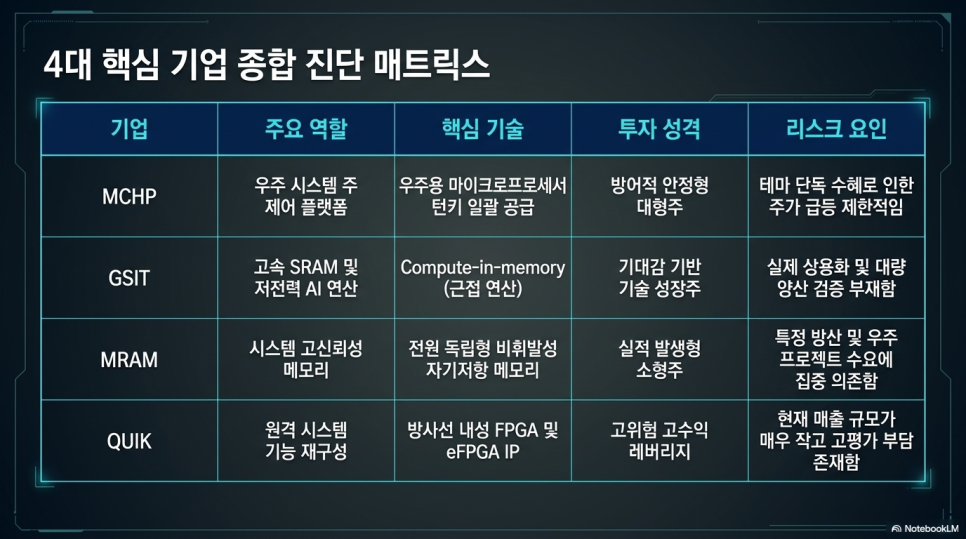
The four companies related to space semiconductors belong to the same theme, but their roles differ significantly.
MCHP functions as the primary control platform for space computers, while GSIT offers high-speed SRAMs and low-power AI computation options. MRAM produces high-reliability memory capable of retaining data even when powered off, and QUIK develops FPGAs and eFPGA IP that can be reconfigured post-launch.
The investment nature of these companies differs as well. If stability and substance are prioritized, MCHP becomes the most defensive choice. Among small caps, if performance and contract backing are emphasized, MRAM offers the most reliable option. In contrast, if technological potential and stock price appreciation are considerations, GSIT and QUIK appear promising, though investors must also keep in mind the risks of contract conversion failure and additional funding needs.
Key Investment Strategies
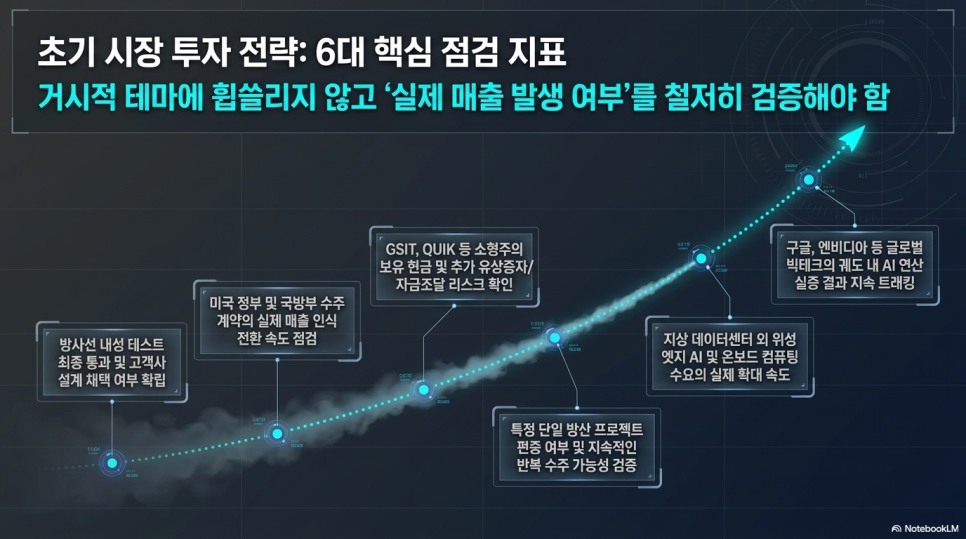
Investing in space data centers is an attractive long-term theme, but currently, it is in the early stages. Thus, rather than judging solely by the forecast that "AI data centers will be established in space," it is important to focus on areas with a high probability of actual revenue generation.
Key indicators to check when investing include: first, whether the customer has adopted designs in the space and defense sectors. Second, it’s important to verify whether they have passed radiation resistance tests. Third is the speed of revenue recognition from government contracts. Fourth, examine available cash and the possibility of additional funding. Lastly, keep an eye on the increasing demand for satellite edge AI and onboard computing. The orbital validation results from Google, NVIDIA, and Starcloud are also worth noting.
Especially, GSIT and QUIK evoke strong technological expectations, necessitating a segmented approach strategy. In contrast, MCHP and MRAM have verified business foundations, allowing for a more stable investment. It is crucial to consider all these factors comprehensively to make informed investment decisions.
Conclusion on Space Semiconductors

Space data centers and space semiconductors are garnering attention as the next evolution in AI infrastructure. However, simply transferring existing Earth-based GPU data centers to space is not realistic. Rather, it is expected that demand will emerge first in areas like internal data processing within satellites, autonomous operations of defense and space systems, radiation-hardened memories and processors, and reconfigurable FPGAs.
MCHP is regarded as a stable investment target, while MRAM is a proven small cap stock with demonstrated defense contracts and performance. GSIT is a technology growth stock offering low-power AI computational options, while QUIK is a high-risk, high-leverage stock investing in radiation-hardened FPGA programs. Each company has its unique characteristics and potentials.
Therefore, in investing in space semiconductors, it is necessary to judge by dividing the four stocks between the performance-based core axis and the technology option satellite axis, rather than lumping them under the same thematic stock. As space data centers become more realized in the long run, the importance of these companies may become more prominent, but in the short term, approaching with a careful eye on actual contracts, revenues, and cash flow is a more reasonable strategy.
#SpaceDataCenters, #SpaceSemiconductors, #AIDataCenters, #SpaceAI, #OnBoardComputing, #SatelliteSemiconductors, #RadiationHardenedSemiconductors, #MCHP, #Microchip, #GSIT, #GSItechnology, #MRAM, #Everspin, #QUIK, #QuickLogic, #FPGA, #eFPGA, #SRAM, #MRAMmemory, #SpaceDefense, #SatelliteAI, #EdgeAI, #NASA_HPSC, #GoogleSuncatcher, #NVIDIA_Space1, #Starcloud, #USStocks, #SemiconductorInvestment, #AIInfrastructure, #InvestmentStrategy
Frequently Asked Questions (FAQ)
Q. What are the main characteristics that make space data centers different from existing terrestrial data centers?
Space data centers focus on relieving the burden on ground power grids and real-time processing of satellite data.
Space data centers are not merely aimed at reducing cooling costs; they focus on utilizing solar power and alleviating the burden on terrestrial power grids. Additionally, onboard computing capabilities crucially process data from satellites in real-time, transmitting only important information to the ground. This differentiates them from traditional terrestrial data centers that struggle with spatial and power limitations.
Q. What is the current level of commercialization and demand status for the space semiconductor market?
Space semiconductors are still in experimental stages, mostly centered around onboard computing within satellites.
The space semiconductor market is still in the stages of technological validation and experimentation. A large-scale AI learning market has not yet formed, and the main demand concentrates on onboard computing for analyzing images within satellites, removing unnecessary data, and transmitting important events. Thus, it is not at a stage where stable and repetitive revenue is being generated.
Q. What are the important technological characteristics for space semiconductors, and which products are gaining attention?
Radiation resistance, power efficiency, and error correction are crucial, and processors, SRAM, and MRAM are core products.
For space semiconductors, attributes such as radiation resistance, long-term supply stability, error correction capabilities, and power efficiency are far more significant than mere performance. Accordingly, notable products include radiation-resistant processors, high-reliability SRAM and MRAM, reconfigurable FPGAs, low-power AI chips, power management semiconductors, and optical communication interfaces between satellites. These products are designed with reliability and functionality suitable for the space environment.
Q. What are the strengths of Microchip Technology (MCHP) in the space semiconductor business?
MCHP provides a wide range of space semiconductor products with proven technological reliability.
MCHP supplies core components for space computers, including radiation-hardened 64-bit microprocessors related to NASA’s HPSC project, NOR Flash, SRAM, power management products, and FPGAs. This expands its role beyond merely providing processors to reinforce its standing as a space control platform. Furthermore, MCHP is financially stable and highly trusted technologically, making it the most defensive choice among investments related to space data centers.
Q. What technologies and investment attractions does GSI Technology (GSIT) offer?
GSIT has radiation-hardened high-speed SRAM and energy-efficient AI computation technology.
GSIT has developed a compute-in-memory architecture that allows for quick read and write operations using radiation-resistant SRAM, positioning it well for minimizing latency and power consumption. This technology is suitable for expanding into markets like drones, defense, and space edge AI. However, GSIT still requires further validation for commercialization and revenue growth, and its technological potential is a key investment point.
Q. What role does Everspin Technologies (MRAM) play in the space semiconductor field and what does it mean for investment?
MRAM is essential non-volatile memory with high reliability for space systems.
MRAM is a magnetoresistive memory that retains data even when the power is off, boasting fast write speeds and durability. It is crucial for storing boot and control data in space and complements NAND and SRAM. Everspin, having proven its market performance and secured defense contracts, shows high investment appeal as a small-cap stock.
Q. What is the technology and investment risk of QuickLogic (QUIK) in the space semiconductor market?
QUIK offers radiation-hardened FPGA technology but carries high investment risks.
QuickLogic develops reconfigurable FPGAs and eFPGA IP for space applications and participates in the US government’s radiation-hardened FPGA program. It is essential for the ability to modify functions even after satellite launch, but its small sales size raises concerns about contract conversion and additional funding needs. Thus, it is assessed as a high-risk, high-leverage investment opportunity.
Q. What are the differences between the four representative companies in the space semiconductor industry (MCHP, GSIT, MRAM, QUIK)?
Each company has different roles and investment characteristics within the space semiconductor sphere.
MCHP provides a stable and broad space control platform, while GSIT offers new technology SRAM and AI computation options. MRAM supplies proven high-reliability memory with documented defense contracts, and QUIK, while possessing growth potential with reconfigurable FPGA technology, carries associated risks. Investors may consider MCHP for stability, MRAM for performance, and GSIT and QUIK for technological growth.
Q. What key points should be checked when investing in space data centers?
Check for design adoption, radiation resistance testing, government contracts, cash flow, and satellite AI demands.
When making investment decisions, it is crucial first to confirm whether customers in the space and defense sectors have adopted designs, and whether the products have passed radiation resistance tests. The speed of revenue recognition from government contracts, adequate cash reserves, and potential for additional funding must also be analyzed. Additionally, pay attention to increasing demand for satellite edge AI and onboard computing, as well as the outcomes of orbital validations to approach with a careful segmented strategy.
Q. How can the future outlook and strategy of semiconductor investment in space data centers be summarized?
Space data centers represent a long-term growth area, requiring careful segmented investment based on contracts and performance.
Space AI infrastructure and data centers represent the future direction of AI development, but they remain in the early stages. Instead of simply transplanting Earth data centers, demand for internal satellite processing, radiation-resistant memory, and FPGA reconfiguration technologies is expected to be commercialized first. Investors should analyze the four stocks with regard to performance and technological options, paying careful attention to contracts and cash flow while managing risks in a rational strategy.