Table of Contents
Birth of the AI Factory

The AI data center is not just a space filled with numerous servers.
Just as textile factories during the industrial revolution produced large quantities of fabrics using cotton and yarn, today’s AI data centers use data as raw materials to create new forms of outputs such as intelligence, predictions, judgments, image processing, code generation, voice recognition, and robot control.
These data centers play a crucial role in driving innovation in modern society.

Just as textile factories brought about a productivity revolution by replacing manual labor with machines, current AI data centers are assisting or replacing some of the intellectual labor performed by humans. This leads to a new form of productivity revolution.

The industrial revolution of AI does not stop at the emergence of chatbots. It signifies a massive structural change across various fields, including semiconductors, power, cooling, communication, real estate, and raw materials. This change will provide us with new opportunities.
Analogy to Textile Factories

The structure of textile factories during the industrial revolution is clearly evident. Raw materials such as cotton were essential, and machines like spinning machines to convert them into yarn and looms to weave them into fabric were needed. Running these machines required steam engines and coal, as well as ventilation systems to expel heat and dust. These elements worked harmoniously for the efficient operation of the textile factories.

The AI data center has a complex structure similar to a factory. Here, data is likened to cotton and yarn, while GPUs serve as the looms that weave this data together. HBM can be seen as the device supplying high-speed yarn.
Additionally, optical connections and networks are responsible for transportation within the factory, and power facilities can be compared to steam engines. Cooling systems act like the factory's ventilation system, while copper serves as the veins of the factory. Transformers can be understood as gears and shafts that adjust the necessary power. Data center REITs are property owners, while SMR and power plants serve as energy sources to continuously operate the factory.
This analogy prevents one from limiting the AI industry to just a single technology or a stock. It shows that AI leads a software revolution while also encompassing an investment cycle in physical facilities, clearly demonstrating the complexity and significance of the AI industry.
Core of GPU and HBM

At the core of the AI data center are GPUs. Just like the loom that was essential for converting yarn to fabric in textile factories during the industrial revolution, the main devices driving computation in today’s AI data centers are GPUs and AI accelerators.
GPUs handle massive calculations in parallel, training large AI models, generating responses to user questions, producing images and videos, and contributing to decision-making in robots and autonomous systems. For this reason, Nvidia stands out in the AI industry, as it encompasses not only the sale of chips but also all essential devices for the AI factory and the software ecosystem that effectively operates them.
Thus, GPUs are positioned as essential elements for the advancement and innovation of AI technology, and they will continue to play a pivotal role in the future AI industry.

In a textile factory, production cannot occur with just a loom. Even if there is an excellent loom, if there is no timely supply of yarn, the machine will not operate. In the AI data center, HBM plays a similar role.
HBM is a memory that supplies data at ultra-high speeds beside the GPU, analogous to a high-speed yarn supply device that always provides yarn next to the loom. No matter how excellent the GPU's performance is, if the performance of HBM is insufficient or the quantity is lacking, there will be a drop in overall productivity. Thus, the importance of HBM cannot be overlooked.
Optical Connections and Networks

The training process of large AI models is not accomplished simply with a few GPUs. Thousands of GPUs are interconnected, operating simultaneously to exchange data like a massive factory. For such large-scale operations, optical connections, network switches, optical transceivers, cables, and interconnect technology are essential.
Just as in a textile factory where raw materials, semi-finished products, and finished products continuously move, data in an AI data center flows ceaselessly between servers, racks, and clusters. Critical in this process is not just the quantity of movement, but how quickly, with low latency, and with minimal power the data is processed. These factors significantly impact the performance of AI models.
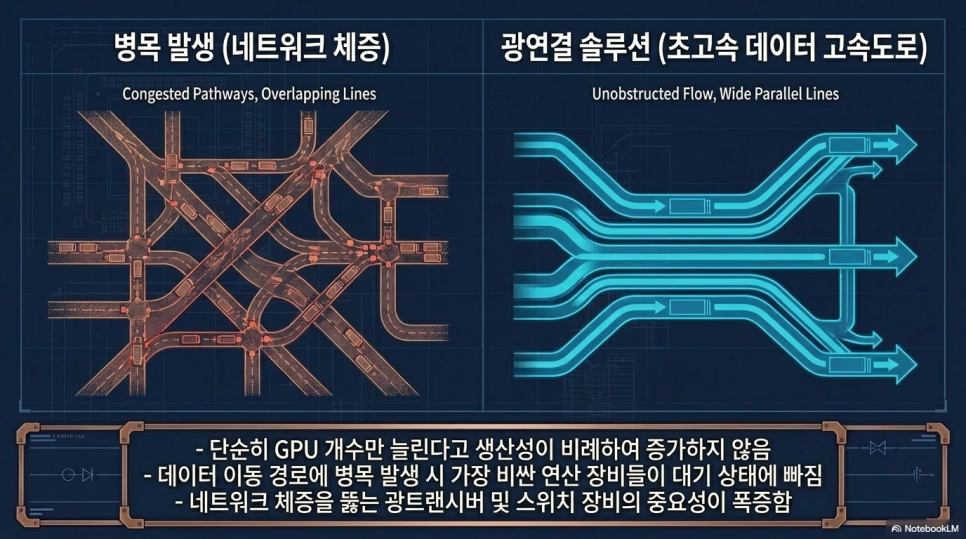
The efficiency of an AI factory is not merely determined by the number of GPUs. Even if many GPUs are installed, a slow network can lead to bottlenecks. If the data transfer paths are blocked, even with excellent equipment, overall productivity is reduced. For this reason, the roles of optical transceivers and optical communication equipment are critically important in AI data centers.
Power Facilities and Copper

Power facilities serve as a core element in the operation of AI data centers. Just as steam engines played the heart role in factories during the industrial revolution, electricity performs such a function in today’s AI data centers. Components such as GPUs, HBM, servers, cooling equipment, and network devices consume substantial amounts of electricity.
As the complexity of AI models increases and the scale of data centers grows, power demand has surged. Consequently, the AI industry is closely linked not only to the semiconductor industry but also to the power industry. This is where the need for power grids, transformers, distribution panels, circuit breakers, power semiconductors, transmission lines, and copper is simultaneously increasing.
In particular, transformers play a crucial role in the operation of data centers, and their function is often overlooked. Since the electricity generated at power plants cannot be supplied directly to the data center's equipment, it must be adjusted and distributed stably through transformers. Additionally, responding to sudden changes in power demand is also an important function of this equipment. If the supply of transformers is not smooth, it poses a risk of delaying the construction schedule of the data center.

Copper serves as a core element in large-scale factories. It is essential for power transmission, equipment connections, cooling systems, and the construction of power facilities. While iron and coal were the main raw materials during the industrial revolution, copper, along with semiconductors, is emerging as an important infrastructure resource in the age of AI data centers. Power devices, special cables, and cooling materials are also recognized as essential elements for this era.
Cooling and Energy

The cooling system has become an essential facility for ventilation and heat management within the factory. During the industrial revolution, textile factories faced issues where machines continuously operated, leading to heat and dust accumulation. Without sufficient ventilation, the working environment deteriorated, and the efficiency of the machines declined. This situation manifests even more sensitively in AI data centers.
As GPUs and servers generate enormous heat, if they are not cooled in a timely manner, performance degradation, equipment damage, and loss of power efficiency can occur. Therefore, various cooling technologies such as air cooling, water cooling, immersion cooling, chillers, cooling towers, and heat exchangers are gaining importance. Particularly for high-performance AI servers, existing cooling methods are often insufficient, thus increasing the need for liquid cooling and high-efficiency thermal management solutions.
The source of power supply also stands out as a critical factor. AI data centers require a stable power supply 24/7 year-round. Thus, various power sources such as solar, wind, natural gas, nuclear power, and small modular reactors (SMR) are gaining attention. Particularly, while the long-term potential for integration with data centers is being discussed for SMR, issues such as commercialization, regulations, economic feasibility, and construction duration remain challenges to be resolved.
Data Center REITs

Data center REITs play a role similar to that of factory owners during the industrial revolution. Back then, the importance of factory buildings, land, and access to ports and railroads was paramount; in today’s AI era, factors such as data center locations, power supply capabilities, cooling conditions, accessibility of communication networks, and long-term lease agreements with customers are essential.
While these data center REITs do not directly develop AI models, they serve to provide space and infrastructure for AI factories. Not all data centers hold the same value, as that value assessment is contingent on various factors. For instance, whether sufficient power has been secured, if there are major cloud companies as customers, their cooling efficiency, the smoothness of network connections, and the availability of expandable land become critical evaluation criteria.
Just as factories could not be established anywhere during the industrial revolution, in the current AI era, the positions of data centers equipped with power and communication infrastructure are valued even higher. These elements will be significant considerations for future investments in data center REITs.
Key Investment Perspectives

The most important question regarding investments in the AI industry is not, "Are we involved in AI?" The key is to identify where the obstacles to AI development currently lie.
For example, if there is a shortage of GPUs, GPU manufacturers become the price leaders. If HBM is in short supply, companies producing high-bandwidth memory will gain favorable positions. Additionally, if there is a lack of power infrastructure, companies making transformers and power equipment will draw attention.
As cooling technology approaches its limits, firms providing liquid cooling and thermal management solutions will shine. If data transmission becomes a hindrance, companies related to optical connections and networks might be reevaluated.
The current state is that all items are bottlenecked.
Not all value chains progress at the same pace.
For instance, even if GPUs demonstrate excellent performance, it does not mean that all semiconductors are superior. Similarly, an increase in data centers does not grant the same benefits to all power equipment manufacturers. Therefore, it is essential to analyze revenue correlations, customer networks, technological barriers, supply shortages, expansion rates, margin structures, and valuation burdens comprehensively.
Summary of the AI Revolution

When likening the AI data center to textile factories during the industrial revolution, the essence of the AI industrial revolution becomes clearer. Data represents cotton and yarn, while GPUs act as the looms. HBM functions as the device supplying high-speed yarn.
Networks and optical connections form the transportation system inside the factory, and power facilities perform a role similar to that of steam engines. The cooling system operates as a critical factor in ventilation and heat management, while copper serves as the veins of the factory. Finally, transformers perform the role of gears and shafts that properly adjust power.

The true winners of the AI era may not solely be the companies providing excellent services.
Just as the textile factories expanded alongside machinery, steel, coal, railroads, finance, and real estate during the industrial revolution, it is likely that companies dealing with GPUs, memory, power, cooling, networks, data centers, raw materials, and energy will be reexamined during the AI industrial revolution.
The key question is which fields are currently experiencing bottlenecks, which companies can solve those issues, and how much profit can be generated in the process.
The AI data center acts as a 21st-century factory producing intelligence in bulk, with the core facilities, raw materials, energy, and real estate making up the new axis of the industrial revolution.
#AIDataCenter, #AIIndustrialRevolution, #AIInfrastructure, #DataCenter, #DataCenterREITs, #GPU, #HBM, #AIAccelerator, #Nvidia, #OpticalTransceiver, #OpticalCommunication, #NetworkSwitch, #PowerFacilities, #Transformer, #PowerEquipment, #Copper, #Wires, #CoolingSystem, #LiquidCooling, #WaterCooling, #SMR, #NuclearPower, #NaturalGas, #RenewableEnergy, #Cloud, #Semiconductors, #AIValueChain, #IndustrialRevolution, #ArtificialIntelligence, #InvestmentStrategy
Frequently Asked Questions (FAQ)
Q. How does the AI data center compare to past textile factories?
The AI data center is a 21st-century intelligence production facility that produces intelligence and outputs using data as raw materials, similar to a textile factory.
The AI data center is not just an assembly of servers but resembles textile factories used during the industrial revolution that made fabrics using cotton and yarn. Data acts as the raw material, while GPUs and HBM operate like machines to produce new forms of intelligence such as image processing, predictions, and code generation. This highlights that AI is an innovative industry form that opens a new chapter in the 21st century.
Q. What are the roles of GPU and HBM?
GPUs are the core devices for AI computation and HBM serves as memory that supplies data at high speeds to the GPU.
GPUs are essential for AI model training and generation through massive parallel computations, analogous to looms in textile factories. HBM functions as a high-speed data source beside the GPU, similar to a high-speed yarn supply device. Both have a decisive impact on performance and productivity; a shortage of HBM can lead to decreased efficiency for the entire AI data center.
Q. How are the networks and power facilities organized in the AI data center?
Optical connections and networks handle data movement, while power facilities, like steam engines, manage energy supply and distribution.
In data centers, thousands of GPUs exchange high-speed data through optical connections, network switches, and optical transceivers, analogous to the movement of raw materials in a textile factory. Power facilities supply electricity to AI equipment, with transformers adjusting voltage to ensure stable operation. Power grids, transformers, and copper have become essential infrastructures for AI data centers.
Q. Why is the cooling system important?
Failure to effectively cool the heat generated by GPUs and servers leads to performance degradation and equipment damage.
AI data centers require various cooling technologies such as air cooling, water cooling, and immersion cooling to manage the immense heat produced by high-performance computing devices, similar to ventilation facilities in textile factories during the industrial revolution. Low cooling efficiency decreases power efficiency and increases equipment failure risks, significantly affecting the stability of data center operations.
Q. What role do data center REITs play in the AI industry?
Data center REITs act as real estate owners providing space and infrastructure for AI factories.
Similar to owners of land and buildings for textile factories in the past, data center REITs manage data center sites, power, cooling, and accessibility to communication networks, while handling long-term lease contracts. Although they do not directly develop AI models, they establish the foundation for the AI industrial revolution by providing infrastructure. Good locations and facilities are also highly assessed in investment value.
Q. What factors should be focused on when investing in the AI industrial revolution?
Identify where bottlenecks exist in the AI supply chain and focus on companies that can resolve those issues.
Investing in AI simply due to labels does not create value. For instance, if there is a shortage of GPUs, attention should be directed to GPU manufacturers; if there is a lack of HBM, memory producers should be evaluated, and if power is lacking, energy-related companies come into focus. It is crucial to make investment decisions based on a comprehensive analysis of technology capabilities, supply situations, customer networks, and expansion rates.