Table of Contents
Key Issues in Apgujeong Reconstruction

The Apgujeong reconstruction is one of the most notable maintenance projects in Seoul, particularly Apgujeong District 3, which attracts much attention due to its scale and symbolism.
The recent incident regarding the photographing of bidding documents in Apgujeong District 5 and the issue of excreting the subcontract agreements of Shinbanpo 19·25 are not trivial matters. These issues are considered examples that potentially reveal the risks that Apgujeong District 3 may face in the future.
This situation marks an important point that will raise awareness about future reconstruction projects.

The key point in this case is how procedural fairness and trust are impacted, and what changes occur across the project as a result.
Therefore, it is increasingly necessary for Apgujeong District 3 to establish preemptive strategies and standards based on past examples.

Response Structure Analysis of Apgujeong District 5

In Apgujeong District 5, allegations surfaced regarding the use of a pen with a photographing function during the opening and stamping process of the bidding proposal, leading to controversies over fairness. The critical aspect of this incident is not merely the suspicion but how the association responds.

Upon allegations of potential filming in the bidding document opening process, the association promptly sprang into action. First, all procedures on-site were immediately suspended, and relevant personnel were asked to leave. Subsequently, an investigation of the suspicious equipment took place, verifying the existence of any video.
Executives from both companies jointly conducted the verification and requested an opinion letter for legal review, even convening an emergency meeting. Finally, they officially informed the association members about the situation, providing guidance on future schedules.

This process is not limited to mere responses; it follows a systematic risk management structure involving fact-checking, evidence preservation, legal review, decision-making, and information disclosure.
Importantly, it stands out that they did not immediately declare the invalidation of the bid but proceeded with procedural judgment. This is significant in that it took a structural approach without being swayed by emotions.

Controversy Over the Excretion of Shinbanpo 19·25

In the reconstruction of Shinbanpo 19·25, a significant subcontract agreement was leaked externally during the selection process of the contractor, only to return later.
The crux of this matter lies not in a simple mistake, but in issues that undermine procedural trust.

The subcontract agreement contains numerous critical information, including construction costs, contractual terms, and scope of responsibilities.
If this document is leaked, it can raise issues such as information asymmetry, the possibility of revisions, and fairness of review. These aspects must be kept in mind.

The question of whether changes are made is not trivial. The key concern is whether trust is continually maintained.
Ultimately, this case exemplifies how failures in procedural management can lead to risks in the business entirely.

Response Strategy for Apgujeong District 3

Apgujeong District 3 holds a unique position that cannot be compared to ordinary maintenance projects due to its scale and symbolism. Thus, it is crucial to establish a preemptive response system rather than a simple response framework. This will act as an essential element for the successful progress of the project.
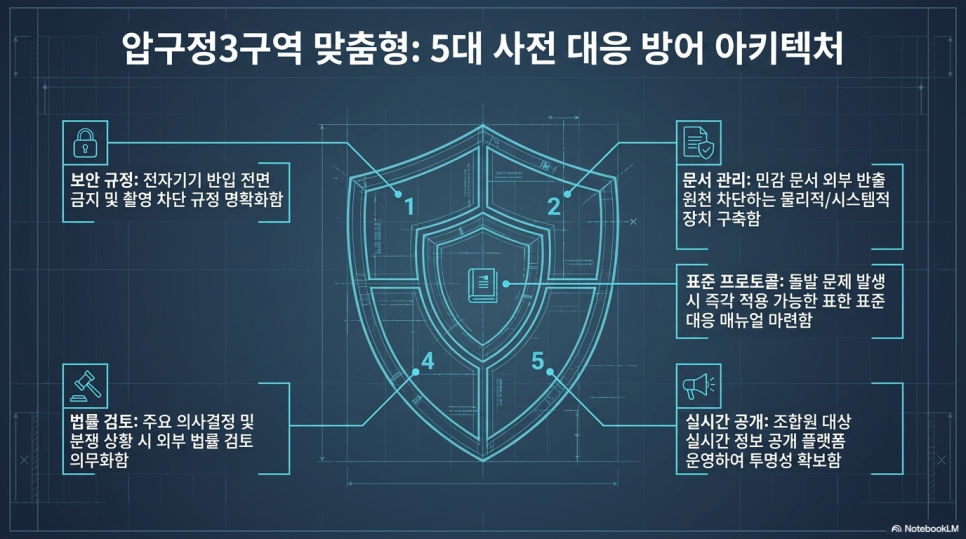
It is essential to clarify rules regarding the entry of electronic devices and photographing. A system must be established to manage sensitive documents and prevent external leakage. In case of problems, establishing standard protocols for response is necessary. Mandatory external legal reviews should be enforced to minimize legal risks.
Additionally, establishing a real-time information disclosure system to the members is crucial. This system serves not only as a management tool but also functions as a structural device to prevent disputes. Effective communication also plays an important role.

If the association disseminates information directly, it can help prevent unnecessary rumors.
When information becomes scarce, there tends to be a spread of distorted content through cafes, communities, and media.
Thus, the provision of transparent information is crucial.
Conclusion on Apgujeong Reconstruction Risks

The Apgujeong reconstruction case provides important lessons. The core element in large-scale reconstruction projects is reliability rather than rapid progress.
Apgujeong District 5 serves as a good example of diligent adherence to procedures, while Shinbanpo 19·25 revealed risks that can easily undermine procedures. These two cases impart significant insights for future reconstruction projects.

Key principles that Apgujeong District 3 must consider are as follows:
First, objectivity must be maintained through fact-checking.
Second, all decisions should be based on evidence.
Third, external legal advice should be sought, and
finally, providing transparent information to association members is crucial.

The success of a maintenance project depends not on avoiding incidents but on how to respond when incidents occur.
When the contractor selection process in Apgujeong District 3 is carried out, how thoroughly these principles are upheld will be a crucial factor linked to the stability of the project.
#ApgujeongReconstruction, #ApgujeongDistrict3, #ApgujeongDistrict5, #ShinbanpoReconstruction, #SubcontractAgreement, #BiddingIssues, #ContractorSelection, #ReconstructionRisks, #MaintenanceProject, #RealEstateInvestment, #ReconstructionAnalysis, #SeoulRealEstate, #LargeMaintenanceProjects, #BiddingFairness, #AssociationManagement, #LegalReview, #ConstructionCosts, #ReconstructionProcedures, #RiskManagement, #ProjectDelays, #AssociationMemberTrust, #MaintenanceProjectIssues, #ReconstructionInvestment, #ApgujeongApartments, #RealEstateIssues, #CoreLocationsInSeoul, #ReconstructionMarket, #UrbanMaintenanceProjects, #RealEstateOutlook, #InvestmentAnalysis
Frequently Asked Questions (FAQ)
Q. Why is the photographing incident of the bidding documents in Apgujeong District 5 important?
The suspicion of photographing bidding documents reveals issues of procedural fairness and trust, highlighting business risks.
Allegations arose regarding the use of a pen with a photographing function during the opening process of the bidding proposal in Apgujeong District 5, leading to controversies over fairness. The crux of this incident lies in how the association responded quickly and systematically, transcending mere suspicion. The actions taken throughout the process, such as suspending procedures, verifying equipment, conducting legal reviews, and holding emergency board meetings, highlight a structural response rather than emotional judgment. This sets a precedence for risk management in future reconstruction projects and offers implications for Apgujeong District 3.
Q. What issues arose from the controversy over the excretion of the subcontract agreement in Shinbanpo 19·25?
The external leakage of the subcontract agreement undermined procedural trust and created issues of information asymmetry.
During the contractor selection process for the Shinbanpo 19·25 reconstruction, a significant subcontract agreement was leaked externally and later returned. This agreement contains pivotal information regarding construction costs, terms, and responsibilities, raising concerns over potential information distortion, modification possibilities, and fairness during reviews. This case exemplifies the risks associated with failures in procedural management and emphasizes the necessity of transparent procedures and maintaining trust.
Q. What response strategies should Apgujeong District 3 adopt during the reconstruction process?
Establishing a preemptive response system and providing transparent information are necessary to ensure procedural trust.
Considering its importance as a large-scale maintenance project in Seoul, Apgujeong District 3 must prioritize systematic and preemptive preparations over simple responses. This includes formulating response regulations regarding the use of electronic devices, document management and external leakage prevention, and mandatory legal reviews. It is also essential to ensure real-time transparent information disclosure to members to maintain trust and prevent the spread of unnecessary rumors. This strategy will play a pivotal role in stabilizing project progress.
Q. How did the association in Apgujeong District 5 respond to the allegations of photographing bidding documents?
The association stopped procedures immediately and undertook systematic responses including evidence verification, legal review, and public communications.
Immediately after the allegations surfaced regarding the photographing of bidding documents, the Apgujeong District 5 association suspended all procedures and conducted verification regarding the related equipment and potential video existence. The executives from both parties collaborated on fact-checking, and an opinion letter was prepared for legal review. They convened an emergency board meeting to determine responsive actions and communicated the situation and future schedules transparently to the association members. This response is regarded as a model case of structural and systematic risk management beyond simple allegation handling.
Q. What are the important principles for risk management in the Apgujeong reconstruction project?
Objective fact verification, evidence-based decision-making, legal consultation, and providing transparent information are the key principles.
Risk management in the Apgujeong reconstruction prioritizes ensuring reliability over rapid project advancement. Thorough fact verification should be conducted for potential problems, and all decisions must be based on clear evidence. By seeking external legal expert opinions, legal risks can be minimized while providing real-time, transparent information to association members helps to prevent unnecessary rumors and misunderstandings. Strict adherence to these principles will lead to successful projects and secure investments.
