Table of Contents
- Delisting Risk Structural Expansion Phase
- KOSPI Delisting Risk Analysis
- KOSDAQ Delisting Risk Deepening
- Interpretation of the Increase in Investment Risk Alert Items
- Key Points of Market Structural Changes
- Reestablishing Investment Strategy Directions
- Conclusion on KOSPI and KOSDAQ Delisting Issues
- Frequently Asked Questions (FAQ)
Delisting Risk Structural Expansion Phase

Based on the end of the 2025 business year, the domestic stock market has entered a clear phase of structural change.

In KOSPI, 12 companies and in KOSDAQ, 42 companies have caused reasons for delisting. This is interpreted as a signal that credit and financial risks are expanding across the entire market, beyond just individual companies. Such a situation can raise awareness among investors.

The key issue here is the 'collapse of accounting reliability' due to insufficient audit opinions. This situation raises serious questions about corporate sustainability, extending beyond simply poor performance. Such signals indicate significant concerns about the future of companies.
KOSPI Delisting Risk Analysis
While KOSPI is generally known as a stable market, recent results indicate that the financial vulnerabilities of mid-sized manufacturers and construction firms are deepening. This can affect future market outlook.

Reasons for KOSPI Delisting Companies (12 companies)
| Category | Company List |
| New (7) | Eastar Jet, Dynamic Design, STX, Daehwa AL, Wilbes, Hands Corporation, Gwangmyeong Electric |
| 2 Years in a Row (4) | Geumyang, KC Green Holdings, Beomyung Construction, Sambutech |
| 3 Years in a Row (1) | Hanchang |
The core point to note is the
accumulated increase in companies with insufficient audit opinions for more than two years.

This situation is not a short-term event.
If the normalization of financial structure does not occur, continuous audit risks will emerge.
As a result, the likelihood of delisting also significantly increases in a typical pattern of deleveraging failure.
KOSDAQ Delisting Risk Deepening
The KOSDAQ market clearly
reveals an expanding
risk phase.

Reasons for KOSDAQ Delisting Companies (42 companies)
| Category | Company List |
| New (23) | Daejeon Systems, Rolling Stone, Medico, ITOX, EngiChem Life Science, Opticore, Jaceco Holdings, KD, Kainos Med, Asta, Utilux, Starlink, Cellumed, Unique Energy Tech, Carry, DHX Company, IT Chem, Daijin Advanced Materials, Bion, Sconex, Alpha AI, Incredible Buzz, KM Tech |
| 2 Years in a Row (11) | Olipass, DA Technology, Samyang ENC, Jeil M&S, Kosnine, Tubi Soft, EoFlow, Korea Union Pharmaceutical, Celestia, IM, TS NextGen |
| 3 Years in a Row (8) | Thera Science, Noble MB, Sunshine Food, Kodaco, BF Labs, RF Semi, Biotech Technology, Syswork |
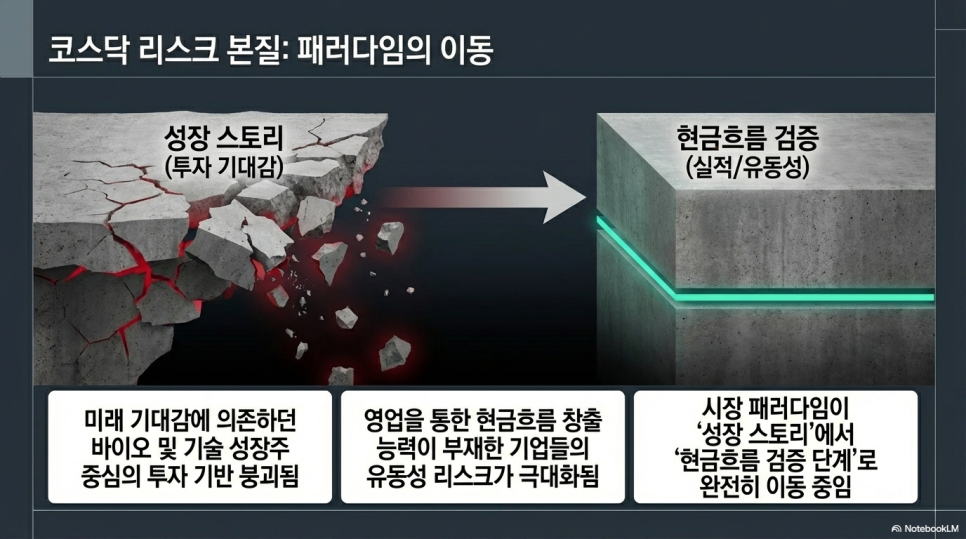
The key characteristics of KOSDAQ can be summarized as follows.
It is in an early stage where the proportion of newly listed companies is high, spreading the risk. Additionally, as it is concentrated on growth stocks in bio and technology, investment expectations are being shaken. With an increase in companies lacking cash flow, liquidity risks are also rising.
In conclusion, KOSDAQ is currently transitioning from a “growth story” to “cash flow validation” in the market paradigm.
Interpretation of the Increase in Investment Risk Alert Items
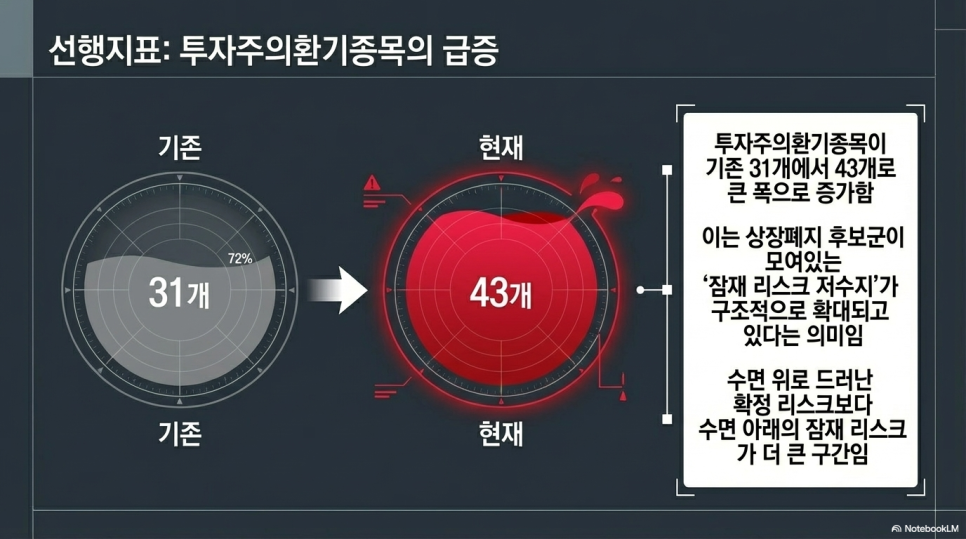
The increase in investment risk alert items from 31 to 43 can be viewed as an important leading indicator.
This increase is not merely a rise in numbers but suggests that the 'reservoir' of delisting candidates is expanding.
Therefore, investors should carefully monitor these changes.

Looking at the market structure, there is a stepwise risk that starts from alert items, proceeds through management items, and leads to delisting.
In this context, the current market seems to have greater potential risks than those already revealed.
Key Points of Market Structural Changes

The current delisting issue can be seen not just as an event but as a signal of structural change in the domestic stock market.
The main changes are as follows. First, the liquidity-driven market has ended, and fundamentals have established themselves as crucial evaluation criteria. Second, the premium on growth stocks is declining. Third, the reliability of accounting and cash flow are being reevaluated as more important.
Consequently, it is becoming increasingly difficult to effectively avoid risks through a story-driven investment approach, as in the past.
Reestablishing Investment Strategy Directions

The current effective strategy is clear. The key is to enhance the ability to filter risks.
To achieve this, certain criteria must be reviewed. First, confirm whether the audit opinion is 'appropriate,' second, check the capital impairment rate and net asset structure. Third, validate the sustainability of operating cash flows, and fourth, analyze the debt ratio and borrowing structure.
In particular, it would be reasonable to promptly exclude companies with insufficient audit opinions.
Conclusion on KOSPI and KOSDAQ Delisting Issues

With recent delisting reasons expanding, we can say that the domestic stock market has entered a point of qualitative change.
The main contents are as follows.
A total of 54 companies have faced reasons for delisting, and there is an increasing structural risk due to insufficient audit opinions. Additionally, credit risks are also rising, especially centered around KOSDAQ growth stocks. With the increase of investment risk alert items, there are additional downward pressures present.

In conclusion, the current market is
not a “buy undervalued” phase but a “risk screening” phase.
#KOSPI Delisting, #KOSDAQ Delisting, #Delisting Risk, #Insufficient Audit Opinions, #Investment Risk Alert Items, #Management Items, #Stock Market Analysis, #Domestic Stock Market, #Corporate Risk, #Financial Statement Analysis, #Cash Flow, #Investment Strategy, #Stock Risk Management, #Small and Mid-Cap Risks, #Bio Stock Risks, #Thematic Stock Risks, #Korea Exchange, #Stock Market Issues, #Market Analysis, #Stock Investment Tips, #Financial Stability, #Corporate Analysis, #Stock Market Outlook, #Stock Information, #Investment Risk, #Stock News, #Economic Analysis, #Investment Judgment, #Risk Management, #Stock Market
Frequently Asked Questions (FAQ)
Q. What are the main reasons for the increase in delisting causes in the domestic stock market?
The collapse of accounting reliability due to insufficient audit opinions and the expansion of credit and financial risks are the main reasons.
As of the end of the 2025 business year, the increase in delisting causes in the domestic stock market is due to the collapse of accounting reliability from insufficient audit opinions. This is a serious issue that goes beyond simple poor performance, raising questions about corporate sustainability. Additionally, the weakening financial structure and expanding credit risks in both KOSPI and KOSDAQ are raising awareness among investors.
Q. What is the current status and characteristics of delisting risks in the KOSPI market?
In KOSPI, 12 companies have caused delisting reasons, and the financial vulnerabilities of mid-sized manufacturers and construction firms are deepening.
The KOSPI market is traditionally perceived as a stable market, but recently, reasons for delisting have emerged from 12 companies, particularly highlighting financial vulnerabilities in the mid-sized manufacturing and construction sectors. Also, there is a trend of cumulative occurrences of companies with insufficient audit opinions for over two years, which can act as a long-term risk typical of deleveraging failures.
Q. What structural changes and risks are being seen in the KOSDAQ market?
KOSDAQ is experiencing an increase in newly listed companies, leading to a lack of cash flow and liquidity risks centered around growth stocks.
The KOSDAQ market is seeing risks diffuse due to a high number of newly listed companies and a focus on growth stocks in the bio and technology sectors. The increase in companies lacking cash flow is intensifying liquidity risks, and the market paradigm is shifting from growth stories to cash flow validation. Such structural changes can disrupt investor expectations and act as additional downward pressure.
Q. What does the increase in investment risk alert items signify?
The increase in investment risk alert items has expanded the reservoir of potential delisting candidates, emphasizing the importance of risk screening.
The increase in investment risk alert items from 31 to 43 indicates not just a numerical rise but an expansion of the group of firms that may face delisting. This signals that risks embedded throughout the market are significant, necessitating a careful observation of these changes by investors and a prudent approach to risk screening.
Q. What is an effective investment strategy in the current domestic stock market?
Risks should be filtered based on the appropriateness of audit opinions, capital impairment ratios, operating cash flows, and debt ratios.
The important investment strategy in the current domestic stock market is to enhance risk screening abilities. This involves first verifying whether audit opinions are 'appropriate', examining capital impairment rates and net asset structures, verifying the sustainability of operating cash flows, and analyzing debt ratios and borrowing structures. In particular, it is reasonable to exclude companies with insufficient audit opinions immediately. Filtering out risky firms based on these criteria is a rational response under the current circumstances.
