Table of Contents
Key Landscape of Domestic ADC

When examining ADC-related stocks in the domestic bio market, approaching from a perspective of simply "including ADC" may overlook the overall flow. Currently, ADC-related stocks in listed companies can be broadly classified into three categories.
First, there are companies dealing with pure ADC entities. Second, there are companies developing next-generation ADC modified platforms. Finally, stocks benefiting from the ADC ecosystem should also be an important consideration. This classification allows for a more detailed analysis.

First, the overall structure can be summarized as follows.
In the pure ADC entity sector, Ligand, Intuscell, and ABL Bio are included.
In the ADC ecosystem platform, Alteogen is well-positioned.
In the area of antibody discovery and co-development, Y Bio-logics and ABION are active, while new exploratory companies include Kanaph Therapeutics and IM Biologics.

Evaluating the current ADC market shows that Ligand, Intuscell, and ABL Bio are considered the companies that are closest to the essence of ADCs. In contrast, Alteogen should be understood more as a platform company that focuses on administration methods and formulation transitions rather than on ADC itself.
Furthermore, Y Bio-logics and ABION are categorized as companies focused on antibody discovery and co-development. Kanaph Therapeutics and IM Biologics can be seen as newly listed exploratory candidates.
In conclusion, what is important in domestic ADC investment is clearly distinguishing who the true entities are, who are the platform beneficiaries, and which companies are the early options. Such analysis will lead to more effective investment decisions.
Recommended Readings for Bio Stock Investment
Reasons for Ligand's Leadership

Currently, the company recognized as the representative of the ADC field in Korea is Ligand. This company has grown its business centered on ADC for a long time, and it has a structure that simultaneously promotes technology transfer, partner development, and the expansion of subsequent pipelines based on its independent platform.
The main strength of Ligand lies in the competitiveness of its linker and payload chemistry. The success of ADC depends not only on the excellence of the antibody but also on which payload is combined with which linker. Additionally, it is crucial to maintain stability in the bloodstream while effectively releasing in the tumor. In this regard, Ligand holds the most references built up in Korea, giving it a competitive edge.

Positive evaluations of Ligand can be divided into several factors. First, it has extensive experience in the domestic ADC (antibody-drug conjugate) field. Additionally, it possesses prior achievements in technology transfer that have earned trust in the industry. Ongoing collaborative development with partners is also taking place while internally developing subsequent pipelines.
In this regard, Ligand is equipped with competitiveness not just based on expectations, but through actual commercialization validation and a strong pipeline.
However, it should also be recognized that a significant premium has already been reflected in the market as a representative of domestic ADC. While it has stability and significance, the stock is seen to have already established a high expectation in terms of stock price.
Differentiation of Intuscell and ABL

Intuscell is a next-generation company currently gaining attention in the domestic ADC market. If Ligand is the leading company with a validated platform, Intuscell focuses on innovative linker and payload chemistry technology. This company has a strong approach to improving factors like blood stability, solubility, release efficiency, and inhibition of normal cell absorption, and the fact that it has actually entered the clinical stage is a significant advancement.
Intuscell’s investment points are distinct. Firstly, the differentiation with next-generation linker technology stands out. Furthermore, there is innovative expectation in payload design, and it has transitioned past the preclinical stage by entering clinical trials. Given the technological freshness, there is great potential for growth.
In conclusion, Intuscell has high technological freshness and is at a crucial point where it needs to prove its value until substantial clinical data is available.

ABL Bio adopts a different approach compared to traditional ADC companies. Notably, this company focuses on bispecific antibody ADC, aiming for higher target precision by targeting two antigens simultaneously instead of one.
Moreover, ABL Bio's competitiveness is not limited to linker chemistry. It provides differentiated value through its expertise in antibody biology and target design.
It's also essential to consider ABL Bio's uniqueness. The design of bispecific antibody-based ADCs, strategies that enhance target precision, and competitiveness centered on antibody biology stand out. Future early clinical data will be significant in assessing how effective these elements are.
In conclusion, while Intuscell aims for next-generation chemistry-based innovation, ABL Bio positions itself as a new design-oriented player through bispecific antibodies.

Benefits from the Alteogen Ecosystem

Alteogen occupies a unique position among ADC-related companies in Korea. To be precise, Alteogen can be defined as a central platform company innovating the formulations and administration methods of ADCs rather than as a pure ADC new drug development company.
In the market, Alteogen is not merely recognized as the core of ADC but is seen as an important player of the SC conversion platform. Changing the traditional IV (intravenous) formulation of ADCs to SC (subcutaneous) administration brings significant changes in convenience, administration time, and patient accessibility from various perspectives.
Consequently, as the ADC market expands, the range of application for Alteogen's technology is expected to widen even further. It is no wonder that interest in Alteogen's future continues to grow.

Several reasons contribute to Alteogen's prominence in ADC investment. First, it holds a strong competitive edge in the formulation transition of ADCs. Particularly, the high potential to convert existing IV ADCs to SC is anticipated to increase its application in the market.
Moreover, the value of the infrastructure platform stands out compared to pure entity stocks. In this regard, Alteogen can be interpreted as the greatest indirect beneficiary of the ADC market expansion.
Simply viewing it as an ADC technology stock may lead to imprecise evaluations, but considering it as an ADC infrastructure platform makes it one of the most advanced companies in terms of commercialization.
New Listings in Antibody Development to Watch

Y Bio-logics is more focused on the discovery and co-development of antibodies needed for ADCs rather than independently developing ADC finished products. Thanks to its structure providing selection and biological differentiation of antibodies to enhance therapeutic efficacy, it resembles a frontend antibody sourcing company more than a platform entity.
Moreover, ABION is seen as an early-stage company currently possessing suitable antibody assets for ADCs. While it might be too early to categorize it as a pure ADC development company like Ligand or Intuscell, it still holds potential for future ADC expansion options. In this regard, these two companies each have their unique positions and possibilities.
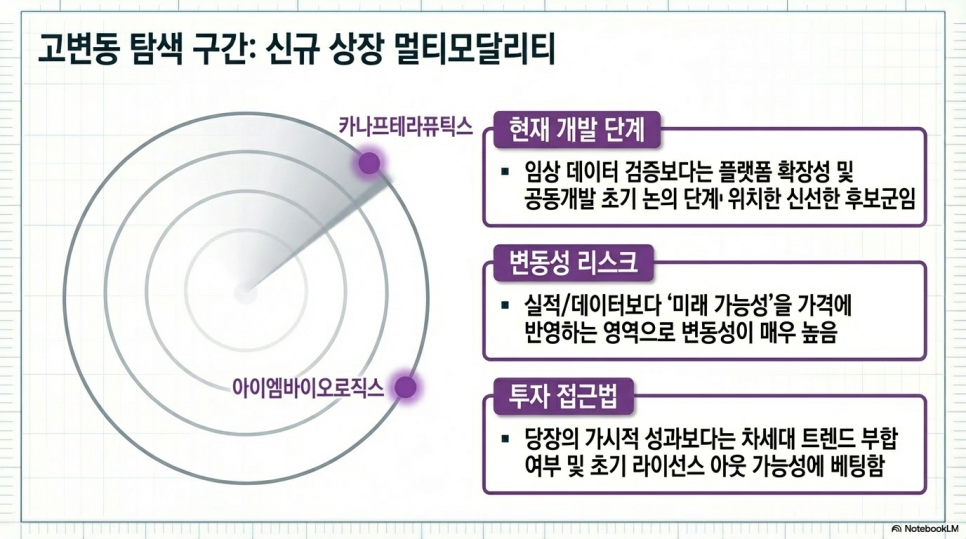
Recently listed companies Kanaph Therapeutics and IM Biologics are noteworthy candidates. However, these companies are currently in the early stages of platform expansion and co-development rather than clinical validation, making it reasonable to understand them as highly volatile exploration periods. While expectations are high, it can be said that at this stage, they are in a phase of investing in possibilities rather than actual validation.
Summarizing the major characteristics of each company,
first, Y Bio-logics focuses on antibody discovery and co-development for ADCs, and ABION has positioned itself as an early option with affinity antibodies for ADCs.
Kanaph Therapeutics is a newly listed multimodality exploratory company, while IM Biologics is emerging as a new candidate with ADC expansion potential. The development potential of these companies is drawing significant attention.
Conclusion on Domestic ADC-Related Stocks

It is essential to clearly categorize domestic ADC-related stocks by character, as the strengths of each company become distinctly evident.
Ligand stands out in commercialization validation, while Intuscell emphasizes the differentiation of next-generation technology. ABL Bio demonstrates strength in bispecific antibody ADC design, and Alteogen is expected to benefit greatly from the expansion of the ADC market ecosystem.
In summary, the current representative of domestic ADC is Ligand. Intuscell, which is gaining attention for next-generation technology, is also a significant stock. ABL Bio, a key player in bispecific antibody ADC, and Alteogen, the indirect largest beneficiary of ADC market expansion, also deserve attention.
Additionally, Y Bio-logics is classified as a co-development type, while Kanaph Therapeutics and IM Biologics are exploratory type newly listed companies. Finally, ABION is regarded as an early option stock. Through these various stocks, one can understand the trends in the ADC market.
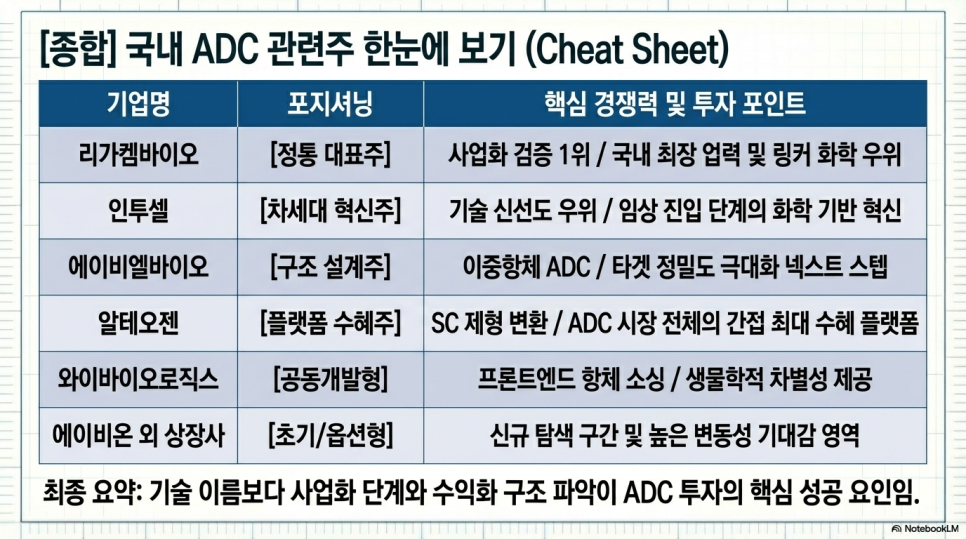
Currently, the most important factor in domestic ADC investment is to conduct a comprehensive analysis not only of the names of technologies but also of the stages of commercialization and profitability structures.
From this perspective, Ligand has established itself as a traditional representative, while Intuscell is emerging as a next-generation chasing stock. Additionally, ABL Bio is gaining attention as a new structural design stock, and Alteogen can be understood as a beneficiary of the platform.
This classification is realistic and greatly aids in understanding the characteristics of each company.
※ This article is not an invitation to invest, but a personal record and information-sharing purpose. It does not encourage the purchase or sale of any specific assets or stocks.
#ADC, #domesticADCrelatedstocks, #Ligand, #Intuscell, #ABL Bio, #Alteogen, #Y Bio-logics, #ABION, #KanaphTherapeutics, #IMBiologics, #bio stocks, #bio investment, #antibody-drug conjugates, #bispecificantibodyADC, #ADCplatform, #ADCecosystem, #bioplatform, #pharmaceuticalbio, #KOSDAQbio, #newdrugdevelopment, #biopipeline, #anticancernewdrugs, #linkerpayload, #ADCtechnology, #biorepresentativestocks, #biogrowthstocks, #ADCbeneficiaries, #domesticbiostocks, #biomarketanalysis, #bioindustry
Frequently Asked Questions (FAQ)
Q. How can domestic ADC-related stocks be classified?
Domestic ADC stocks are divided into pure ADC entities, next-generation platforms, and ecosystem beneficiaries.
Domestic listed ADC-related stocks can be broadly categorized into three types. First, companies that directly develop ADC entities, including Ligand, Intuscell, and ABL Bio. Second, Alteogen, which is a platform company innovating ADC formulations and administration methods. Lastly, there are companies focusing on antibody discovery and co-development as well as newly listed exploratory companies. This classification enables detailed market analysis and investment strategy formulation.
Q. What is Ligand's position in the domestic ADC market?
Ligand is considered the representative company in the domestic ADC market, excelling in linker and payload chemistry technology.
Ligand leads the ADC entity field in Korea. Leveraging extensive experience and its independent platform, it is simultaneously advancing technology transfer, partner development, and subsequent pipeline expansions. Particularly, its competitiveness in linker and payload chemistry shows strengths in blood stability and selective release within tumors. However, one should consider that the stock price already reflects a significant premium, so market expectations need to be taken into account when investing.
Q. What differentiates Intuscell in the domestic ADC market?
Intuscell focuses on next-generation linker and payload technologies, showing significant potential for growth as it enters clinical trials.
Intuscell is a next-generation ADC company with a basis in innovative linker and payload chemistry technology, emphasizing blood stability, solubility, release efficiency, and normal cell absorption inhibition. It has entered the clinical stage, proving the freshness of its technology, and as clinical data becomes available, it becomes increasingly important to prove its value. Unlike Ligand, it is still at an early stage of clinical trials but is gaining attention as a company with high technological freshness and potential.
Q. What are ABL Bio's ADC technical strengths?
ABL Bio excels in bispecific antibody ADC design and enhancing target precision.
ABL Bio adopts a strategy emphasizing bispecific antibody ADCs targeting two antigens simultaneously, enhancing target accuracy compared to traditional ADC approaches. Its capabilities in linker chemistry, antibody biology, and target design provide it with differentiated competitiveness. Initial clinical results will be crucial in assessing the effectiveness of its bispecific approach and securing a unique position in the new drug development market.
Q. What role does Alteogen play in the ADC market?
Alteogen serves as an innovative platform for ADC administration methods, showcasing strengths in SC conversion technology.
Rather than a pure ADC development company, Alteogen functions as a platform innovating ADC formulations and administration methods. Its strength lies in its capability to transition existing IV (intravenous) ADCs to SC (subcutaneous) administration, contributing to enhanced patient convenience and accessibility. As the ADC market expands, the value of Alteogen's formulation transition platform is expected to increase, marking it as a significant indirect beneficiary.
