Table of Contents
Overview of KODEX US Aerospace ETF

KODEX US Aerospace ETF is expected to be listed on March 17, 2026, and is a thematic ETF developed by Samsung Asset Management targeting a "portfolio consisting of rockets, satellites, and defense industries."
Notably, this ETF is not just a collection of a few shares from large defense companies, but has structured its core portfolio with high-potential companies focusing on the private-centric New Space era.
As a result, it is expected to offer investment opportunities that reflect the various changes in the aerospace industry.
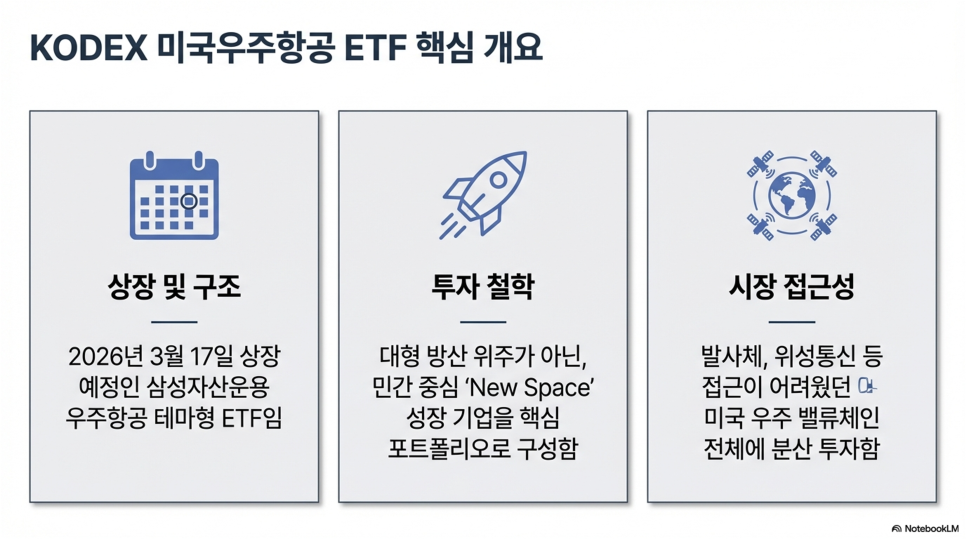
For investors in Korea, directly investing in the US space industry has not been an easy choice, but by utilizing this ETF, opportunities for diversified investments across various fields such as rockets, satellite communications, space data, and defense aviation systems are provided.
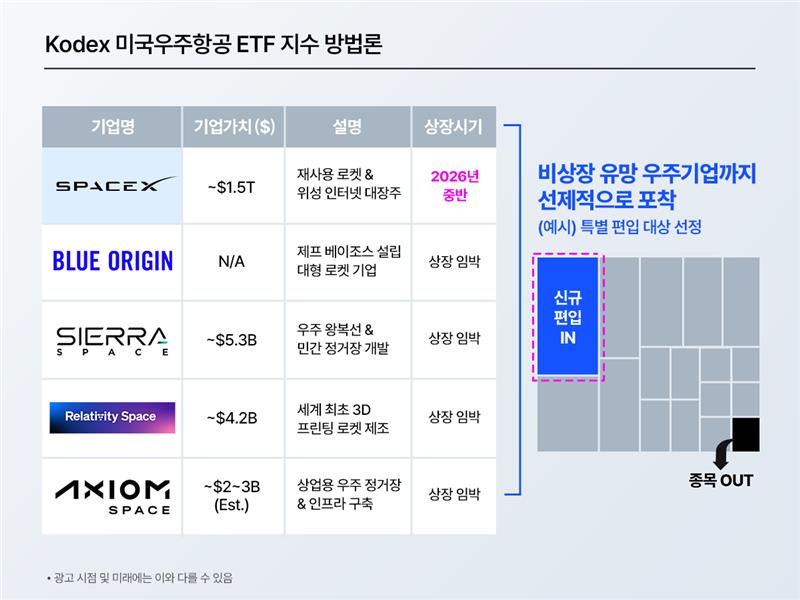
Another notable aspect of this ETF is that it has been designed with the possibility of including unlisted space companies, such as SpaceX, in mind if they go public. Currently, this index does not include unlisted companies, but it has a structure that allows for their inclusion through the review of the Index Committee when new companies go public in the future.
These features provide investors with greater opportunities to expand their investment potential in the growth of the space industry and create a foundation to respond flexibly to future market changes.

This ETF notably possesses an “evolving ETF structure” that comprehensively covers not only current investments in space industry-related companies but also major companies in the space industry that will go public in the future. This characteristic offers investors more opportunities.
iSelect US Aerospace Index Structure

KODEX US Aerospace ETF is an investment product that follows the iSelect US Aerospace Index. This index is a thematic index composed of companies that are expected to benefit positively from the growth of the private space industry in the US stock market.
The space industry is segmented into various fields including rocket manufacturing and launch services, satellite data and services, satellite communication, space infrastructure and ground equipment, as well as aerospace systems and components. Companies engaged in these areas are evaluated to have high growth potential along with the development of the space industry.
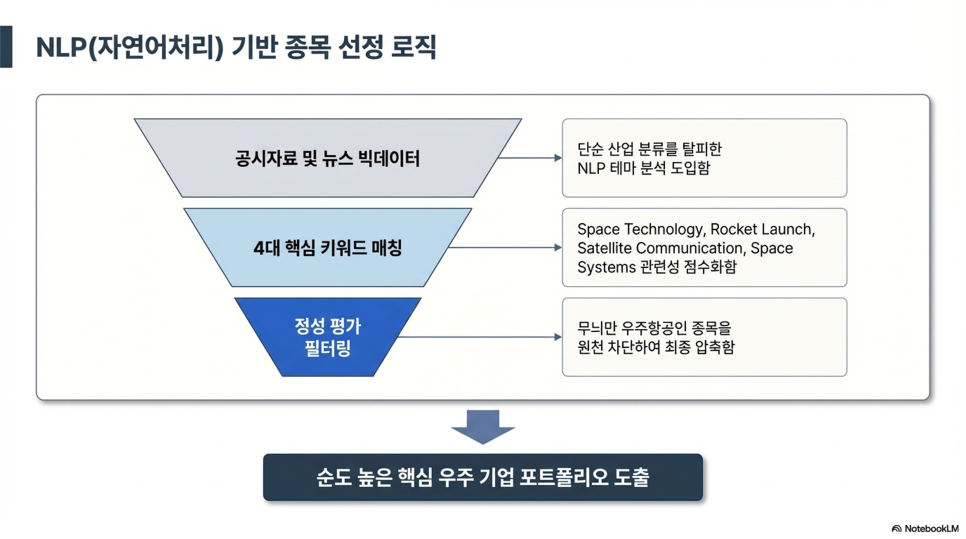
The stock selection process goes beyond simple industry classification and adopts an NLP (Natural Language Processing) based theme analysis method. In this process, specific keywords are used to evaluate the relevance of companies to the space industry. The keywords used include Space Technology, Rocket Launch, Satellite Communication, and Space Systems.
By closely analyzing the disclosure materials and news articles of companies to calculate keyword scores, the structure is designed to prevent the inclusion of stocks with low relevance to the space industry through qualitative assessments by NH Investment & Securities' research headquarters.
This approach allows for the creation of a portfolio that includes not only simple aerospace companies but also those that are closely related to the space industry, ultimately contributing to the provision of more accurate and reliable investment opportunities.
Selection of Stocks and Weight Calculation Method
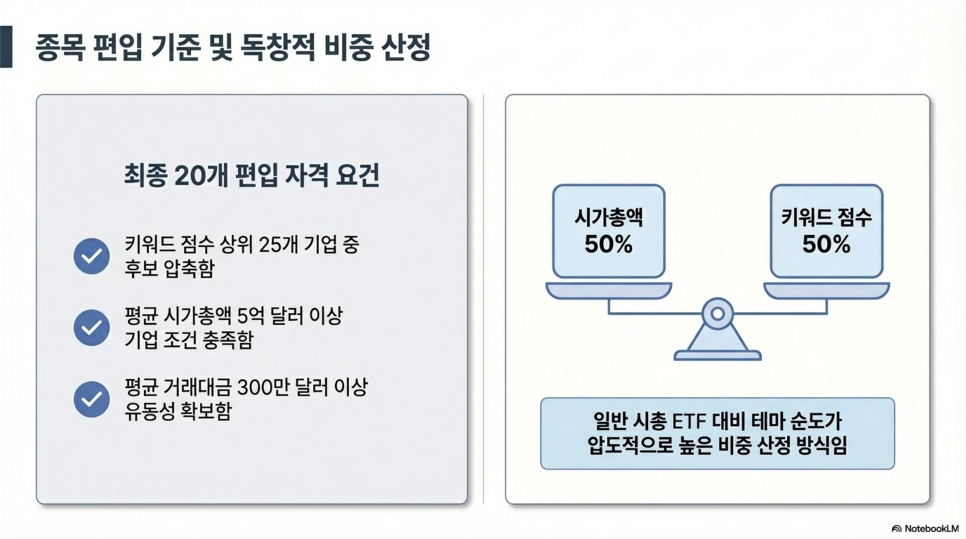
The stock selection process of the iSelect US Aerospace Index is as follows.
First, the top 25 companies are organized as candidates based on keyword scores.
Then, companies that meet the following criteria are finally included.
A maximum of 20 stocks are included in the final index among those with an average market capitalization of over $500 million and an average trading volume of over $3 million.
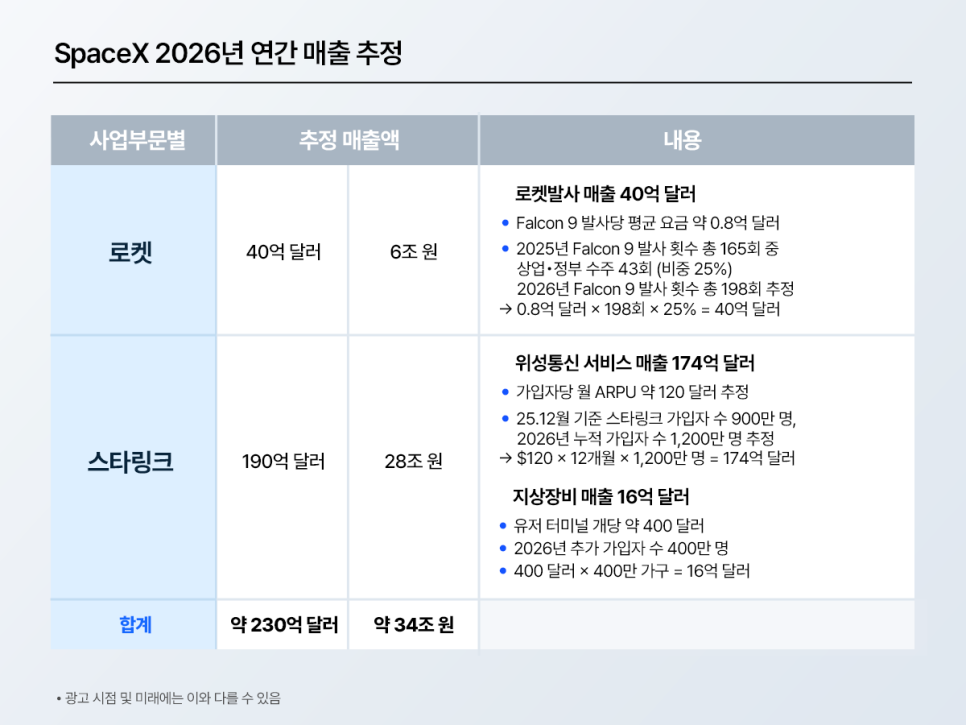
The weight determination method takes a different approach compared to general ETFs.
Market capitalization weight accounts for 50%, while the remaining 50% is calculated based on keyword scores.
The final weight is determined by combining these two elements.
Additionally, the upper limit of the weight is also set differentially.
Core universe stocks are limited to a maximum of 10%, while ordinary universe stocks are set to a maximum of 4%.

Keyword scores are distributed as follows: 1st place gets 15%, 2nd place gets 12%, 3rd place gets 7%, places 4 to 6 each get 4%, and places 7 to 10 each get 1%.
This structure increases the thematic purity of specific themes compared to simple market capitalization ETFs, allowing companies actually related to the space industry to be reflected with a larger weight.
Components of KODEX US Aerospace ETF
As of March 2026
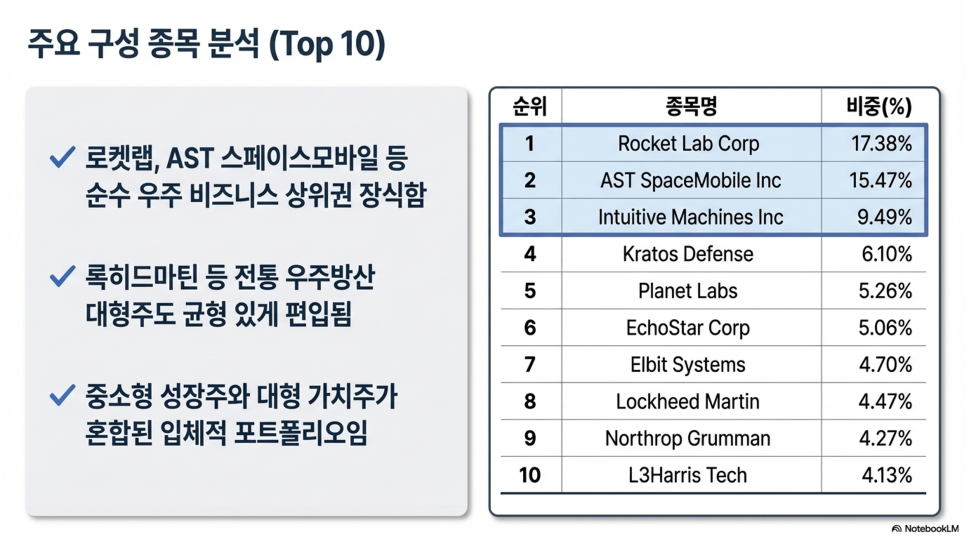
The main components of KODEX US Aerospace ETF
are as follows.
| Rank | Stock Name | Weight (%) |
| 1 | Rocket Lab Corp | 17.38 |
| 2 | AST SpaceMobile Inc | 15.47 |
| 3 | Intuitive Machines Inc | 9.49 |
| 4 | Kratos Defense & Security Solutions Inc | 6.10 |
| 5 | Planet Labs PBC | 5.26 |
| 6 | EchoStar Corp | 5.06 |
| 7 | Elbit Systems Ltd | 4.70 |
| 8 | Lockheed Martin Corp | 4.47 |
| 9 | Northrop Grumman Corp | 4.27 |
| 10 | L3Harris Technologies Inc | 4.13 |
| 11 | Howmet Aerospace Inc | 3.89 |
| 12 | Carpenter Technology Corp | 3.30 |
| 13 | Boeing Co | 3.28 |
| 14 | GE Aerospace | 3.23 |
| 15 | TransDigm Group Inc | 3.13 |
| 16 | HEICO Corp | 2.18 |
| 17 | Globalstar Inc | 1.85 |
| 18 | Firefly Aerospace Inc | 1.39 |
| 19 | Redwire Corp | 1.28 |
| 20 | BlackSky Technology Inc | 0.12 |
Looking at the proportions of the top stocks, distinct characteristics are found.
The top 3 stocks account for about 42%, 5 stocks account for about 54%, and 10 stocks account for a remarkable 76%.
In conclusion, this can be considered a highly concentrated thematic ETF centered around growth stocks in the space sector.
Investment Appeal and Risk Analysis

KODEX US Aerospace ETF offers several attractive elements to investors.
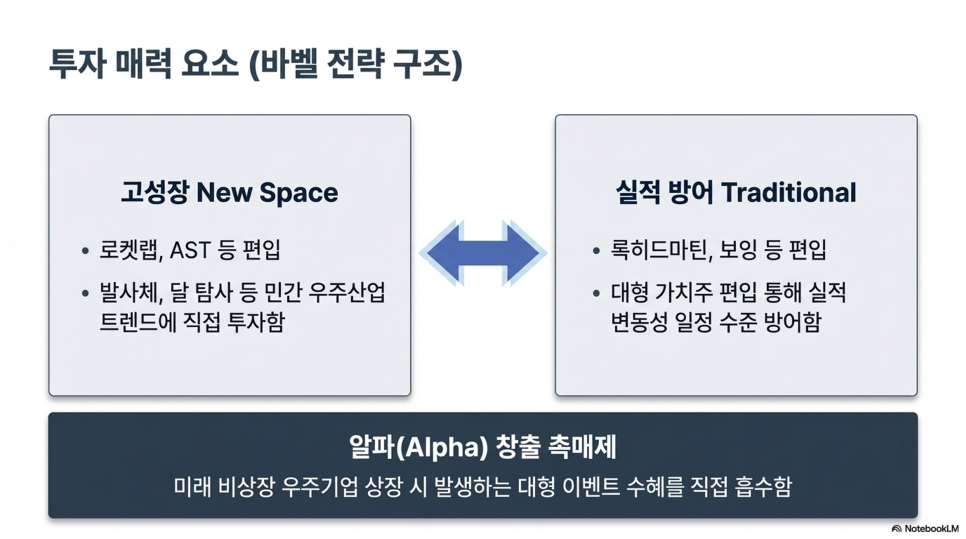
First, it provides an opportunity to invest directly in the private space industry. Companies such as Rocket Lab, AST SpaceMobile, Intuitive Machines, and Planet Labs are operating in core areas of the space industry, including rocket launch, satellite communication, lunar exploration, and Earth observation data.
Secondly, traditional defense companies enhance the stability of the portfolio. Major aerospace companies such as Lockheed Martin, Northrop Grumman, L3 Harris, Boeing, and GE Aerospace contribute to reducing performance volatility.
Finally, there are benefits that could arise from IPO events of unlisted space companies. The index methodology includes a clause allowing for the swift inclusion of newly listed companies, so if SpaceX or Blue Origin go public in the future, they can be quickly reflected.
These three elements enhance the investment value of KODEX US Aerospace ETF.
However, it is also important to consider the risk factors. In particular, with many fast-growing space companies like Rocket Lab and AST SpaceMobile, this ETF is evaluated as having high volatility. Therefore, it is advisable to approach this ETF with a focus on high growth themes rather than stable investments.
Summary of KODEX US Aerospace ETF Investment Strategy

KODEX US Aerospace ETF is not a simple defense-related product. This ETF incorporates three main elements.
First, it reflects the current US aerospace value chain, and second, it encompasses companies growing in the private New Space sector. Third, it has the potential to include space companies that will go public in the future.
The iSelect US Aerospace Index combines thematic analysis and qualitative assessment based on NLP to select stocks. This index has a unique weight structure reflecting both market capitalization and keyword scores equally.
Thus, it aims to be an ETF that considers the current space industry ecosystem while incorporating future IPO events. It is expected to play a significant role as a long-term investment vehicle in the space industry.
However, considering the high thematic concentration and growth stock ratio, it is rated as a product more suitable for being incorporated as part of a long-term growth investment or portfolio.

#KODEXUSAerospaceETF, #AerospaceETF, #USSpaceETF, #NewSpace, #SpaceIndustryInvestment, #RocketLab, #ASTSpaceMobile, #IntuitiveMachines, #PlanetLabs, #LockheedMartin, #NorthropGrumman, #L3Harris, #SpaceIndustryOutlook, #SpaceInvestment, #AerospaceValueChain, #SatelliteCommunicationETF, #SpaceCompanyInvestment, #SpaceXListing, #BlueOrigin, #AerospaceThematicETF, #USThematicETF, #SamsungAssetManagementETF, #SpaceEconomy, #SpaceData, #SatelliteDataIndustry, #AerospaceCompanies, #USSpaceIndustry, #AerospaceStocks, #SpaceTechnologyInvestment, #AerospaceMarket
Frequently Asked Questions (FAQ)
Q. When will KODEX US Aerospace ETF be listed, and what portfolio does it provide?
KODEX US Aerospace ETF will be listed on March 17, 2026, and it provides a portfolio of rockets, satellites, and defense industries.
This ETF is a thematic product developed by Samsung Asset Management, composed of companies in the space industry with high growth potential, reflecting the private-centric New Space era. It offers investment opportunities that encompass various changes in the aerospace industry for Korean investors, including areas such as rocket manufacturing, satellite communication, and space data.
Q. How does the iSelect US Aerospace Index select stocks and determine their weight?
The iSelect Index selects companies based on NLP-based thematic analysis and qualitative assessments, determining weights based on market capitalization and keyword scores.
The stock selection assesses companies' relevance to the space industry based on keywords such as Space Technology, Rocket Launch, and Satellite Communication. After organizing the top 25 candidates, a maximum of 20 stocks is included, meeting conditions of a market capitalization of over $500 million and a trading volume of over $3 million. Weights are determined by combining a 50% market capitalization weight and a 50% keyword score, with core universe stocks limited to a maximum of 10% and ordinary universe stocks limited to 4%.
Q. What are the main components and characteristics of the KODEX US Aerospace ETF?
It is a highly concentrated thematic ETF centered around growth stocks in the space sector, with the top 3 stocks accounting for about 42% and 10 stocks for 76%.
As of March 2026, this ETF consists of key players in the private and traditional defense sectors, including Rocket Lab, AST SpaceMobile, Lockheed Martin, and Northrop Grumman. The portfolio's high concentration is evident, with the top 3 stocks accounting for about 42% and 76% for the top 10 stocks, reflecting a characteristic structure focused on investing in high-growth stocks within the space industry.
Q. What are the investment appeal and risks of KODEX US Aerospace ETF?
It allows for diversified investments in the private space sector and traditional defense companies but has high volatility centered around growth companies.
This ETF includes innovative private companies like Rocket Lab and AST SpaceMobile along with major defense companies like Lockheed Martin and Northrop Grumman, pursuing both stability and growth. It also has a structure that allows for the quick reflection of future IPOs from unlisted space companies like SpaceX and Blue Origin. However, since it is centered on rapidly growing companies, it is more suitable for high-growth theme investment rather than stability.
Q. What are the investment strategies and long-term values of KODEX US Aerospace ETF?
It is an evolving ETF that encompasses the aerospace value chain and New Space companies, suitable for long-term growth investments.
This ETF reflects the current aerospace value chain in the US and includes growing companies within the private space industry (New Space). It is designed as an evolving structure that allows for the future inclusion of newly listed space companies. With a unique methodology that combines NLP-based thematic analysis and market capitalization weighting, it is expected to play a significant role as a long-term investment vehicle in the space industry, considering future industrial shifts. However, given the high thematic concentration and growth stock proportions, it is advisable to incorporate it as part of a portfolio strategy.
