Table of Contents
- Impact of Middle East War on Grain Market
- Rising Fertilizer Prices and the Impact on Corn
- Price Forecast Structure for Three Types of Grains
- Domestic Grain Investment Methods ETN
- KODEX 3 Major Agricultural ETF Strategy
- Conclusion on Grain Investment amid Middle East War
- Frequently Asked Questions (FAQ)
Impact of Middle East War on Grain Market

As recent battles between Iran, Israel, and the U.S. have intensified, the geopolitical conflict is increasingly impacting the global commodity market. What is noteworthy is that the issues of logistics in the Strait of Hormuz may play a more crucial role in affecting energy and fertilizer supply chains than the actual combat situations.

According to the U.S. Energy Information Administration (EIA), the Strait of Hormuz is the world's most critical energy transportation route, with about 20 million barrels of crude oil transferred daily. It also accounts for around 20% of global LNG trade, underscoring its significance. With the escalation of the war, international oil prices have surged, leading to increased maritime insurance premiums and shipping rates, causing a ripple effect in the commodity market.

The current situation goes beyond simple geopolitical issues. The simultaneous rise in crude oil, natural gas, shipping costs, insurance premiums, and fertilizer prices is creating a complex impact on production costs. As the war prolongs, the market's focus will shift from military victories to who can endure higher costs for longer. In this context, the grain market, particularly corn prices, is emerging as a significant investment factor.
Rising Fertilizer Prices and the Impact on Corn
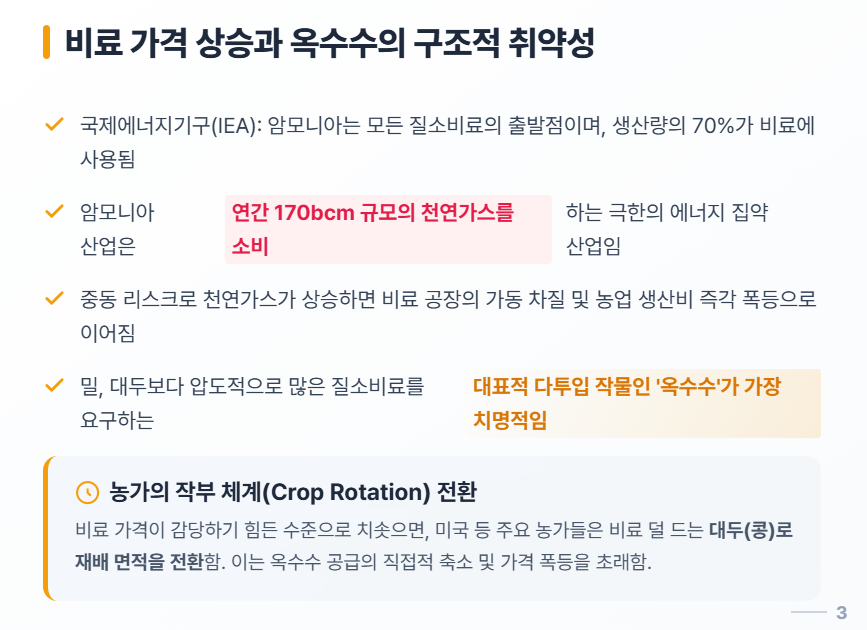
The reason corn is a focal point in this war is that it is the crop most severely impacted by rising fertilizer prices.
The International Energy Agency (IEA) explains that ammonia is the primary raw material for all nitrogen fertilizers, with about 70% of global ammonia production used for fertilizer manufacturing.
However, the process of producing ammonia requires significant energy. In fact, the global ammonia industry consumes about 170 bcm of natural gas annually.
This situation further highlights the impact of rising fertilizer prices on corn crops.
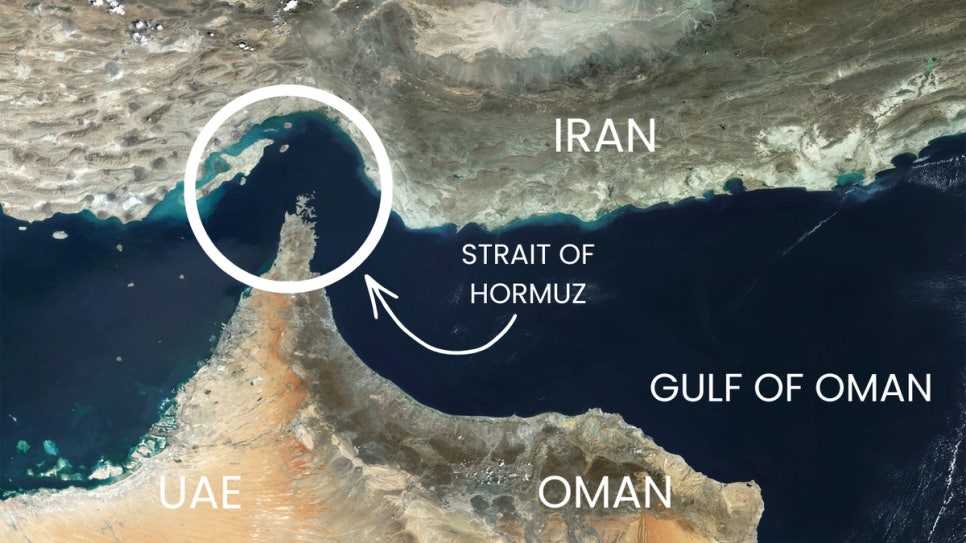
The war in the Middle East is causing natural gas prices to rise, and instability in fertilizer production and transportation is driving up agricultural production costs immediately. Since corn requires a significant amount of nitrogen fertilizer, rising fertilizer prices lead to a considerable increase in production costs.
These changes are likely to affect U.S. farmers' crop cultivation strategies significantly. If fertilizer prices rise sharply, farmers may increase the planting ratio of soybeans instead of corn. If such a scenario occurs, it could result in a reduced supply of corn, leading to greater upward pressure on prices.
Ultimately, the effects of the Middle East war on the agricultural market go beyond simple price fluctuations, potentially bringing significant changes to farmers' crop selections.
Price Forecast Structure for Three Types of Grains

Looking at the current structure of the grain market, wheat, corn, and soybeans are likely to react differently.
The U.S. Department of Agriculture (USDA) has projected average farm prices for the 2026/27 season, estimating corn at about $4.20, soybeans at about $10.30, and wheat at about $5.00. These prices are based on scenarios without war in normal supply conditions.
Therefore, future trends in the grain market need to be scrutinized carefully based on these price forecasts.
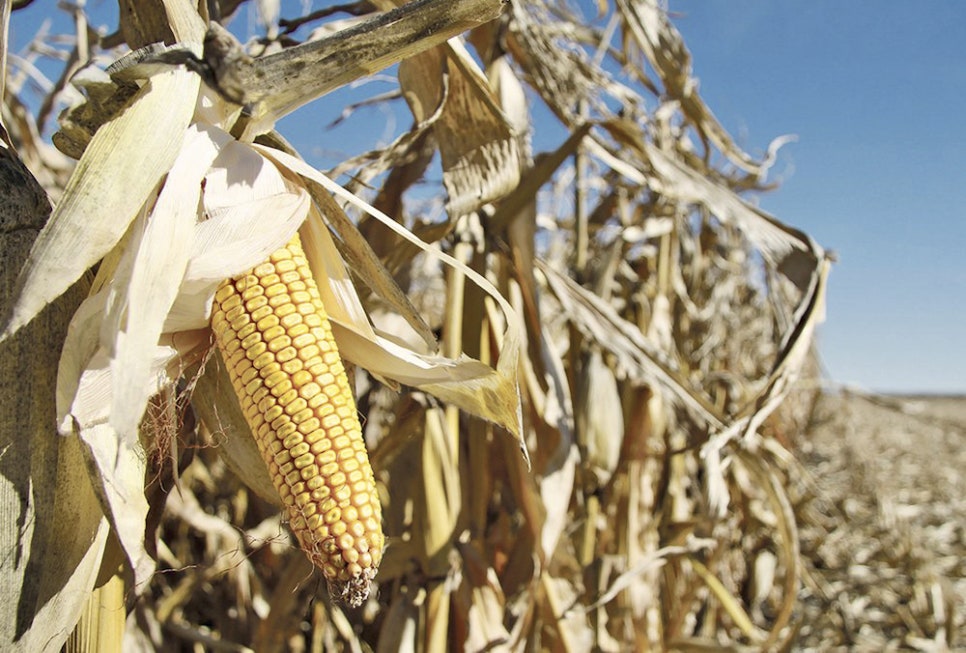
The deteriorating situation in the Strait of Hormuz and the continued rise in energy prices leave room for additional premiums to be added to base prices.
The reaction structure of grain prices generally proceeds through the following stages. First, wheat is most sensitive to food security issues and exhibits notable price fluctuations initially. Second, corn reflects the pressure of rising fertilizer prices and production costs, showing structural upward trends in the medium term. Finally, soybeans respond subsequently depending on the conditions and changes in South America.
Analyzing this structure comprehensively, if the war prolongs, corn is likely to exhibit the strongest price elasticity.
Domestic Grain Investment Methods ETN
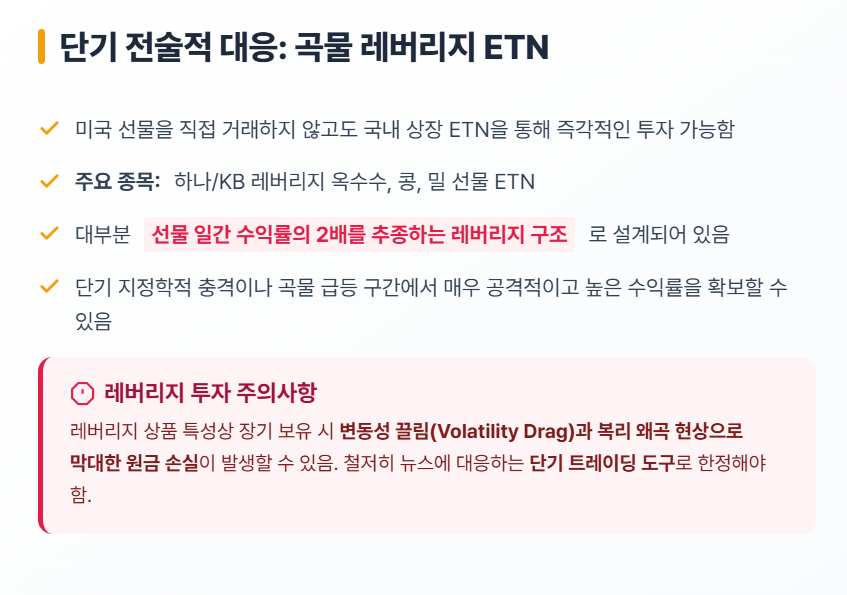
Domestic investors have the opportunity to invest in grain-related ETN products, even if they do not directly handle U.S. grain futures.
Major domestic listed products include Hanwha Leverage Corn Futures ETN (H), Hanwha Leverage Soybean Futures ETN (H), KB Leverage Wheat Futures ETN, and KB Leverage Soybean Futures ETN.
These products generally feature a leverage structure that tracks the daily returns of futures, meaning investors can expect significantly high returns during short-term spikes in grain prices or news related to the war. This investment option is useful for leveraging the volatility of the grain market.
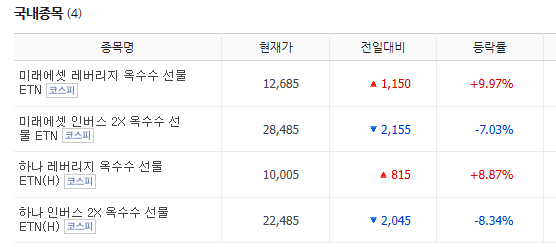
Leverage ETNs may incur volatility losses and compounding distortions when held for extended periods.
Therefore, accessing these products should be done cautiously.
In other words, leverage ETNs are best utilized as strategic trading tools that respond to news events such as the war.
KODEX 3 Major Agricultural ETF Strategy

In preparation for the prolonged war, a stable investment vehicle worth considering is the KODEX 3 Major Agricultural Futures (H) ETF. This ETF is designed to allow simultaneous investment in corn, soybeans, and wheat futures.
Following the primary benchmark, the S&P GSCI Grains Select Index Excess Return, it has several characteristics: it was listed in June 2017, and the total fees are set at an annual rate of 0.55%. Its key assets include corn, soybean, and wheat futures, offering investors stability.
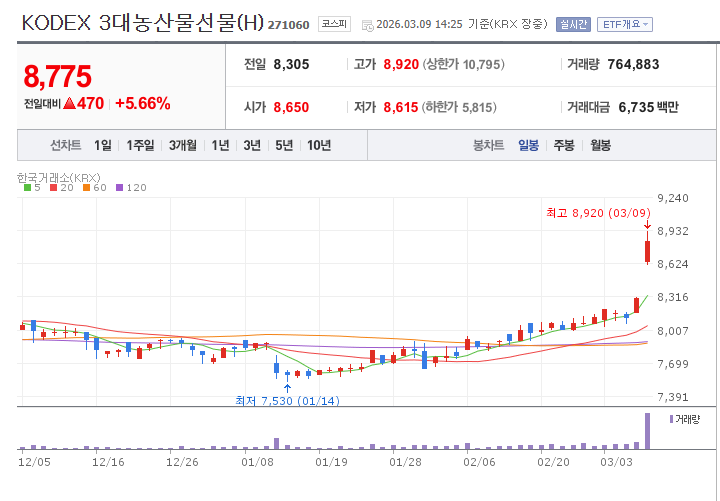
This ETF’s feature is that it does not limit itself to specific grains but encompasses the overall upward trend in the grain market. If the war prolongs, it can reflect the chain reaction impacting wheat, corn, and soybeans simultaneously.
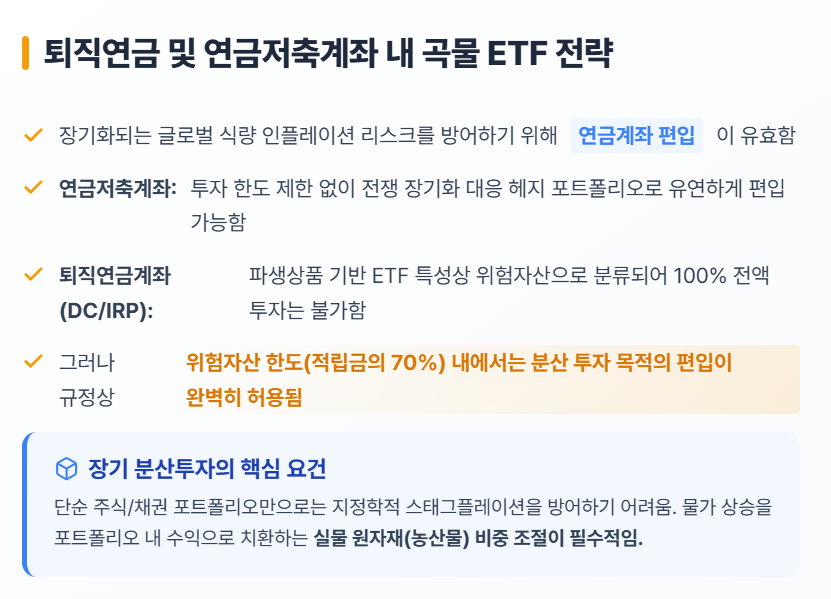
In pension accounts, there is also a variety of uses.
The pension savings account can be effectively used as a hedge against war and inflation.
In retirement pension accounts, an “X” mark does not indicate a prohibition on purchasing but signifies that it cannot account for 100% of the total assets.
According to retirement pension regulations, investments in risk assets are limited to 70% of the accumulated fund.
Therefore, while this ETF is not a product that can be fully invested in retirement pensions, it can serve as a tool for diversified investment within the limit of risk assets.
Conclusion on Grain Investment amid Middle East War

Recently, military clashes between Iran, Israel, and the U.S. have led to a complex supply chain crisis impacting the energy, fertilizer, and grain markets. This situation holds significant implications for investors.
Particularly noteworthy is that the deterioration of the situation in the Strait of Hormuz drives energy prices up, which in turn leads to a surge in fertilizer prices. Ultimately, the rising fertilizer prices result in increased production costs for corn.
Therefore, when establishing investment strategies in the grain market, the potential rise in corn prices is emerging as a key factor. Understanding and responding to this trend is crucial.
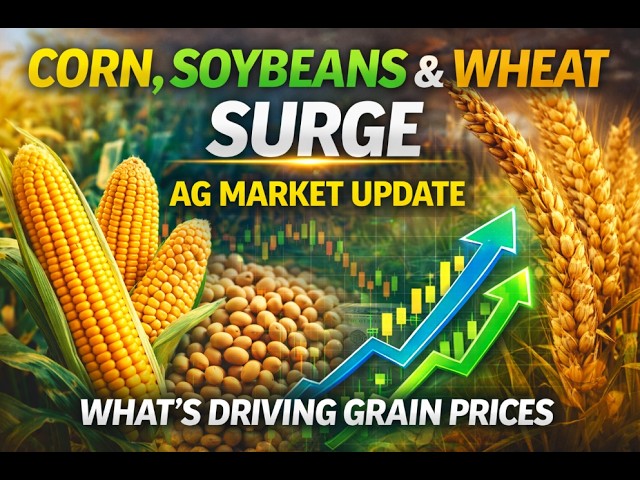
Examining investment strategies in detail, short-term responses may involve leveraging grain ETNs. In the medium term, hedging through the KODEX 3 Major Agricultural Futures ETF is effective.
Additionally, in pension accounts, it is advisable to engage in diversified investments within the risk asset range. These methods can be evaluated as realistic investment strategies to cope with the protraction of war and the potential for global food inflation.
#IranIsraelWar, #MiddleEastWar, #StraitofHormuz, #GrainPriceForecast, #CornPrice, #WheatPrice, #SoybeanPrice, #GrainInvestment, #GrainETF, #AgriculturalETF, #KODEX3MajorAgriculturalFutures, #GrainETN, #LeverageETN, #CornFutures, #WheatFutures, #SoybeanFutures, #FertilizerPrices, #NitrogenFertilizer, #AmmoniaPrices, #EnergyInflation, #CommodityInvestment, #AgriculturalInvestmentStrategy, #FoodSecurity, #GlobalGrainMarket, #WarInflation, #InvestmentForecast, #ETFInvestment, #PensionSavingsInvestment, #RetirementPensionETF, #CommodityMarket
Frequently Asked Questions (FAQ)
Q. What impact does the Middle East war have on the grain market?
The Middle East war is causing rising grain prices and increased agricultural production costs due to energy and fertilizer supply issues.
The military conflict between Iran, Israel, and the U.S. raises concerns over a blockade of the Strait of Hormuz, disrupting oil and natural gas supplies, which leads to an increase in fertilizer prices. The sharp rise in fertilizer prices significantly increases production costs for nitrogen fertilizer-dependent crops like corn, applying upward price pressure across the grain market. This complex supply chain crisis acts as a crucial variable affecting changes in crop cultivation strategies for farmers and intensifies price volatility in the grain market.
Q. Why is corn particularly highlighted due to the Middle East war?
Corn is the crop most affected by rising fertilizer prices, leading to increased production costs and price volatility.
According to the International Energy Agency, ammonia is the primary raw material for all nitrogen fertilizers and is significantly influenced by energy price fluctuations due to high natural gas consumption. Corn is a major user of nitrogen fertilizers, leading to the largest production cost increases due to rising fertilizer prices. Consequently, there is a possibility that U.S. farmers may switch to lower fertilizer-dependent crops like soybeans, which is expected to reduce corn supply and increase price pressures.
Q. What is the price outlook for the three grains (wheat, corn, soybeans)?
Wheat, corn, and soybeans are expected to react to price fluctuations at different times and due to various factors.
According to the USDA's price forecast for the 2026/27 season, corn is projected to be about $4.20, soybeans about $10.30, and wheat about $5.00. Wheat reacts most sensitively to food security issues, leading to initial price fluctuations, while corn shows a structural upward trend due to the impact of rising fertilizer prices. Soybeans mainly react subsequently based on conditions and changes in South American crops, revealing different timings and structures in the price reactions of each grain.
Q. How can domestic investors invest in the grain market?
Domestic investors can invest in grain-related leverage ETNs and the KODEX 3 Major Agricultural Futures ETF.
Domestic companies such as Hanwha and KB are listing leverage ETNs linked to corn, soybeans, and wheat futures, making them suitable for responding to short-term volatility. However, since leverage ETNs carry significant risks of loss due to volatility when held long-term, a cautious approach is necessary. For medium to long-term investments or hedging, the KODEX 3 Major Agricultural Futures ETF is useful, offering a diversified portfolio by incorporating corn, soybeans, and wheat.
Q. What are the features and investment strategies for the KODEX 3 Major Agricultural Futures ETF?
This ETF diversifies investments in corn, soybeans, and wheat, serving as a stable investment tool to respond to war and inflation.
The KODEX 3 Major Agricultural Futures ETF follows the S&P GSCI Grains Select Index Excess Return, with total fees around 0.55% annually. Since its listing in 2017, it has been recognized as a product encompassing the overall upward trend in the grain market. It is especially useful in pension accounts for investments within the limit of risk assets, allowing for long-term diversification against rising grain prices and food inflation.
Q. What should be paid attention to when investing in grain leverage ETNs?
Leverage ETNs carry risks of volatility losses and compounding distortions, thus are suitable for short-term trading.
Leverage ETN products track the daily returns of futures magnified, reacting sensitively to short-term market fluctuations. However, when investing long-term, phenomena such as compounding distortion and high volatility may lead to increased risks of loss. Therefore, it is recommended to use them as a strategy for short-term responses to rapid price fluctuations resulting from wars or domestic and international instabilities.