Table of Contents
- NAVER's Performance and Structural Limitations
- Expansion of AI Search and Changes in NAVER's Market Share
- Trust Issues in the Content Ecosystem
- Changes in Information Search Patterns
- Competitive Pressures on NAVER's Commerce Business
- The Reality of NAVER's AI Strategy
- NAVER's Investment Outlook and Stock Valuation
- Conclusion: Summary of NAVER's Stock Outlook
- Frequently Asked Questions (FAQ)
NAVER's Performance and Structural Limitations

NAVER expects revenue of 12.03 trillion won and operating profit of 2.21 trillion won by 2025, likely marking its best performance to date.
Superficially, it shows stable growth, but analysis suggests that it relies more on its existing portal and ad-driven model than on forward-looking business initiatives.
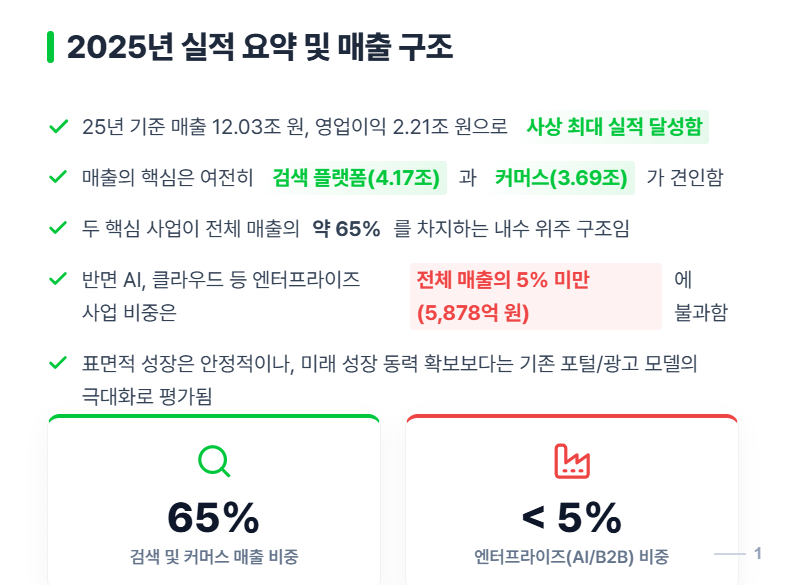
Looking at NAVER's revenue structure, its core areas can be divided into search platforms and commerce businesses.
Revenue from search platforms reaches approximately 4.17 trillion won, while the commerce sector records about 3.69 trillion won.
The enterprise section, which includes B2B and cloud services, accounts for approximately 587.8 billion won, with 65% of total revenue generated from these two main businesses.
The contribution of enterprise business areas, such as AI and cloud, is relatively low at under 5%.

NAVER faces challenges to be recognized as an AI infrastructure company or B2B SaaS player, similar to global giants.
In particular, in Q4 2025, the revenue from the search platform decreased by 0.5% compared to the previous year. This signals not just a normal quarterly fluctuation but a slowdown in growth of core revenue sources.
Ultimately, NAVER heavily relies on converting search traffic into ads and linking them with shopping through a domestic-focused platform model. This situation raises questions about its future growth potential.
Expansion of AI Search and Changes in NAVER's Market Share
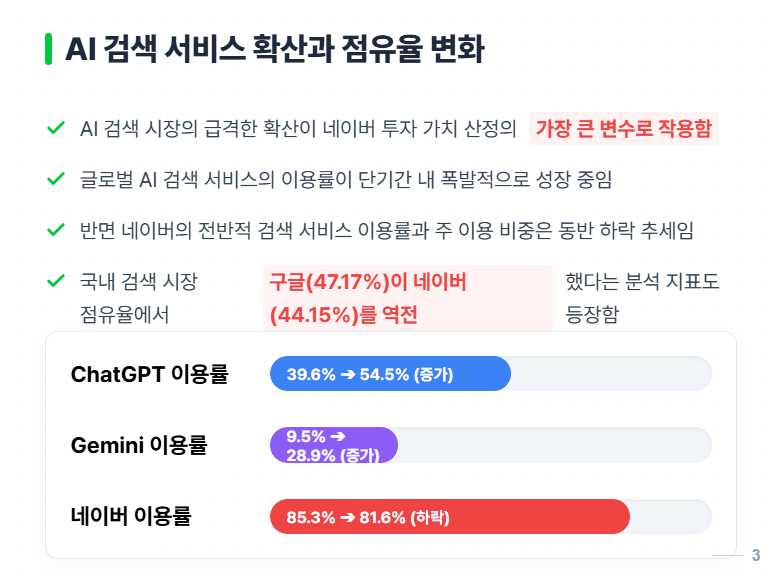
The most significant factor in NAVER's investment outlook is the growth of the AI search market.
The usage of AI-based search services is rapidly increasing. For instance, the usage rate of ChatGPT rose from 39.6% to 54.5%, while Gemini increased from 9.5% to 28.9%.
In contrast, NAVER's usage rate decreased from 85.3% to 81.6%, reducing its share of primary search services from 49.1% to 46.0%.
Furthermore, recent statistics show a domestic search market share of 47.17% for Google and 44.15% for NAVER, indicating that NAVER no longer maintains an overwhelming first position in the market.
This change is expected to significantly impact NAVER's future strategies.

The main change brought about by AI search can be viewed as a fundamental shift in user behavior patterns. Previously, the portal search method involved clicking links and navigating multiple pages after a search.
In contrast, AI search provides immediate responses to a single question. This results in reduced ad exposure space, decreased user dwell time, and less frequent exploration of external links.
Consequently, even if search volumes remain steady on platforms like NAVER, there is a structural change that could lead to a decline in advertising efficiency. This transformation is expected to have a significant impact on the future search ecosystem.
Trust Issues in the Content Ecosystem

The elements that determine NAVER's competitive edge in search lie within its self-sustained content ecosystem, such as blogs, cafes, and Knowledge IN. However, in recent years, this ecosystem has faced numerous issues.
For instance, there has been a surge in experience group advertising reviews and an excessive supply of sponsored content. Additionally, blogs optimized for SEO are being produced abundantly, increasing keyword-centric content. These phenomena have continuously raised criticism for diminishing the reliability of search results.

Recently, the average usage time of the NAVER app has decreased. In January 2025, the usage time was 472 minutes, which dropped to 422 minutes by December, demonstrating a decline of about 10.5%.
This trend does not merely indicate a decrease in traffic but can be interpreted as a critical signal that users are spending less time on the platform.
Especially for platforms reliant on advertising, an increase in ads can hinder user experience, creating a vicious cycle of diminishing user numbers and declining advertising efficiency.
Changes in Information Search Patterns

The way information is sought is changing unfavorably for NAVER.
One major change is the increase in video content and AI-based exploration. For example, the utilization of YouTube for travel information has increased by 57%, whereas blog usage has decreased by over 30%.
Even when searching for international travel information, the usage rates of blogs and YouTube have become almost comparable, with blogs at 35% and YouTube at 34%, showing a narrow gap. This change well illustrates the trends in information exploration.
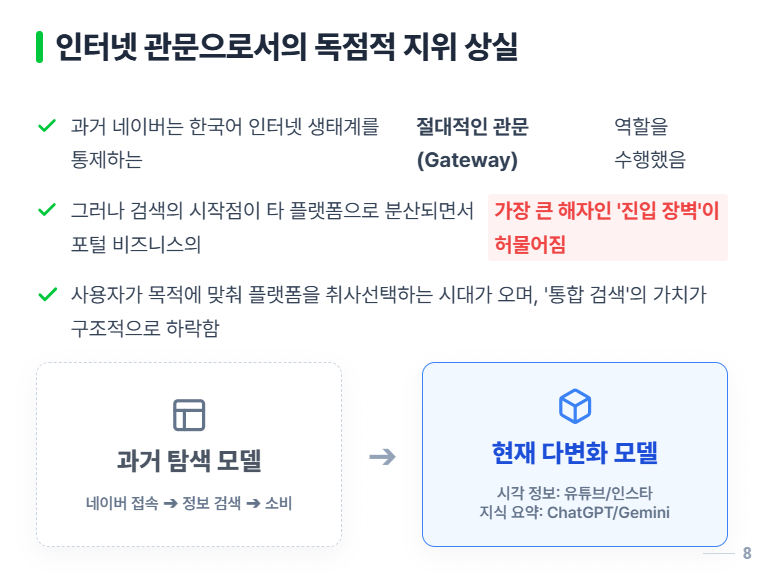
Changes in the travel sector are not merely superficial. Current information search methods are diversifying across various platforms such as YouTube, Instagram, ChatGPT, and Gemini.
Previously, NAVER served as the primary starting point of the Korean internet, but now multiple platforms are becoming the starting points for searches, significantly lowering entry barriers to portals. Such changes will greatly influence future information exploration methods.
Competitive Pressures on NAVER's Commerce Business
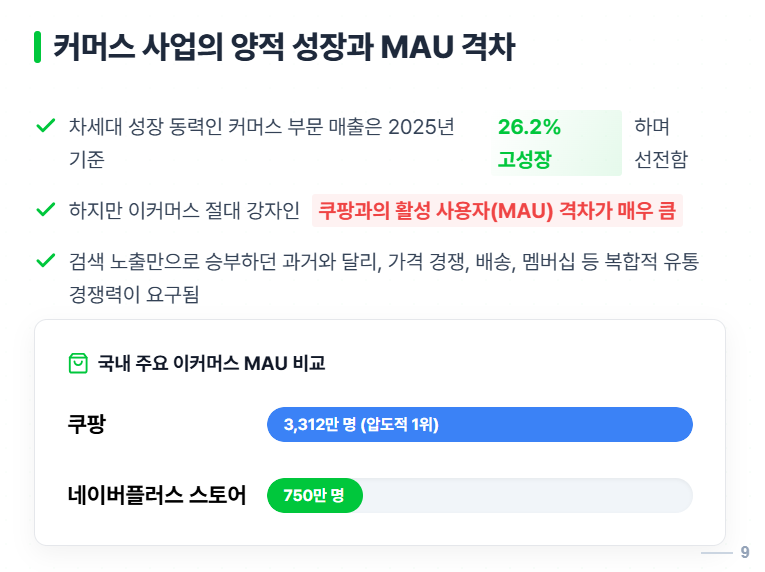
NAVER has set growth as a primary goal in the commerce sector. Revenue from commerce is expected to increase by 26.2% by 2025.
However, looking at the market structure, the gap with Coupang remains significant. Recent figures show that Coupang has 33.12 million monthly active users (MAU), while NAVER Plus Store has only 7.5 million.
The commerce market requires competition across various factors such as price, delivery speed, membership, return experiences, and seller quality, rather than just competition in search ads. This is one of the challenges NAVER must address to further develop.

Since NAVER operates as an open-market format, it does not place a significant emphasis on logistics investment. This results in excellent capital efficiency, but limits its ability to create a strong delivery lock-in effect like Coupang.
While the commerce sector has growth potential, expecting high profitability that can replace search ads is difficult. In this regard, NAVER's business model has clear pros and cons.
The Reality of NAVER's AI Strategy
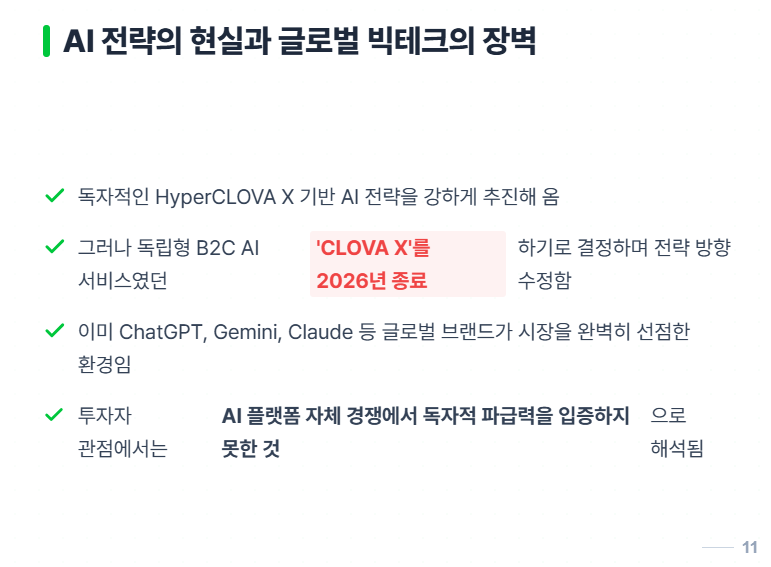
NAVER has been pursuing an AI strategy based on HyperCLOVA X. However, the consumer-oriented independent AI service CLOVA X is set to end in 2026.
This decision can be viewed as a strategic shift, but investors may interpret it as NAVER not achieving distinct results in the AI platform competition.
The global AI platform market currently has strong brands like ChatGPT, Gemini, Claude, and Perplexity already established, raising concerns about NAVER's future competitiveness.
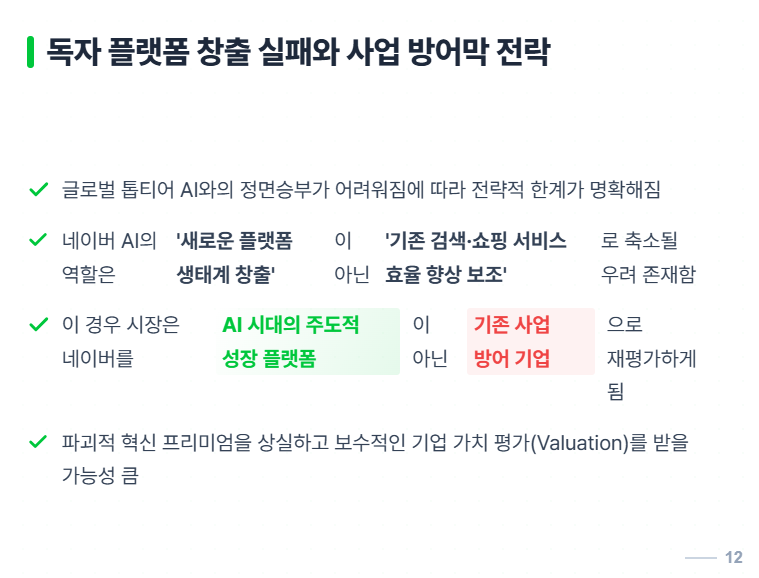
In this situation, NAVER AI may play a supplementary role that enhances the efficiency of search and shopping rather than establishing itself as an independent platform.
Ultimately, there is a possibility that NAVER will remain a company focused on defending its existing operations rather than transforming into an innovative growth platform in the AI era.
NAVER's Investment Outlook and Stock Valuation

Examining NAVER's main weaknesses comprehensively reveals the following:
First, the reliance on domestic-centric revenue structure driven by search ads and commerce is identified as a problem. Second, the expansion of AI search has intensified competition between search platforms.
Third, the decreasing reliability of content is leading to a trend of reduced user dwell time. Fourth, compared to Coupang, the weak user lock-in structure in commerce competition also raises concerns.
Lastly, it is disappointing that the AI strategy is focused on defending existing operations instead of creating new platforms.
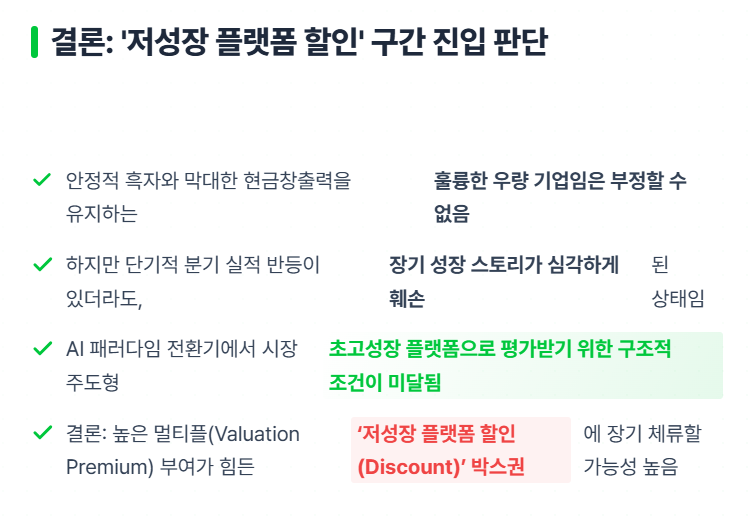
NAVER remains a platform company with excellent cash generation capability.
However, from an investment perspective, there are several structural constraints that make it difficult to regard it as a rapidly growing platform in the AI era.
This implies that NAVER's stock may experience short-term performance recovery but, in the long term, is likely to remain in a 'low-growth platform discount' period that cannot attract high-value multiples.
In conclusion, NAVER is undoubtedly a good company, but it may not be viewed as the most promising growth stock of the current era.
Conclusion: Summary of NAVER's Stock Outlook
In conclusion, NAVER is a company boasting stable cash flow, yet its growth potential is weakening in the competitive landscape of the AI era.
Considering changes in market share, trust issues in the content ecosystem, pressures of commerce competition, and competition among AI platforms, NAVER's stock may not show significant upward potential in the long term.
For these reasons, the perspective of re-evaluating NAVER as a domestically focused platform company rather than an ultra-fast-growing AI corporation is gaining more credibility.
#NAVER Stock Forecast, #NAVER Stock, #NAVER Investment Analysis, #NAVER Search Market Share, #NAVER AI Strategy, #End of ClovaX, #NAVER Commerce, #NAVER Ad Revenue, #AI Search Market, #ChatGPT Search, #Gemini Search, #Search Engine Market, #NAVER Blog Issues, #NAVER Content Ecosystem, #NAVER Platform, #Coupang Competition, #E-commerce Competition, #AI Platform Competition, #NAVER Corporate Analysis, #NAVER Revenue Structure, #NAVER Ad Model, #Platform Company Analysis, #Domestic Big Tech, #Business Analysis in the AI Era, #Tech Company Outlook, #NAVER User Time, #NAVER Search Trends, #Korean IT Companies, #NAVER Growth Potential, #NAVER Investment Risks
Frequently Asked Questions (FAQ)
Q. What are NAVER's expected revenue and operating profit for 2025?
NAVER expects revenue of 12.03 trillion won and operating profit of 2.21 trillion won in 2025.
By 2025, NAVER is projected to record its best performance ever, expecting revenue to reach approximately 12.03 trillion won and operating profit to approximately 2.21 trillion won. However, this performance is based on stable growth reliant primarily on the existing portal and ad-centric business model, indicating some limitations in securing future growth drivers.
Q. What are the main business sectors in NAVER's revenue structure?
The search platform and commerce business account for 65% of NAVER's revenue.
NAVER's main revenue sectors are categorized into search platforms and commerce businesses, recording approximately 4.17 trillion won and 3.69 trillion won in revenue, respectively. These two sectors account for over 65% of total revenue, making them core income sources. In contrast, the share of enterprise businesses such as AI and cloud is relatively low, at less than 5%.
Q. What is the status of NAVER's AI strategy and the CLOVA X service?
NAVER's AI strategy focuses on supporting existing business roles alongside the end of CLOVA X.
NAVER had pursued an AI strategy based on HyperCLOVA X; however, the consumer-oriented independent AI service CLOVA X is set to conclude in 2026. This indicates a strategic transition, signifying that NAVER is focusing more on boosting the efficiency of search and shopping than on creating an independent AI platform. NAVER's position in the global AI platform competition is somewhat weakened.
Q. What impact does the recent spread of AI search have on NAVER's market share?
The spread of AI search is decreasing NAVER's usage rates and search market share.
The rapid growth of AI-based search services has seen increased utilization of new services like ChatGPT and Gemini, while NAVER's usage rate has decreased from 85.3% to 81.6%. The domestic search market share is also shaping an environment where NAVER struggles to maintain its leading position, with Google at 47.17% and NAVER at 44.15%. This serves as a significant challenge for NAVER's core search business.
Q. What is the competitive environment facing NAVER's commerce business?
There is significant competitive pressure due to the user gap compared to Coupang and lack of delivery lock-in.
NAVER's commerce is expected to grow its revenue by approximately 26.2% in 2025, yet it is significantly trailing in MAU with Coupang having 33.12 million compared to NAVER Plus Store's 7.5 million. The lack of robust delivery lock-in, due to low logistics investment, indicates that it is challenging for NAVER to generate competitive strength similar to Coupang. Improvements are necessary in various aspects of competition such as price, delivery, and membership.
Q. What trust issues does the NAVER content ecosystem currently face?
The increase in experience group advertising, excessive sponsored content, and growing SEO-optimized blogs diminish trust.
NAVER’s self-sustained content ecosystem, including blogs, cafes, and Knowledge IN, has recently faced declines in search result trustworthiness and quality due to increased experience group advertising reviews, surplus of sponsored content, and the proliferation of keyword-centric SEO blogs. These phenomena are adversely affecting user experience and weakening the competitive edge of the search platform.
Q. How has user information search patterns changed since the introduction of AI search?
AI search with instant responses and video content exploration has increased, lowering ad exposure and dwell time.
Traditional portal searches typically involved exploring multiple pages and clicking links; however, AI search now focuses on providing immediate answers with a single inquiry. As a result, the ad exposure space is shrinking, dwell times are declining, and the frequency of exploring external links is decreasing. Additionally, the usage of video content platforms like YouTube is significantly on the rise, altering information search trends.
Q. What is the status of NAVER's user platform dwell time? The average usage time decreased from 472 minutes in January 2025 to 422 minutes in December, showing about a 10.5% drop.
The average usage time of the NAVER app decreased from 472 minutes in January 2025 to 422 minutes by the end of December, reflecting a reduction of approximately 10.5%. This is not merely indicative of traffic decline but could signal significatively lesser time spent by users on the platform, creating a looming risk of diminishing ad efficiency and user attrition.
Q. What are the key factors influencing NAVER's stock outlook?
The intensifying AI competition and reliance on advertising suggest a low-growth discount period.
NAVER is a stable platform company with strong cash flow, yet the limitations of a revenue structure heavily reliant on search and commerce hinder its classification as a rapid growth platform in the AI era. With the intensifying AI platform competition, decreasing trust in content, and pressures from commerce competition, it is likely to stay within a low-growth platform discount range in the long term.
