Table of Contents
- The Role of ELW Puts in KOSPI200 Overheating Periods
- Investment Logic for ELW Puts Amidst KOSPI200 Bull Market
- How to Find HanTuu ELWs and Stock Selection Criteria
- Operating Principles for Buying and Selling KOSPI200 ELW Puts
- Conclusion: How to Utilize ELW Puts as an Inverse Alternative
- Frequently Asked Questions (FAQ)
The Role of ELW Puts in KOSPI200 Overheating Periods

Looking at the recent trend of KOSPI200, it is evident that there is a distinct upward momentum in the short to medium term. The moving averages are generally trending upwards and maintaining a positive arrangement, while RSI is nearing an overheating state.
In such an environment, instead of haphazardly holding inverse or leveraged positions, strategies are needed to minimize losses during adjustment periods or to effectively respond to short-term declines. This sophisticated approach becomes even more important.
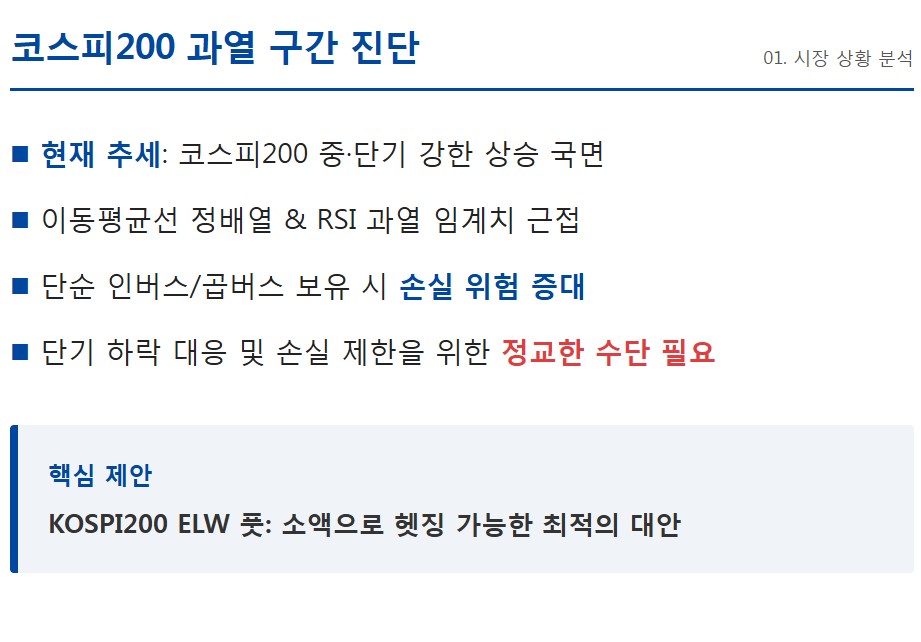
One option to consider is the KOSPI200 ELW put. This product is securitized rights that allow one to profit when the index declines, and it has the advantage of being easy to hedge and respond in the short term with small investments. For these reasons, it is widely utilized by many investors.
Recommended Readings



Investment Logic for ELW Puts Amidst KOSPI200 Bull Market
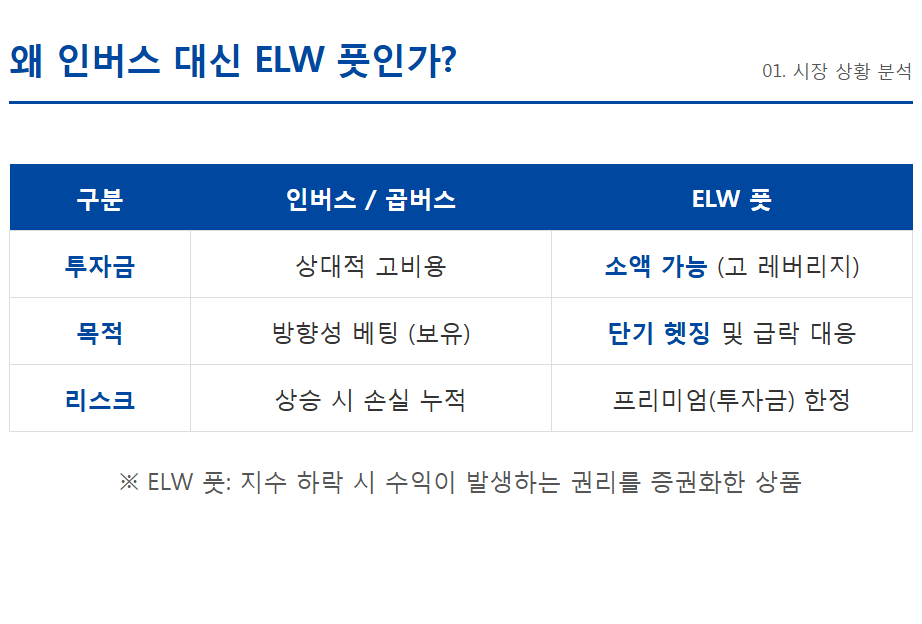
In a strong bullish market like the current one, simply betting on ELW puts for declines can be risky. This is because ELWs are affected by both the decrease in time value and changes in volatility. Therefore, this type of investment approach should be approached with caution.

For accounts with a significant long position in stocks or index ETFs, ELW puts serve as an effective hedging tool. They act as a shield to reduce portfolio losses during sharp declines.
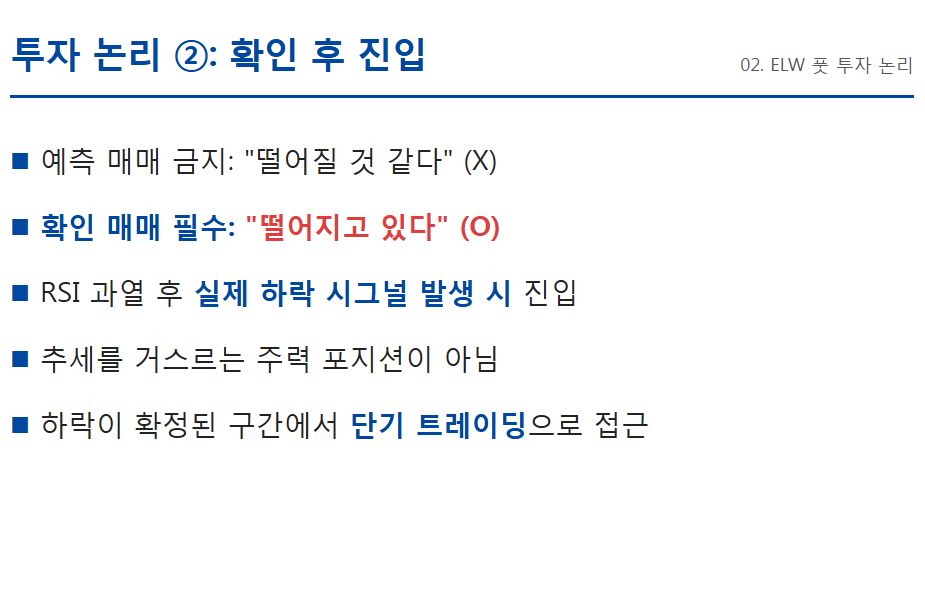
Secondly, in periods where RSI has overheated and an actual decline is observed, short-term adjustment trading can be considered. That is, it is more effective to enter after confirming a signal of "it is declining" rather than a prediction of "it is likely to decline."
Therefore, it is reasonable to see ELW puts not as a primary position, but as a supplementary means for risk management and short-term response. This approach allows for more effective coping with market volatility.
How to Find HanTuu ELWs and Stock Selection Criteria
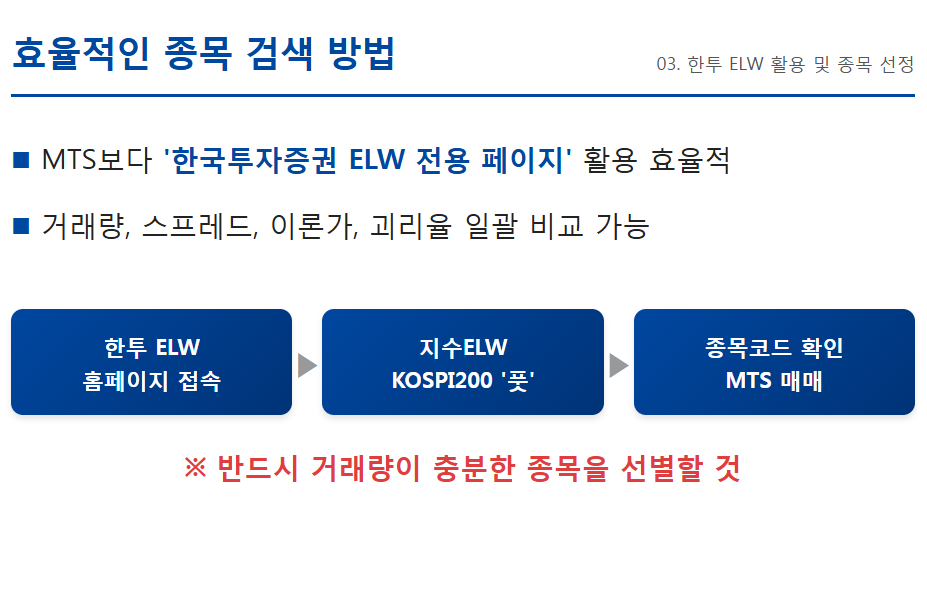
One of the most challenging aspects for beginners regarding ELWs is stock selection. The process of searching and comparing ELWs in the brokerage's MTS can often be cumbersome. In this case, utilizing the dedicated ELW page of Korea Investment Securities is efficient.
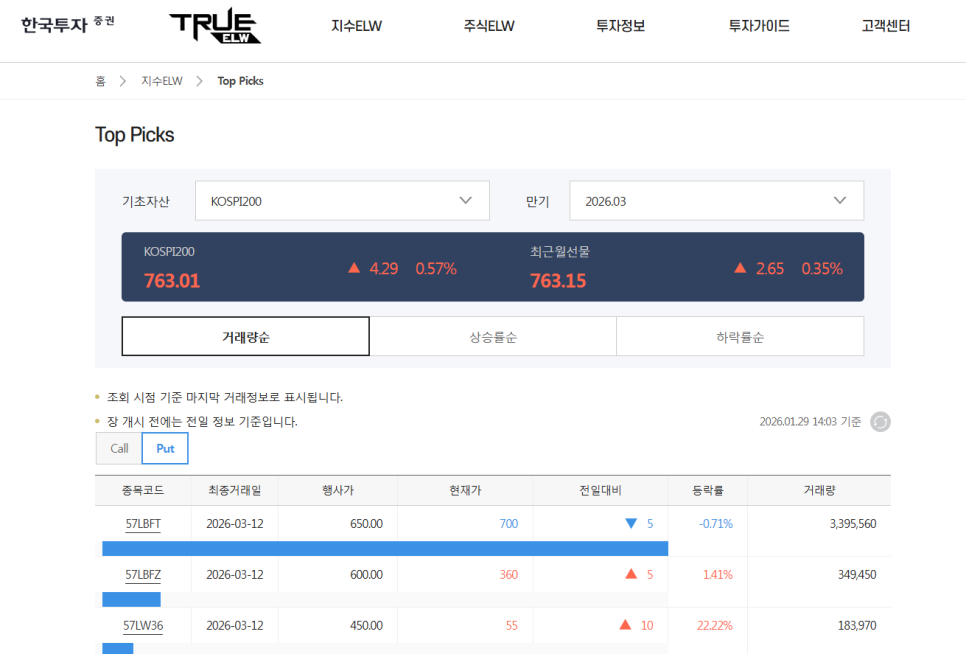
Search for 'HanTuu ELW' in a portal to visit the ELW homepage of Korea Investment Securities. After that, select KOSPI200 from the index ELWs and enter the put menu to easily check the list of stocks by expiration date. This time, we looked at the March KOSPI200 put ELWs.
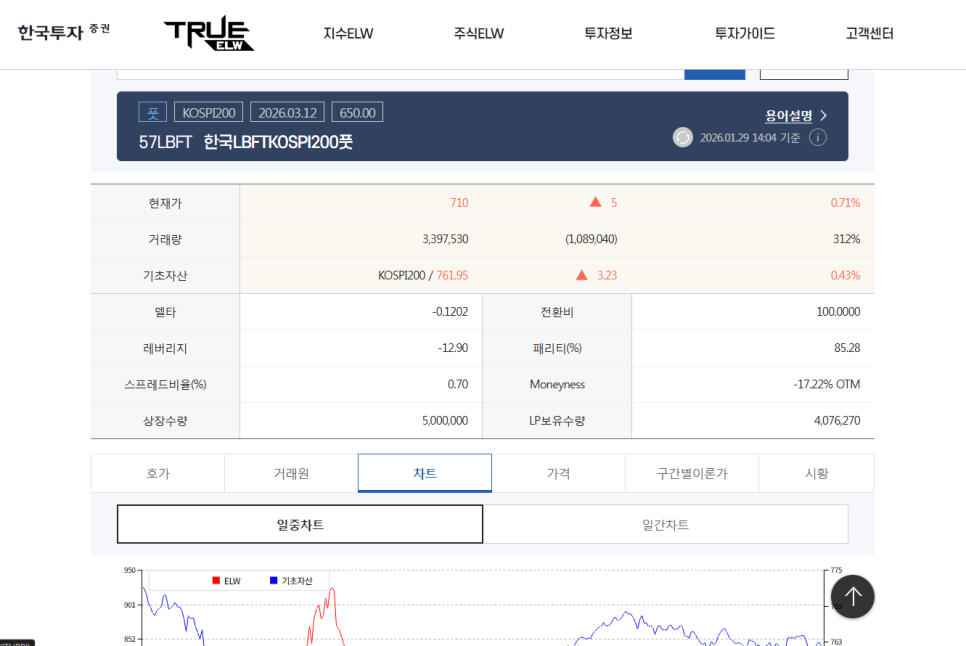
By clicking on the stock code, you can easily compare current prices, trading volume, spread, theoretical price, and discrepancy rate. Afterward, it is very efficient to select stocks with appropriate trading volumes and enter trades by typing the stock codes in the MTS.

There are important factors to consider when selecting stocks. First, it is advisable to choose stocks with ample trading volumes and narrow spreads. Additionally, it is necessary to set the expiration not too short to reduce theta burden.
Avoid OTM stocks that are too far, and it is preferable to select stocks that show delta response near ATM or slightly OTM. By adhering to these criteria, the return that can be felt when directionality is correct will significantly improve.
Operating Principles for Buying and Selling KOSPI200 ELW Puts
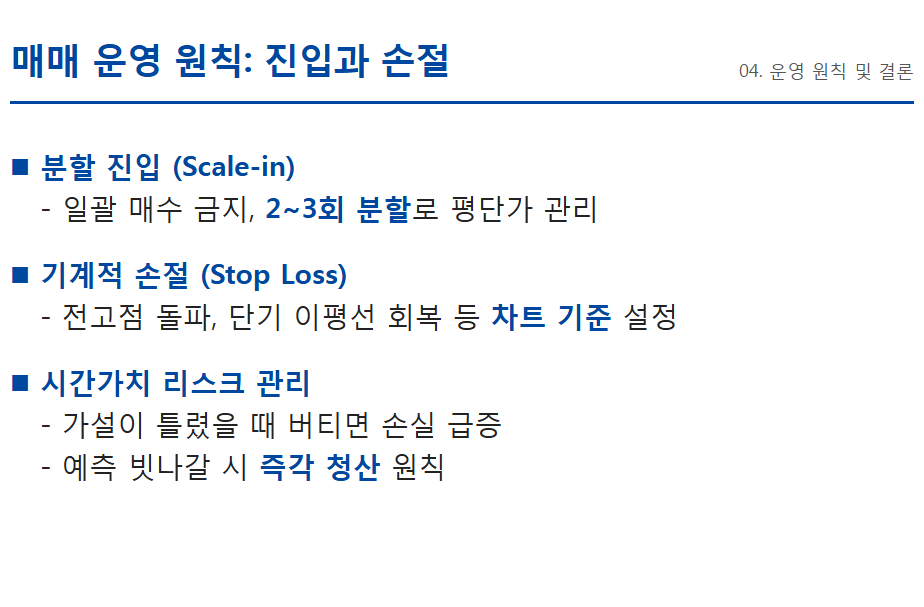
The most important aspect of investing in ELW puts is the operating rules rather than the entry strategies. It is better to divide the investment into two or three times rather than investing all at once. This allows for effective management of the average unit price. Additionally, it is important to clearly set loss-cut criteria. For example, conditions that can be confirmed on charts, such as breaking previous highs or re-breaking short-term moving averages, should be predetermined. If you endure despite the hypothesis being wrong, losses can quickly accumulate due to the decrease in time value.

When taking profits, it is important to let go of excessive greed. Although the price of put options can rise rapidly in the event of a sharp decline in the index, there are often cases of sharp rebounds as well. Therefore, when the target range is reached, it is safer to take partial profits to recover some of the investment and expect further declines with the remaining quantity. In particular, it is essential to effectively manage the risk of the entire account by limiting the investment in ELW puts as "premium."
Conclusion: How to Utilize ELW Puts as an Inverse Alternative
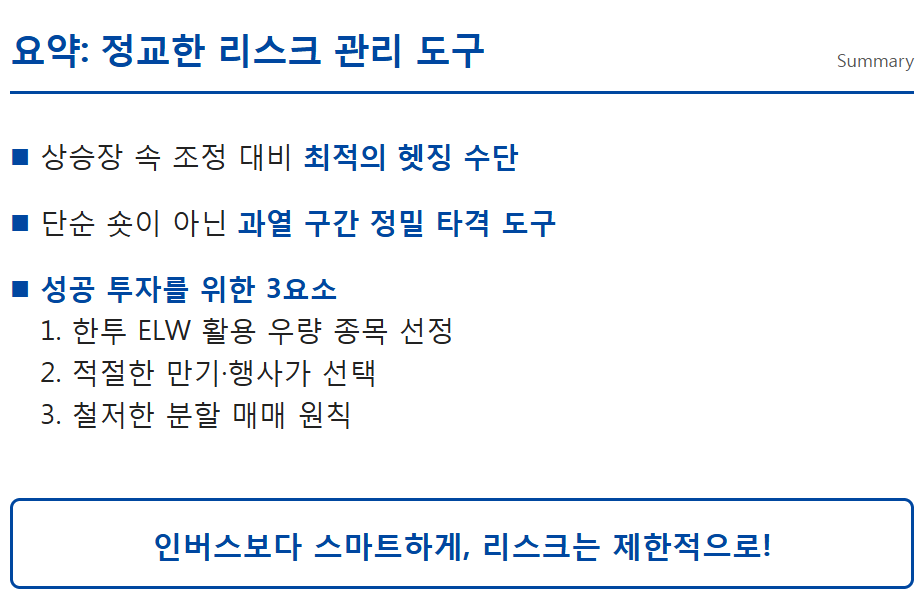
In a situation where KOSPI200 continues to show an upward trend, ELW puts do not merely stop at being a short position.
They serve as a hedging tool against adjustment declines and as a tool for short-term response after market overheating.
If you select stocks with good liquidity by referring to the HanTuu ELW homepage, do not be overly greedy regarding expiration and strike prices, and adhere to principles of entering and exiting in portions, ELW puts can become a much more sophisticated risk management tool than inverse or leveraged positions.
#KOSPI, #KOSPI200, #ELW, #ELW put, #Korea Investment Securities, #HanTuu ELW, #KOSPI inverse, #leveraged, #hedging, #downturn comparison, #adjustment market, #risk management, #derivatives, #index investment, #stock investment, #short-term trading, #volatility, #RSI, #moving average, #theta, #delta, #vega, #spread, #liquidity, #LP bids, #expiration selection, #strike price selection, #ATM, #OTM, #investment strategy
Frequently Asked Questions (FAQ)
Q. What is the role of ELW puts in KOSPI200 overheating periods?
ELW puts are effective tools for responding to short-term adjustments and hedging during KOSPI200 overheating.
When KOSPI200 enters an overheating phase, the RSI indicator rises, increasing the possibility of price adjustments. In such situations, ELW puts can be utilized not as a primary position but as a supplementary tool to respond to short-term adjustments. They are particularly useful for investors holding long positions in stocks or index ETFs, as they help mitigate portfolio losses during sharp declines.
Q. What are the stock selection criteria for investing in ELW puts?
Choose ATM or slightly OTM stocks with high trading volume and narrow spreads.
When selecting ELW put stocks, it is essential to prioritize stocks with abundant trading volumes and narrow spreads. To minimize theta burden, the expiration should not be set too short. The strike price should be near ATM or slightly OTM, allowing for a favorable delta response that positively impacts returns. Utilizing the dedicated ELW page of Korea Investment Securities allows for convenient comparison and selection of stocks.
Q. What are the effective trading operation principles for ELW puts?
It is important to enter in portions and clearly set loss-cut criteria, and perform partial liquidation in the profit-taking range.
When investing in ELW puts, it is advisable to divide the investment into 2-3 phases rather than injecting all funds at once. This helps manage the average unit price. The loss-cut criteria should be predetermined based on chart signals, such as breaking previous highs or re-crossing moving averages, to prevent losses from expanding. When taking profits, a stable strategy is to liquidate part of the position upon reaching the target profit range, allowing for recovery of the investment while anticipating further declines with the remaining quantity.
Q. What advantages does the ELW put have over KOSPI inverse or leveraged positions?
ELW puts are effective hedging tools favoring sophisticated risk management and short-term responses.
Possessing inverse or leveraged positions during bullish trends in KOSPI200 can carry significant loss risks, making indiscriminate holdings dangerous. Conversely, ELW puts allow for short-term responses to declines with small investments, and if managed cautiously in terms of time value and volatility, they can minimize portfolio losses. Additionally, divided entries and liquidations enable more sophisticated risk management.
