Table of Contents
- Turning Point for Alleviating Busan's Traffic Congestion
- Overview and Significance of the Selection of 4 Projects in Busan
- Bansong Tunnel and Hoedong Tunnel, a Decisive Shift for the 4th Battle
- Three Major Supplementary Routes to Alleviate East-West Busan Bottlenecks
- Completion of Busan Outer Circular Road and Its Overall Impact on the City
- Conclusion | Structural Changes Enabled by Securing National Funding
- Frequently Asked Questions (FAQ)
Turning Point for Alleviating Busan's Traffic Congestion
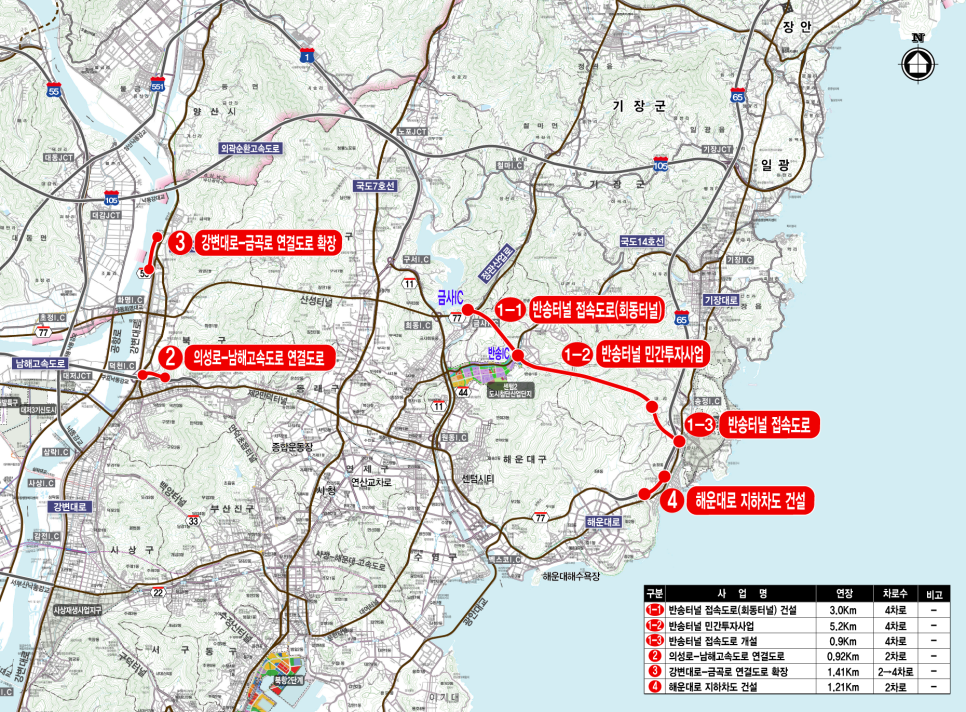
Four major road projects in Busan have been finally included in the 5th Metropolitan Area Traffic Congestion Road Improvement Project (2026-2030) to fundamentally address Busan's traffic congestion problems.
This selection secures a total of 252.7 billion won in national funding, aiming to alleviate major bottlenecks in eastern and western Busan and enhance overall mobility efficiency in the city.
In particular, the long-delayed Bansong Tunnel has been prioritized, raising expectations for policy changes. It is anticipated that these projects will significantly contribute to solving Busan's traffic issues.
Overview and Significance of the Selection of 4 Projects in Busan

This plan is a legal framework prepared by the Ministry of Land, Infrastructure and Transport every five years, aiming to reduce congestion on major arterial roads in metropolitan areas.
Busan has proposed four routes considering regional balance, with a total project cost of 653.9 billion won.
The core of this plan is to shorten travel times between the city center and outskirts through the reinforcement of arterial axes and to enhance the completeness of the outer circular road network to maximize traffic dispersion effects.
Additionally, improved accessibility for tourism, logistics, and industry carries significant implications for enhancing the city's competitiveness.
Bansong Tunnel and Hoedong Tunnel, a Decisive Shift for the 4th Battle
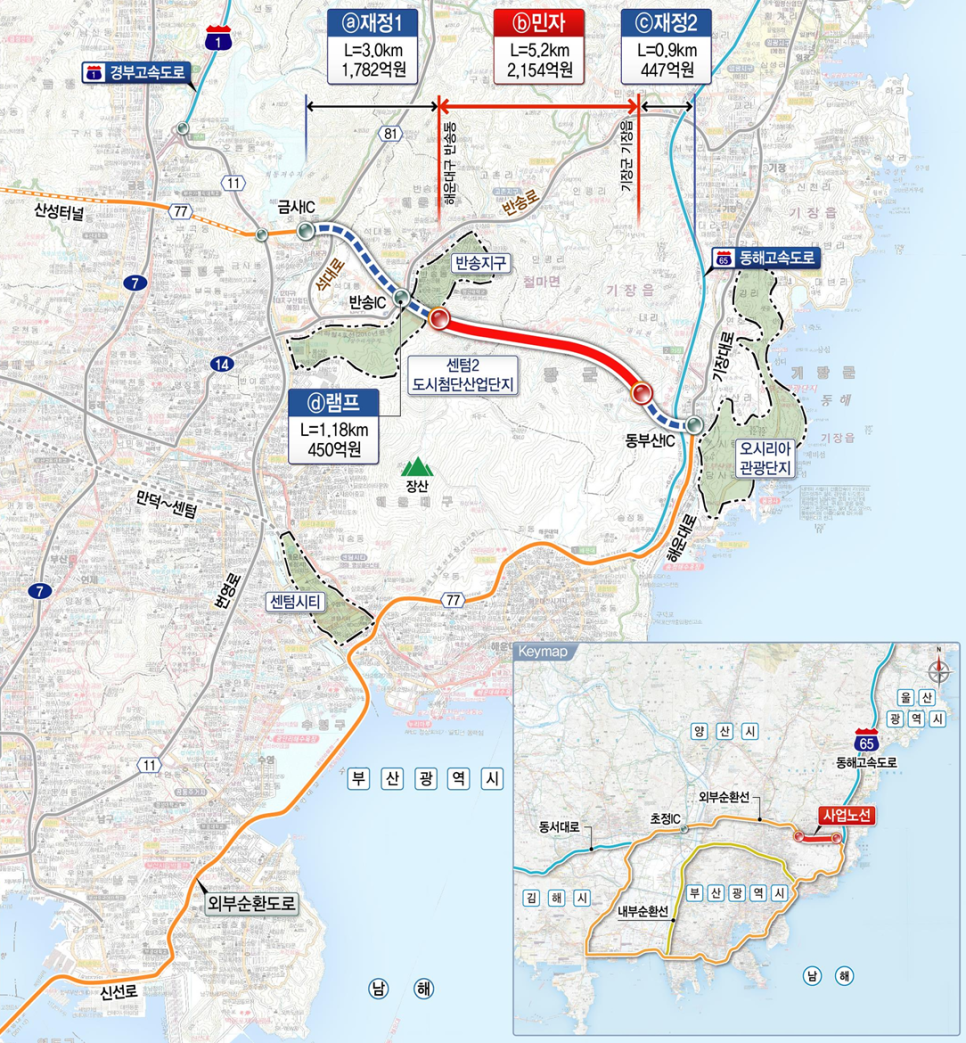
The Bansong Tunnel is the final component of the external circular road network connecting Hoedong-dong in Geumjeong-gu and Songjeong-dong in Haeundae-gu. This project is divided into three parts: the access road (Hoedong Tunnel), the privately financed Bansong Tunnel, and the complementary access road.
The effects of its opening are clear. It is expected that travel times will be reduced by 26 to 35 minutes compared to Haeun-ro and Bansong-ro. The shortest route between central and eastern Busan will be secured, and after the internal circulation between Mandeok and Centum is completed, the external circulation will also gain practical functionality.
Previously excluded due to a lack of economic feasibility, it has now been selected as a top priority project due to rising traffic demands from nearby development plans and a reassessment of its benefits.
Three Major Supplementary Routes to Alleviate East-West Busan Bottlenecks
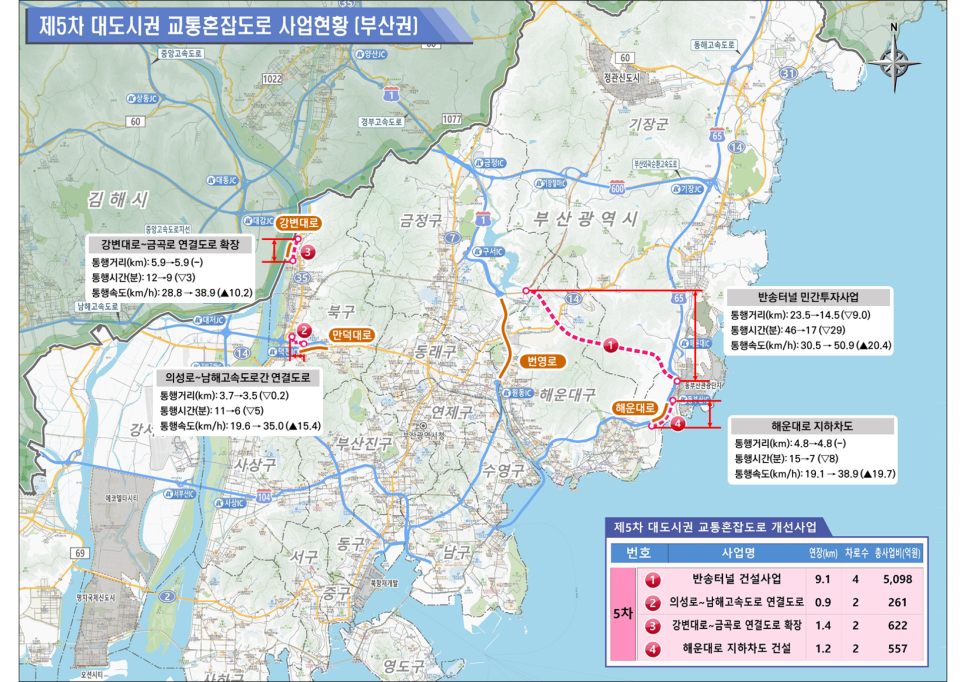
A road connecting Uiseong-ro and the Namhae Expressway will be established. This will contribute to dispersing traffic on the Namhae Expressway and alleviating the frequent congestion on Uiseong-ro in Buk-gu. The increased accessibility to the expressway is also expected to enhance the efficiency of long-distance travel.
Additionally, there will be an expansion of the road connecting Gangbyeon-daero and Geumgok-ro. The Geumgok IC will be expanded from two lanes to four lanes, improving bottlenecks during peak commuting hours. This is expected to enhance traffic convenience in residential and industrial areas in northern Busan.
Finally, an underground tunnel will be constructed on Haeundae Road. This underground tunnel, to be installed at Songjeong Intersection and Songjeong-egu Intersection, will ensure continuous flow. The entry and exit routes for the Osiria tourism complex will be improved, significantly easing traffic congestion during peak seasons.
Completion of Busan Outer Circular Road and Its Overall Impact on the City

The selection of this project holds significant meaning beyond the simple construction of roads, as it aims to reorganize Busan's traffic system.
By strengthening the external circular function, traffic passing through the city center will be dispersed, reducing logistics costs and improving accessibility to tourist destinations. This will ultimately have a positive ripple effect on the local economy.
Busan City plans to expedite feasibility studies and national funding application procedures to realize such plans and will gradually begin construction.
Conclusion | Structural Changes Enabled by Securing National Funding

The selection of four major projects to improve Busan's transportation system includes the Bansong Tunnel and the Hoedong Tunnel.
If this project proceeds smoothly through cooperation with the central government, citizens will experience greater convenience in movement, and connectivity between East and West Busan will be significantly enhanced.
#BansongTunnel, #HoedongTunnel, #MetropolitanAreaTrafficCongestionRoad, #TrafficCongestionImprovementProject, #BusanNationalFunding, #BusanOuterCircularRoad, #HaeundaeUndergroundHighway, #UiseongroNamhaeExpressway, #GangbyeonDaeroGeumgokRo, #OsiriaTraffic, #BusanTrafficPolicy, #BusanUrbanPlanning, #BusanSOC, #BusanRoadProjects, #EastWestBusanConnection, #BusanTrafficImprovement, #BusanDevelopmentOpportunities, #HaeundaeTraffic, #GeumjeongGuTraffic, #BukGuTraffic, #BusanInfrastructure, #BusanUrbanCompetitiveness, #BusanCircularRoad, #BusanTrafficNetwork, #BusanLargeProjects, #BusanPolicy, #BusanNews, #BusanCurrentIssues
Frequently Asked Questions (FAQ)
Q. What major projects were selected for Busan’s 5th Metropolitan Area Traffic Congestion Road Improvement Project?
Busan selected 4 major road projects, including the Bansong Tunnel and the Hoedong Tunnel, for the 5th Traffic Congestion Road Improvement Project.
Busan has finalized 4 projects, including the Bansong Tunnel and Hoedong Tunnel, for the 5th Metropolitan Area Traffic Congestion Road Improvement Project, which will run from 2026 to 2030. This project will secure a total of 252.7 billion won in national funding, greatly contributing to alleviating major bottlenecks and increasing urban mobility efficiency. In particular, the long-delayed Bansong Tunnel project has been included as a top priority, establishing a pivotal policy shift.
Q. What are the objectives of the 5th Metropolitan Area Traffic Congestion Road Improvement Project, and what is the significance of selecting 4 routes within Busan?
The project aims to reduce congestion on major metropolitan arterial roads and shorten travel times in Busan while completing the outer circular road.
This legal plan established by the Ministry of Land, Infrastructure and Transport every five years aims to alleviate traffic congestion on metropolitan arterial roads. Busan has proposed 4 routes, considering regional balance, with a total project cost of 653.9 billion won, focusing on significantly reducing travel times between the city center and outskirts. As the completeness of the outer circular road network increases, the effects of traffic dispersion will be maximized, improving accessibility for tourism, logistics, and industry, thus enhancing the city's competitiveness.
Q. What specific effects will the Bansong Tunnel and Hoedong Tunnel projects have on transportation in Busan?
Opening the Bansong Tunnel and Hoedong Tunnel is expected to reduce travel time by 26 to 35 minutes and improve connectivity between East and West Busan.
The Bansong Tunnel is the final connecting element of the external circular road network linking Geumjeong-gu, Hoedong-dong, and Haeundae-gu, Songjeong-dong, and comprises the Hoedong Tunnel and access road improvement projects. Upon opening, travel times are expected to be reduced by an average of 26 to 35 minutes compared to Haeun-ro and Bansong-ro, securing the shortest path between central and eastern Busan. With the completion of the internal and external circular road networks from Mandeok to Centum, the overall traffic flow and logistics efficiency across Busan are expected to improve significantly.
Q. What impact will the completion of the Busan outer circular road network and other road expansion projects have?
Completing the outer circular road network and expanding key roads will significantly improve traffic efficiency and alleviate bottlenecks.
The construction of a road connecting Uiseong-ro and the Namhae Expressway will help to disperse congestion on the expressway and relieve traffic pressures on Uiseong-ro. The expansion of the road connecting Gangbyeon-daero and Geumgok-ro and the expansion of Geumgok IC from 2 to 4 lanes will alleviate bottlenecks during peak commuting hours. The construction of an underground tunnel on Haeundae Road will ensure continuous traffic flow, improving access to Osiria tourism complex and significantly reducing traffic congestion during high season. These projects are expected to greatly contribute to easing traffic inconveniences between East and West Busan and enhancing the city’s competitiveness.
Q. What does securing national funding mean for changes in Busan's transportation structure?
Securing national funding represents a turning point for restructuring Busan's transportation system, leading to economic revitalization and increased urban competitiveness.
The securing of national funding for the four major transportation projects in Busan marks a pivotal turning point for the overall reconstruction of the traffic system beyond simple road construction. Strengthening the external circular function will disperse traffic through the city center, leading to reduced logistics costs and improved accessibility for tourism. Busan City plans to carry out feasibility studies and prompt national funding applications to gradually initiate construction, which is expected to spur urban competitiveness and local economic revitalization.
