Table of Contents
Overview of MSCI Korea Changes
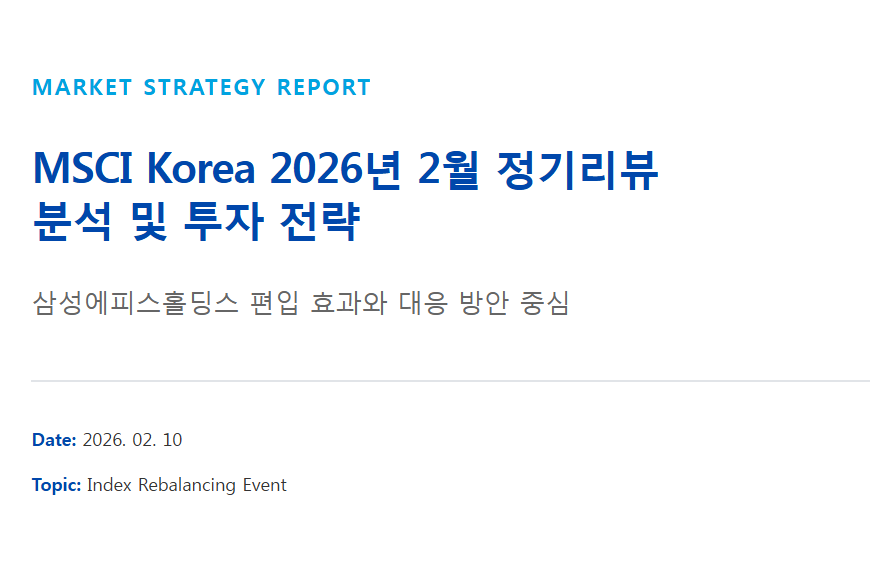
The results of the February 2026 MSCI Korea Index regular review announced by MSCI are impacting the short-term supply and demand in the domestic stock market. This index serves as a major benchmark covering about 85% of the market capitalization, including large-cap and mid-cap stocks in Korea.
The announcement was made on February 10, 2026, and will take effect based on the closing price on Friday, February 27, 2026. These changes are attracting attention from investors and are likely to play a significant role in the future movements of the market.

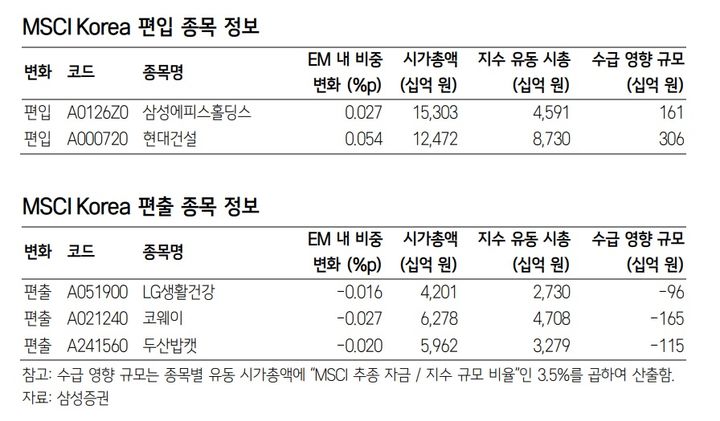
Recently, Hyundai Construction and Samsung Epise Holdings have been newly included. On the other hand, Coway, Doosan Bobcat, and LG Household & Health Care have been removed from the index.
Notably, Samsung Epise Holdings, which has drawn significant attention from stock investors, is a distinctive name different from Samsung Bioepis and is included on the list of stocks invested by passive funds. This could have a substantial impact on market movements.
Investors should closely observe these changes.
Effect of Samsung Epise Holdings Inclusion
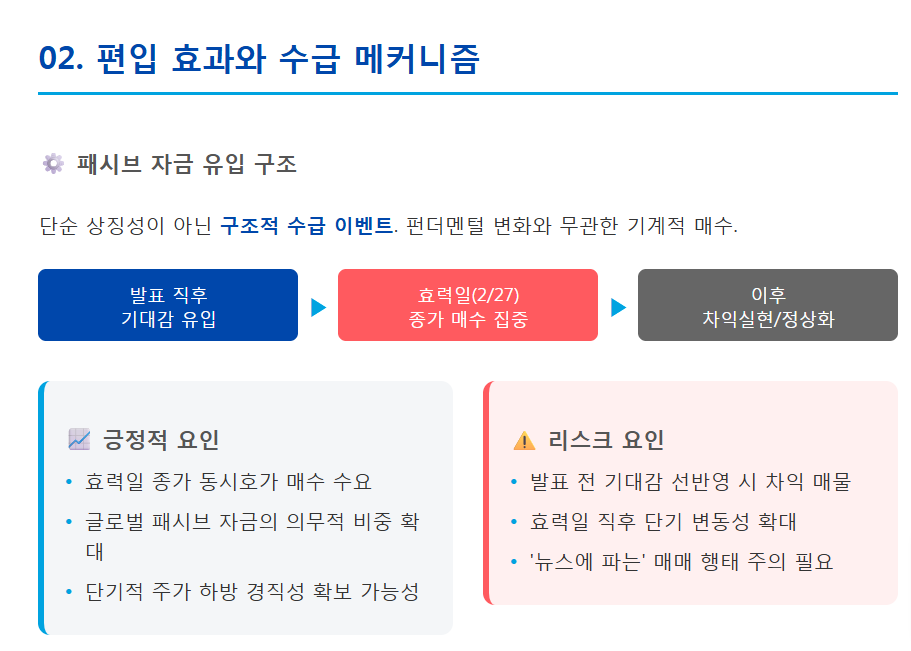
Being included in the MSCI Korea Index goes beyond mere symbolic significance and leads to structural changes in supply and demand. Global ETFs and index funds that track this index are obligated to purchase the stocks based on the closing price on the effective date.
In this process, a series of flows consistently occur. First, immediately after the announcement, buying pressure due to anticipation is observed. Second, around the effective date, passive funds will concentrate on buying at the closing price. Third, after the effective date, a phase of profit-taking or normalization is formed.
The rebalancing based on the closing price on February 27, 2026, marks a point of concentrated trading, and in the short term, the buying demand at the closing price is likely to support stock prices.
However, it's important to note that inclusion in MSCI involves mechanical trading according to benchmark rules, regardless of changes in the company's fundamentals. If the stock price has already reflected much of this after the announcement, it may experience increased volatility before and after the effective date.
Daily Chart Technical Analysis
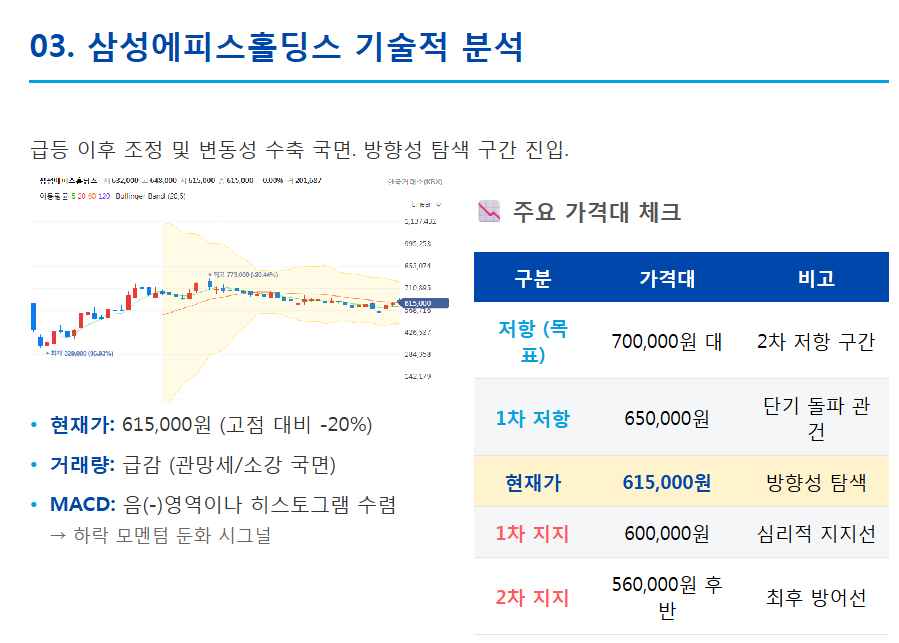
Recently, the stock price of Samsung Epise Holdings has entered a correction and volatility reduction phase after a sharp rise.
The low point in December was 329,000 won, and it rose to 773,000 won in January, currently standing at 615,000 won, a decrease of about 20% from the peak.
During this sharp rise, significant transactions occurred, but the trading volume has decreased sharply as it entered the correction phase. This is more appropriately interpreted as an increase in the wait-and-see attitude rather than panic selling.
Currently, the Bollinger Bands are narrowing, indicating a signal that volatility may expand again. However, the direction of the stock price is still not clearly determined.
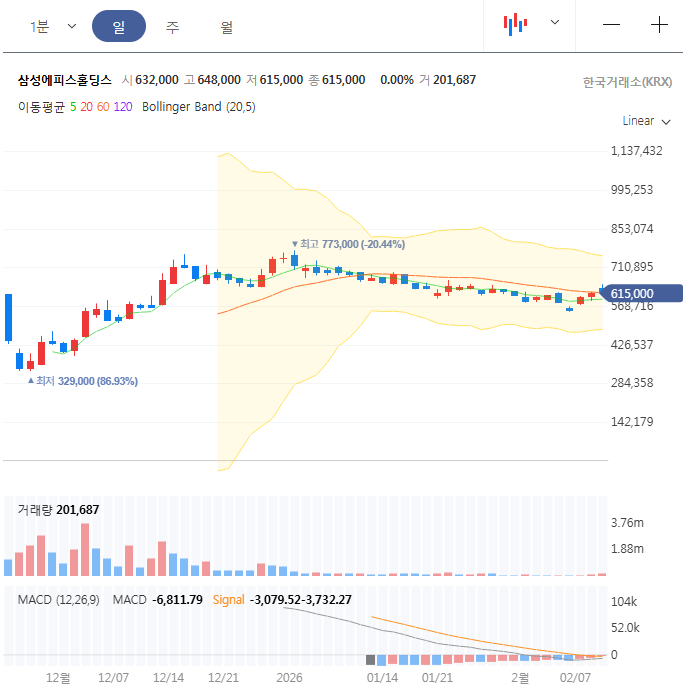
The key points for technical analysis of the current stock price are as follows.
The first support level is at 600,000 won, and the second defensive line is positioned in the upper 560,000s. In contrast, the first resistance level is set at 650,000 won, while the second resistance zone is around 700,000 won.
The MACD indicator is in the negative zone but the histogram shows signs of convergence. This is interpreted as a signal that the downward momentum is slowing down and indicates the possibility of a bottoming out. However, it is still too early to consider this as a definite rebound signal.
Investment Strategies and Risk Factors
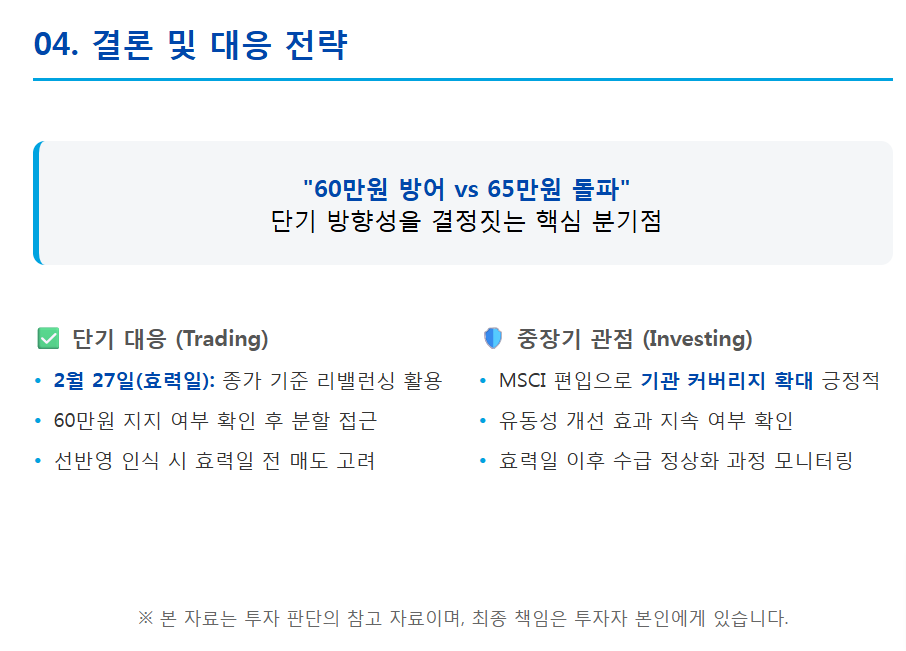
The recent discussions around the MSCI Korea inclusion are expected to act as positive factors in the short term. In particular, the rebalancing based on the effective date may positively affect supply and demand.
However, alongside this, several risks must also be kept in mind. First, there is a possibility that anticipation regarding the inclusion has already been priced in. Second, profit-taking sales may occur before and after the effective date. Third, there is a risk of increased volatility in the overall market.

Ultimately, whether 600,000 won can be defended or whether it can surpass 650,000 won will become a critical point that influences the short-term direction.
Being included in the MSCI Korea Index will act as a positive factor that improves liquidity and expands coverage from global institutions. However, in the short term, understanding and responding to the supply and demand cycle of "announcement → pre-reflection → effective date → normalization" is needed.
#MSCI Korea, #MSCI regular review, #MSCI inclusion effect, #Samsung Epise Holdings, #Samsung Bioepis, #Hyundai Construction, #Coway exclusion, #Doosan Bobcat, #LG Household & Health Care, #passive funds, #index rebalancing, #closing price simultaneous bid, #foreign investment supply, #ETF inclusion, #index funds, #stock supply analysis, #technical analysis, #daily chart, #MACD analysis, #Bollinger Bands, #stock volatility, #short-term trading strategy, #institutional investment, #KOSPI large-cap stocks, #index change date, #February 27 effectiveness, #global benchmark, #Korean stock market issues, #MSCI announcement, #stock investment strategy
Frequently Asked Questions (FAQ)
Q. When does the MSCI Korea Index change take effect and what are the main details?
The MSCI Korea Index change takes effect based on the closing price on February 27, 2026, and includes large and mid-cap stocks comprising about 85% of the market capitalization.
The results of the MSCI Korea Index regular review announced by MSCI on February 10, 2026, will take effect based on the closing price on February 27, 2026. This index serves as a major benchmark encompassing approximately 85% of the market capitalization, including large and mid-cap stocks in the Korean stock market, and has a practical effect on market supply and demand. The results of this regular review are attracting significant attention from investors and the market and are expected to act as an important variable in the future trends of the domestic stock market.
Q. What does the new inclusion of Samsung Epise Holdings in the MSCI Index mean?
Samsung Epise Holdings is expected to attract passive funds and has significant market influence due to its inclusion in the MSCI Korea Index.
In the recent MSCI Korea Index regular review, Samsung Epise Holdings was newly included, while Coway, Doosan Bobcat, and LG Household & Health Care were excluded. Samsung Epise Holdings is a separate entity from Samsung Bioepis and is included on the list of stocks that passive funds are obligated to purchase, attracting attention in the stock market. As a result, this stock is likely to have a positive impact on supply and stock prices, drawing significant interest from investors.
Q. How is the price movement and technical analysis of the stocks included in the MSCI Korea Index?
Samsung Epise Holdings' stock price has observed a correction after a surge, with support at 600,000 won and resistance at 650,000 won, while volatility expansion signals are noted.
The stock price of Samsung Epise Holdings surged from a low of 329,000 won in December to 773,000 won in January but has currently decreased to 615,000 won, marking a drop of about 20% from the peak. Trading volume has decreased during the correction phase, indicating a growing wait-and-see attitude. Technical analysis shows that the main support level for the stock price is 600,000 won, with an additional defensive line in the upper 560,000s, while resistance levels are located at 650,000 won and 700,000 won zones. The MACD indicator remains in the negative zone, but momentum is slowing down and suggests the possibility of a bottom. Additionally, a narrowing of the Bollinger Bands indicates a possibility of expanded volatility, though the direction of the stock price remains uncertain.
Q. What are the investment strategies and risks associated with the inclusion in the MSCI Index?
Strategies need to consider the positive supply-demand effects of rebalancing along with the risks of pre-reflection and profit-taking.
The inclusion in the MSCI Korea Index obligates global ETFs and index funds to purchase, positively affecting short-term supply and improving liquidity and institutional coverage. However, if the stock price changes have already been priced in after the announcement, profit-taking sales may occur around the effective date, and there is also a risk of increased volatility. Therefore, it is essential for investors to understand the supply-demand cycle of "announcement → pre-reflection → effective date → normalization," and strategic responses based on whether the support at 600,000 won can be defended and whether it can surpass the resistance at 650,000 won are important.
