Table of Contents
- Deregulation of Residential Accommodation Facilities and Smart City Validation
- Allowance for Operating One Room in Residential Accommodation|Relaxation of Accommodation Business Reporting Standards
- Changes in Operating Methods|Online Platforms and Non-Face-to-Face Systems
- Conclusion|Expansion Effect of the Smart City Regulatory Sandbox
- Frequently Asked Questions (FAQ)
Deregulation of Residential Accommodation Facilities and Smart City Validation

The Ministry of Land, Infrastructure and Transport held the 31st National Smart City Committee and approved two main tasks. The first is to allow the operation of one room in residential accommodation facilities, and the second is the regulatory sandbox demonstration project that includes a crime prevention system utilizing smartphones.
This decision is significant as it aims to improve residential accommodation facilities that have been difficult to utilize due to institutional constraints and to simultaneously validate smart city services that can enhance citizens' sense of safety.
Allowance for Operating One Room in Residential Accommodation|Relaxation of Accommodation Business Reporting Standards
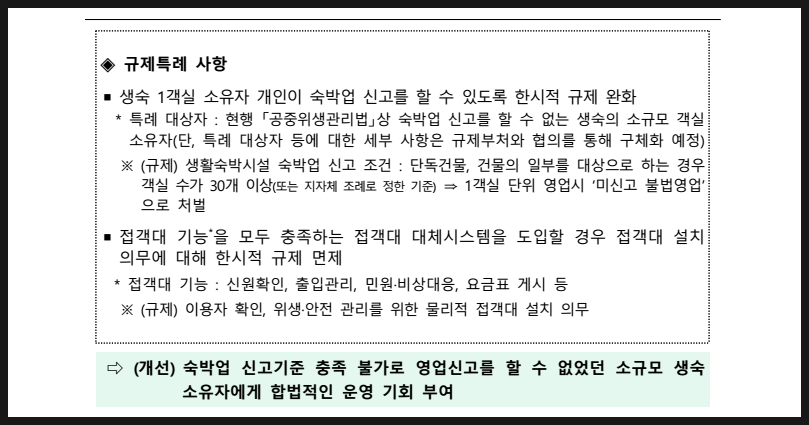
The main content of this demonstration project is to grant regulatory exceptions that temporarily allow owners of one room in residential accommodation facilities (living accommodation) to operate accommodation businesses. Previously, according to the Public Health Management Act, accommodation business reports could only be made if the number of rooms exceeded 30, making it nearly impossible for small accommodation operators to operate legally.
Due to the relaxation of regulations, booking and operational methods through online platforms and OTAs are now allowed. Furthermore, the obligation to install a reception desk can be replaced with a smart identity verification system, which is expected to reduce illegal operations and provide opportunities to legally utilize dormant accommodation resources. This change is likely to offer new business models to small accommodation owners.
Changes in Operating Methods|Online Platforms and Non-Face-to-Face Systems

This demonstration project utilizes online accommodation platforms based on non-face-to-face operating models. For example, platforms like Mister Mansion can manage the entire process from booking to check-in and check-out in an integrated manner.
The function of the reception desk is replaced with digital identity verification procedures such as identity authentication, ID card photography, and facial recognition. As a result, it becomes legally possible to operate one room similar to Airbnb, and concerns about public health and safety are planned to be addressed through real-time monitoring and regular inspections via the platform.
Conclusion|Expansion Effect of the Smart City Regulatory Sandbox

This regulatory sandbox has introduced a smartphone-based crime prevention system in addition to improving the residential accommodation system. This system allows users' smartphones to work as mobile CCTV and emergency bells through QR code scanning or web connections, transmitting real-time information about suspicious areas to the Urban Integrated Operation Center. This is expected to significantly enhance the safety of everyday spaces such as walking paths and public restrooms.

The Ministry of Land, Infrastructure and Transport plans to evaluate the potential for normalizing the residential accommodation system and spreading smart city safety services nationwide through this demonstration. Depending on the results of this demonstration, the institutionalization of related regulations may be decided, which is expected to have a significant impact on the residential accommodation market and smart city policies.
#ResidentialAccommodationFacilities, #OneRoomInAccommodation, #AccommodationDeregulation, #LegalAirbnb, #AccommodationBusinessReporting, #MinistryOfLandPolicy, #RegulatorySandbox, #SmartCity, #ResidentialTypeAccommodation, #RealEstatePolicy, #AccommodationRegulation, #AccommodationOperation, #OTAPlatform, #NonFaceToFaceAccommodation, #SmartIdentityVerification, #ReceptionDeskExemption, #UrbanIntegratedOperationCenter, #CrimePreventionSystem, #SmartphoneCCTV, #LifeSafety, #SmartCityPolicy, #MinistryOfLandInfrastructureAndTransport, #RealEstateDeregulation, #ChangesInAccommodationMarket, #RealEstateIssues, #PolicyAnalysis, #RealEstateNews, #SmartSafety, #RegulatoryInnovation
Frequently Asked Questions (FAQ)
Q. What is the main content of allowing the operation of one room in residential accommodation facilities?
The regulations have been relaxed to allow owners of one room in residential accommodation facilities to operate accommodation businesses temporarily.
The Ministry of Land, Infrastructure and Transport has introduced regulatory exceptions for allowing the operation of one room in residential accommodation facilities, relaxing the previous requirement of 30 or more rooms for accommodation business reporting. As a result, small accommodation owners can now legally operate their businesses. In addition, reservations and operations through online platforms and OTAs are now possible, and the requirement to install a reception desk is replaced by a smart identity verification system, reducing illegal operations and offering opportunities to efficiently utilize dormant accommodation resources.
Q. What operating methods are allowed when operating one room in residential accommodation?
Operating methods utilizing online accommodation platforms and non-face-to-face identity verification systems have become possible.
This policy change allows for the management of all processes from reservation to check-in and check-out non-face-to-face through online platforms such as Mister Mansion. The previous requirement for a reception desk has been replaced with digital identity verification procedures such as identity authentication, ID card photography, and facial recognition. This enables small operations of one room in a manner similar to Airbnb within a legal framework, and plans to manage hygiene and safety issues through real-time monitoring and regular inspections via the platform.
Q. What are the functions of the crime prevention system introduced in the smart city demonstration project?
Smartphones can be utilized as mobile CCTV and emergency bells for real-time information delivery.
The smartphone-based crime prevention system allows users' smartphones to function as mobile CCTV and emergency bells through QR code scanning and web connections. This system is expected to greatly enhance the safety of everyday spaces such as walking paths, public restrooms, by transmitting real-time information about suspicious areas to the Urban Integrated Operation Center. This enhances citizens' sense of safety and lays the groundwork for the expansion of smart city services.
Q. What are the expected effects of this regulatory relaxation and demonstration project?
It promotes the normalization of the residential accommodation system and the expansion of smart city safety services.
This regulatory relaxation and demonstration project by the Ministry of Land, Infrastructure and Transport aims to facilitate the legalization of residential accommodation operations and evaluate the potential for nationwide expansion of smart city safety services. As a result, the institutionalization of related regulations will be determined. This is expected to provide new business models for the residential accommodation market and have a significant impact on smart city policies and the real estate sector.