Table of Contents
- 1Q U.S. Aerospace Tech Overview
- Individual Stock Composition and Key Business Summary
- Summary of Akros Index Rebalancing Rules
- Rocket Lab's Weight Increase and Rebalancing Scenarios
- Possibilities and Conditions for SpaceX's Inclusion
- Conclusion: 2026 Retirement Account Management Points
- Frequently Asked Questions (FAQ)
1Q U.S. Aerospace Tech Overview

1Q U.S. Aerospace Tech ETF includes 12 aerospace and aviation technology companies listed in the U.S. This ETF offers investment opportunities across various sectors including space infrastructure, satellite communication, and urban air mobility (UAM).

Recently, the anticipation of SpaceX's listing and the concrete schedule for the Artemis 2 human lunar orbit mission have restored investor sentiment across the aerospace industry. The SpaceX listing is likely to become a benchmark for valuation relaying in this sector, and the Artemis 2 mission is expected to lead to increased contracts from NASA and rising revenues for private space companies. These factors will ultimately contribute to greater visibility of earnings.

Given the volatility of this topic, understanding the rebalancing process that causes changes in holdings and the inclusion process for SpaceX is essential. If this momentum continues until the second half of 2026, high returns can be expected through long-term theme ETFs in retirement savings, IRP, and ISA accounts.
Related Articles



Individual Stock Composition and Key Business Summary
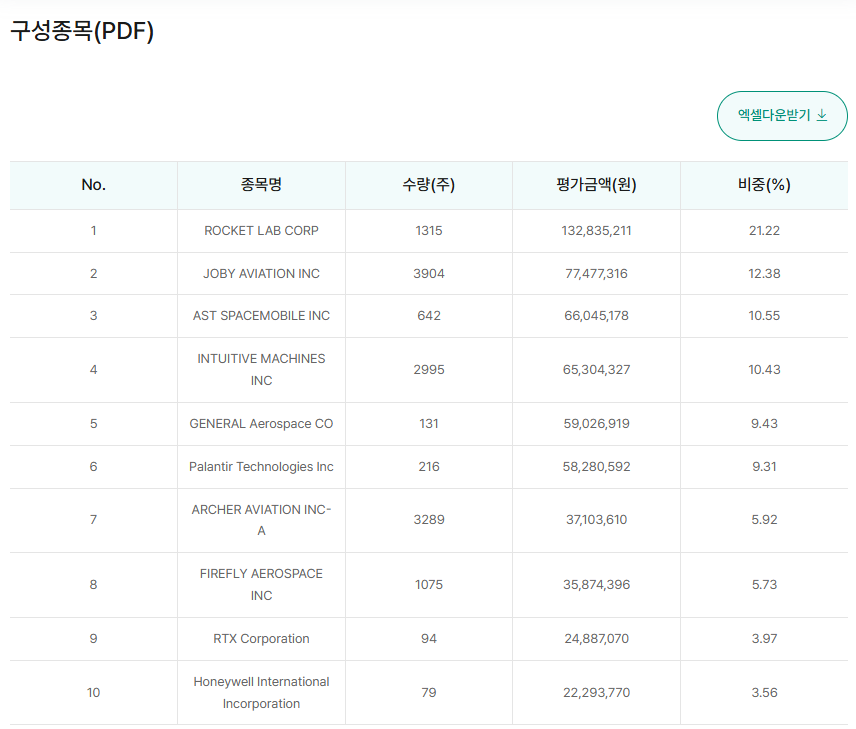
The 1Q U.S. Aerospace Tech ETF is primarily composed of innovative new space and UAM companies such as Rocket Lab, Joby, AST, and Intuitive Machines. This ETF also includes traditional aerospace giants like GE Aerospace, RTX, and Honeywell, which help to mitigate volatility to some extent.
Recently, Rocket Lab's stock has surged, increasing the weight of this company within the ETF. However, it is important to consider that upcoming quarterly rebalancing and the rule limiting the weight to 25% may necessitate weight adjustments. Recognizing these factors will significantly impact investment strategy.
Rocket Lab (21.22%)

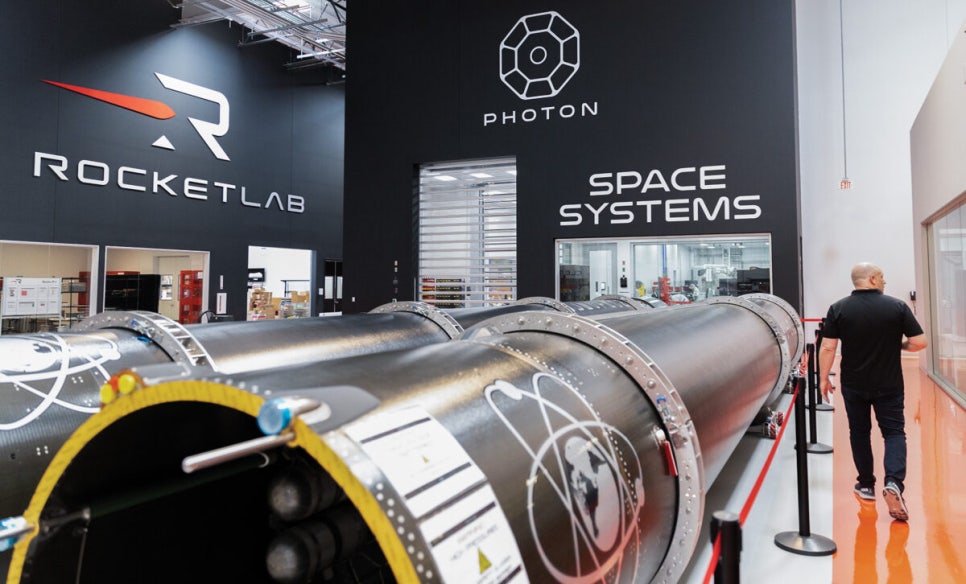
There is a leading new space company commercially operating the small satellite launch vehicle 'Electron'. The company is increasing its launch success rate while also seeking to expand its satellite platform and components business, resulting in a recent uptick in stock price. This company has the largest weight within the ETF and is becoming a key stock that significantly influences index rebalancing.
Joby Aviation (12.38%)
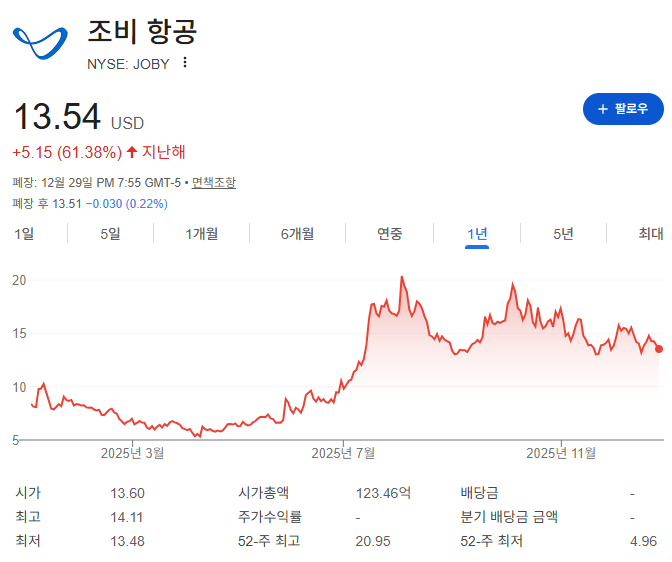
Leading the UAM (eVTOL) sector in the U.S., it is progressing rapidly through the FAA certification process. As commercialization approaches, it is gaining significant attention as a stock related to urban air mobility (UAM).
AST SpaceMobile (10.55%)

Communication technology is being developed through direct connection of low Earth orbit satellites and smartphones. While there are high expectations for commercialization, this is a volatile area that requires large-scale investments and presents technical risks.
Intuitive Machines (10.43%)

A private space exploration company collaborating with NASA on lunar exploration projects. The company aims for lunar landers and building space infrastructure, benefiting directly from increased government space budgets in the U.S.
GE Aerospace (9.43%)
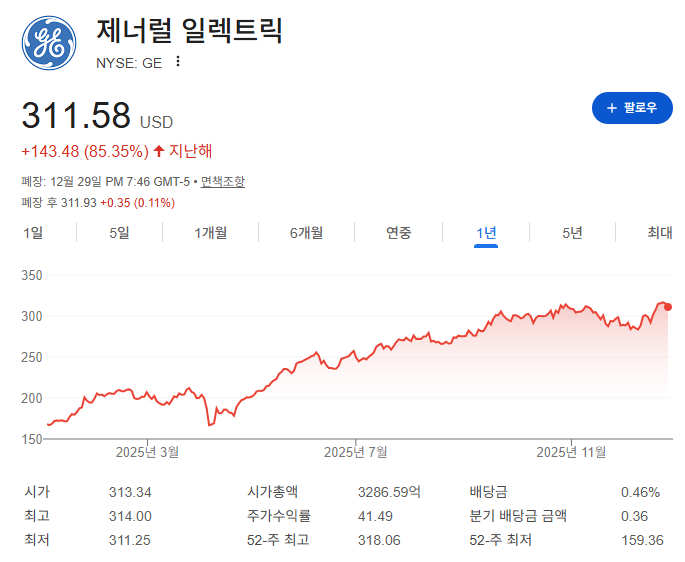
A traditional aerospace giant specializing in aircraft engines and systems. Compared to emerging space companies, it has lower volatility and plays a crucial role in adding stability to the ETF.
Palantir Technologies (9.31%)

A software company excelling in data analysis for defense, intelligence, and space sectors. With the increasing need to process satellite and space monitoring data, this company is playing a crucial role in space and defense data infrastructure.
Archer Aviation (5.92%)

Joby is leading as an eVTOL company in the UAM market. Although there are some delays in the certification process, the company's strategy for commercialization targeting major U.S. cities is viewed positively for future growth potential.
Firefly Aerospace (5.73%)
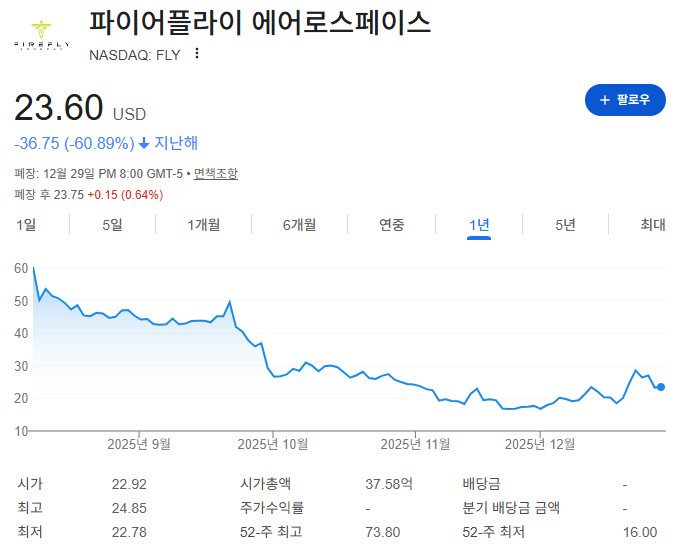
A private space company specializing in small to medium launch vehicles and lunar transport missions. It is expanding its presence in the next-generation launch vehicle and lunar logistics market by leveraging its experience with NASA contracts.
RTX Corporation (3.97%)
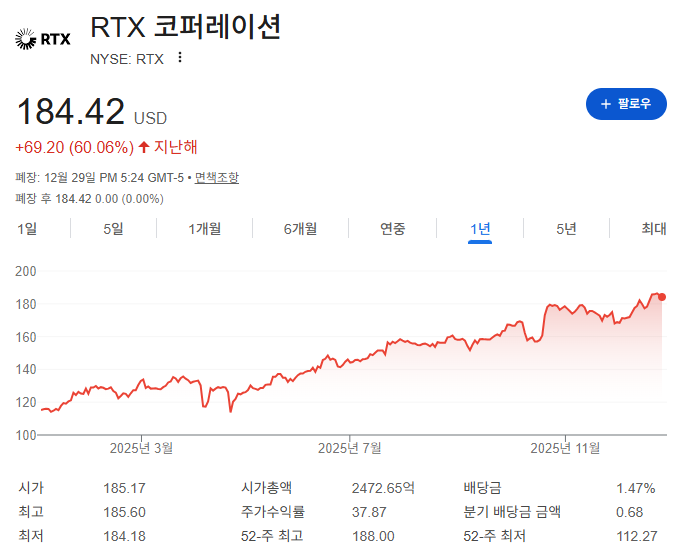
A global defense and aerospace company that includes missiles, avionics, and space systems. This company plays a stable role in the defense and aerospace sectors within the ETF.
Honeywell International (3.56%)

A company that manufactures aerospace electronics, navigation, and space sensors. They provide essential infrastructure for the space and aviation industry, and long-term demand is expected to remain stable.
Summary of Akros Index Rebalancing Rules
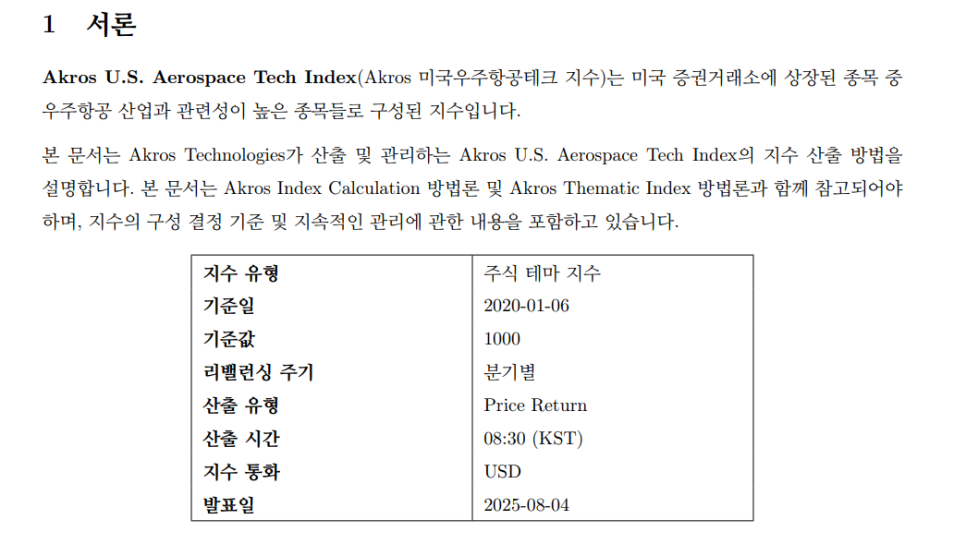
The underlying index, the Akros U.S. Aerospace Tech Index, undergoes rebalancing quarterly. The weight determination date is set for the last trading day (D) of March, June, September, and December each year, with the actual implementation occurring after the market closes on D+3 days. Consequently, if the index is composed at the end of the month, the actual change in the ETF's inclusion weight will occur a few days later.
Moreover, the rules for ad-hoc changes are very important. If a specific stock's weight exceeds 30% for 5 consecutive trading days, its weight will be adjusted to 25%, and the excess will be redistributed among other stocks. These rules contribute to the flexibility and stability of the index.

This process is continuously repeated to ensure that the weights of all stocks remain below 25%. As a result, even if stocks like Rocket Lab surge, the excessive concentration of weights is designed to be controlled at a certain level.
Rocket Lab's Weight Increase and Rebalancing Scenarios
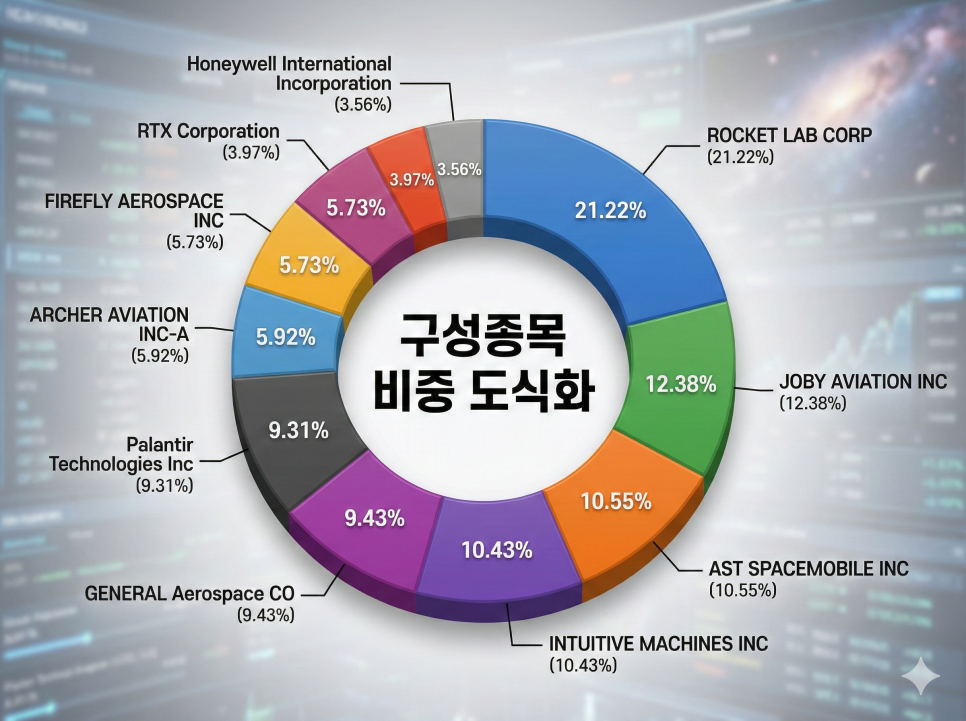
According to the recent composition ratios, ROCKET LAB CORP accounts for 21.22%, ranking first. This can be interpreted as a result of Rocket Lab's stock price increase, leading to a rise in valuation.
However, this index does not simply determine weights according to market capitalization but allocates target weights of 16%, 10%, 8%, and 4% based on the rating of the stock. Therefore, even if Rocket Lab continues to perform well in quarterly rebalancing, the weight may be adjusted according to the target weight and the 25% upper limit rule.
These factors will serve as important references for investors managing portfolios that include Rocket Lab.
There are three main points to consider when investing.
The first is that during a bull market, short-term returns can increase significantly, but as the quarter-end approaches, there may be weight adjustments to realize profits.
The second is that during overheating periods, if a specific figure approaches 30%, there is a risk that if this persists for more than 5 days, the ratio will be forcibly adjusted down to 25%.
Finally, in a correction market, stocks that have decreased may recover their weights during the quarterly rebalancing process, potentially leading to a buying effect within the theme.
Understanding and utilizing these points is crucial.
Possibilities and Conditions for SpaceX's Inclusion
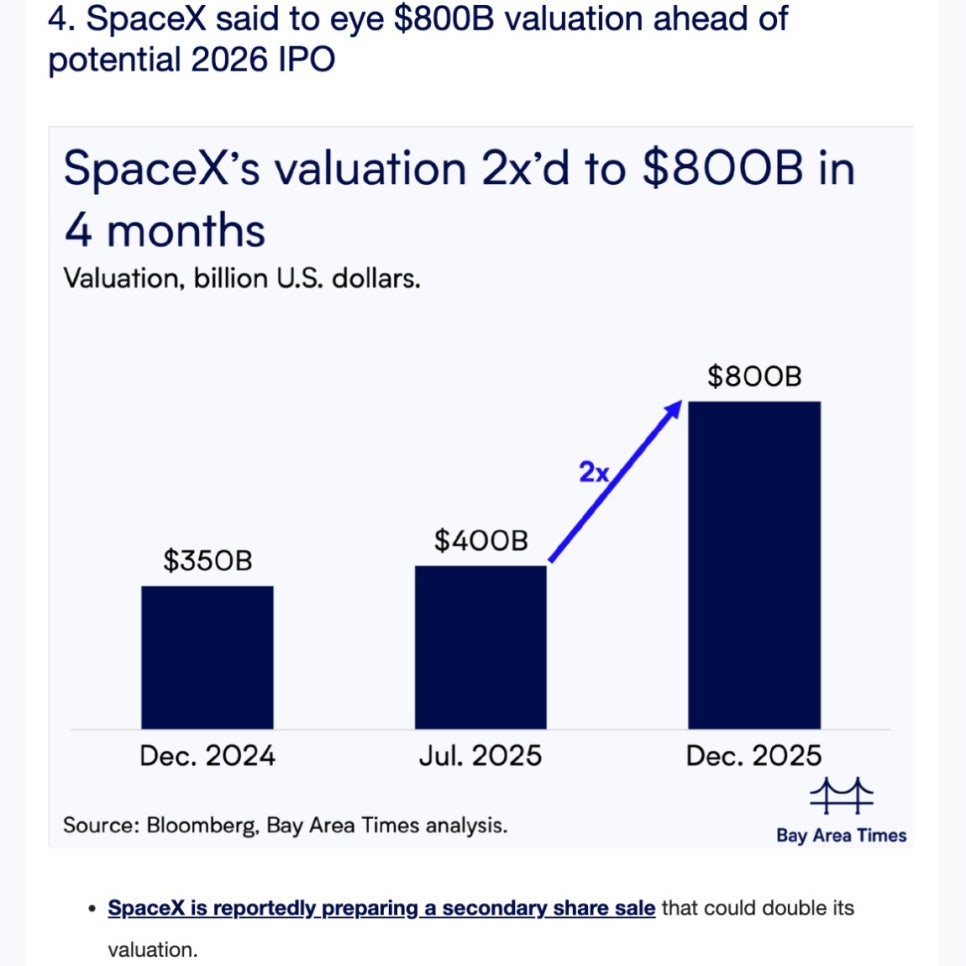
In conclusion, if SpaceX goes public through an IPO and gets listed on a U.S. exchange, it is highly likely to be included in the 1Q U.S. Aerospace Tech ETF. The inclusion requirements for this ETF generally stipulate that companies must be listed on either the NYSE or NASDAQ and meet minimum market capitalization, liquidity, and trading volume criteria.
SpaceX's listing is very likely to meet these conditions, especially since Starlink's satellite communication business is closely related to the communications field and aligns well with the ETF's theme. Therefore, SpaceX's listing is expected to have a positive impact as part of the space infrastructure and satellite communication theme.

The timing of ETF inclusion is divided into two approaches. The first is a principled approach where the inclusion is reviewed during the regular changes that occur at the end of the quarter.
The second is an exceptional case of early inclusion, where new listings that are deemed to play a significant role in the market can be considered for early inclusion based on the last business day of the month. However, since this requires committee judgment and specific criteria must be met, investors should plan with the consideration of the possibility of "immediate inclusion" not being a certainty, but rather a possibility of regular changes or early inclusion at month-end.
Conclusion: 2026 Retirement Account Management Points

The 1Q U.S. Aerospace Tech ETF is composed primarily of new space companies such as Rocket Lab, Joby, AST, Intuitive, Palantir, Archer and Firefly, but it also appropriately includes traditional large caps such as GE Aerospace, RTX, and Honeywell, maintaining a balanced exposure to the theme. However, since the top weights can change rapidly, it is essential to understand and approach the quarterly rebalancing (at the end of March, June, September, and December) and the 25% upper limit rule.
In 2026, there are points to watch closely. Continuously checking how far Rocket Lab's weight will increase and whether SpaceX's listing will satisfy the universe requirements and be included at month-end or quarter-end will be a key strategy. From this perspective, it is necessary to monitor the movements of the ETF closely.

The 1Q U.S. Aerospace Tech ETF is expected to yield high returns over the next 26 years, so buying through retirement savings or IRP accounts and tax-saving ISA accounts is recommended. If the balance in your retirement savings account is only in the tens of millions of KRW, it would be advisable to buy the entire amount of the 1Q U.S. Aerospace Tech ETF and expect long-term gains.
#1QU.S.AerospaceTech, #U.S.AerospaceETF, #AerospaceTech, #AkrosIndex, #Rebalancing, #QuarterlyRebalancing, #SpaceXInclusion, #SpaceXIPORelatedStocks, #SpaceETFsRecommendations, #RetirementSavingsETF, #IRPInvestment, #ISATaxSavings, #TaxDeductibleInvestments, #LongTermInvestmentStrategy, #ThemeETF, #NewSpace, #RocketLab, #ROCKETLAB, #JOBY, #JobyAviation, #ASTS, #ASTSpaceMobile, #IntuitiveMachines, #LUNR, #Palantir, #PLTR, #ArcherAviation, #UAM, #Firefly, #RTX, #Honeywell
Frequently Asked Questions (FAQ)
Q. What companies are included in the 1Q U.S. Aerospace Tech ETF?
This ETF includes 12 U.S. aerospace-related companies, including new space companies and traditional aerospace giants.
The 1Q U.S. Aerospace Tech ETF includes innovative new space and UAM companies such as Rocket Lab, Joby Aviation, AST SpaceMobile, and Intuitive Machines, as well as traditional aerospace giants like GE Aerospace, RTX, and Honeywell International. This provides balanced exposure to various sectors of aerospace, mitigating volatility while offering investment opportunities.
Q. What impact will SpaceX's listing have on the 1Q Aerospace ETF?
SpaceX's IPO increases the chances of inclusion in the ETF and has a positive effect on valuation relaying.
If SpaceX gets listed on a U.S. exchange, it is likely to meet the ETF's inclusion criteria. The Starlink satellite communication business aligns closely with the ETF's theme, contributing to the recovery of investor sentiment. Furthermore, SpaceX's listing will establish a benchmark for valuation reassessment in the aerospace sector, positively impacting the visibility of earnings across the industry.
Q. How does the sudden increase in Rocket Lab's weight and the rebalancing rules work within the ETF?
The sudden increase in Rocket Lab's weight is adjusted through quarterly rebalancing under the 25% limit rule.
Recently, Rocket Lab's stock price has risen, increasing its weight within the ETF to 21.22%. The Akros index applies a 25% cap when a particular stock exceeds 30%, and the actual weight adjustment occurs during quarterly rebalancing (at the end of March, June, September, and December). This prevents excessive concentration in any single stock and maintains stability.
Q. What should investors be cautious of when investing in the 1Q U.S. Aerospace Tech ETF?
Understanding the quarterly rebalancing and specific stock weight limit rules is crucial.
The ETF's short-term returns can fluctuate significantly due to stock price changes, but weight adjustments may occur at the end of each quarter for profit realization. Specifically, if a stock exceeds a 30% weight for more than 5 business days, it will be forcibly adjusted to 25%. Additionally, in correction periods, there may be a potential recovery of undervalued stocks' weights during the rebalancing process, necessitating an understanding of the rebalancing rules for strategic action.
Q. Which tax-saving accounts are suitable for the 1Q U.S. Aerospace Tech ETF?
Ideal for long-term investments in retirement savings, IRP, and ISA tax-saving accounts.
The 1Q U.S. Aerospace Tech ETF is a long-term investment option with expected high returns, making it particularly suitable for retirement savings, IRP accounts, and tax-deductible ISA accounts. Utilizing these accounts helps reduce tax burdens while promoting stable, high returns over the long term, making it a recommended approach to long-term investment strategies.
