Table of Contents
- Future Tech ETFs: Why Invest Now?
- KODEX US Nuclear SMR – Energy Infrastructure for the AI Datacenter Era
- SOL US Quantum Computing TOP10 – Concentrated Investment in the Next-Generation Computing Paradigm
- 1Q US Aerospace Tech – Simultaneous Exposure to UAM and Aerospace
- PLUS Global Humanoid – Concentrated Investment in Robot and Component Value Chain
- Conclusion – How to Utilize the Four Major ETFs in Retirement and Child Gifting Portfolios
- Summary Table of the Future Tech Four Major ETFs
- Frequently Asked Questions (FAQ)
Future Tech ETFs: Why Invest Now?

AI, electric vehicles, aerospace, and humanoid robots are emerging as key themes that will change the paradigm of industry in the next 10 to 20 years.
This article aims to introduce ETFs that represent four core fields: energy, computing, mobility, and automation.
KODEX US Nuclear SMR, SOL US Quantum Computing TOP10, 1Q US Aerospace Tech, and PLUS Global Humanoid Robot Active ETFs are the key players.
These ETFs are expected to provide new investment opportunities through advancements in future technologies.
Particularly, these four ETFs focus on themes with high long-term growth potential. Therefore, they are suitable for continuous purchase through pension savings or IRP accounts, or to be gifted to children for structuring long-term investment portfolios.
Let’s take a detailed look at each ETF, what themes they include, and which companies they invest in.
Are you feeling FOMO because you couldn’t invest in NVIDIA and Hynix, which everyone else is profiting from?
Let’s prepare for the future well.
KODEX US Nuclear SMR – Energy Infrastructure for the AI Datacenter Era
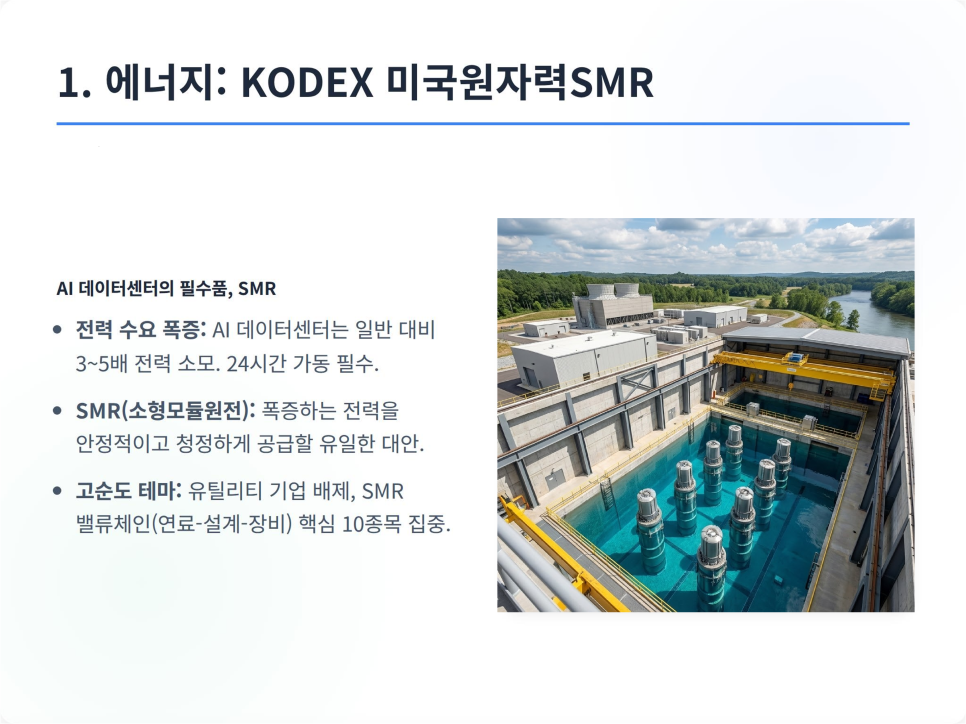
AI datacenters consume three to five times more power than conventional datacenters and must operate continuously for 24 hours. As a solution to efficiently and environmentally supply this massive power, SMR (Small Modular Reactor) has gained attention.
In particular, the KODEX US Nuclear SMR ETF is notable for focusing on companies related to SMR investments. Unlike existing nuclear ETFs that include utilities and fossil fuel companies, this ETF consists of 10 core stocks such as fuel, design & manufacturing, and equipment.
This heightened purity of theme structure provides investors with a clearer investment direction and increases expectations for the growth potential of SMR.
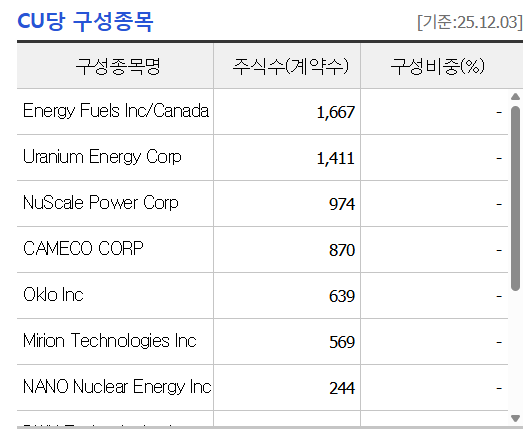
NuScale and Oklo are companies designing and developing the next-generation Small Modular Reactors (SMR), pushing for the commercialization of small reactors for AI datacenters. Oklo aims for commercial operation of AI datacenter-specific SMRs by 2027, garnering significant attention in the market.
Cameco, Uranium Energy, and Energy Fuels are companies specialized in the production and refinement of uranium fuel, expected to benefit directly from the increased demand for uranium due to SMR proliferation.
Additionally, companies like Centrus Energy, BWX Technologies, Curtiss-Wright, Mirion, and NANO Nuclear supply essential components and measurement equipment required for uranium enrichment and small reactor manufacturing.
If SMR plays a central role in AI and energy infrastructure, related ETFs will have long-term growth potential through innovation in power infrastructure. This change is expected to significantly impact the energy market in the future.

A key point to note in long-term investing is the essential infrastructure theme to solve the power shortages of the AI era. It is important to encompass various elements such as fuel, technology, and equipment to cover the entire value chain. This can effectively diversify the risks of individual stocks.
Moreover, it can be utilized as a core asset to increase the proportion of the energy sector in pension savings and IRP accounts. This strategy is advantageous for investors seeking stable returns.
SOL US Quantum Computing TOP10 – Concentrated Investment in the Next-Generation Computing Paradigm
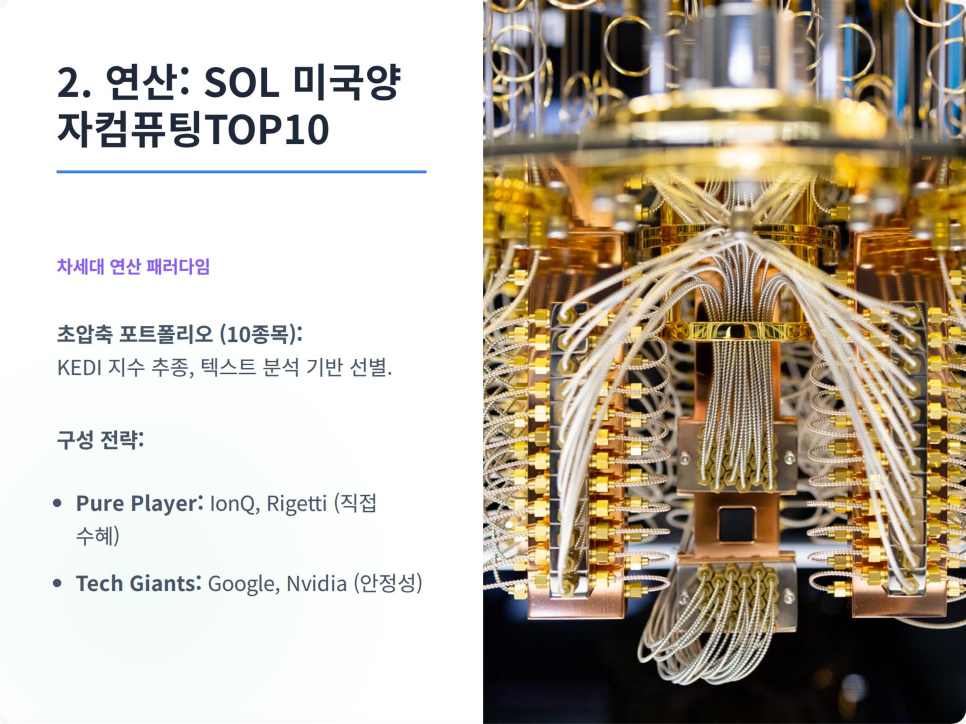
The SOL US Quantum Computing TOP10 ETF is a thematic ETF that focuses on 10 US-listed companies specialized in quantum computing.
This ETF is based on the KEDI US Quantum Computing TOP10 index and selects companies with high quantum relevance by analyzing text data such as business reports and news.
This approach provides investors with a portfolio reflecting the growth potential of the quantum computing field.
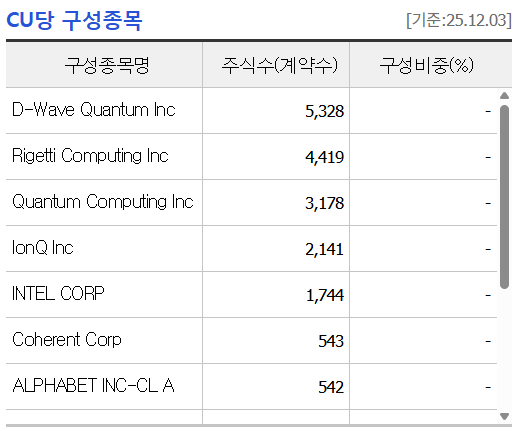
The portfolio can be broadly divided into two categories.
The first includes pure quantum specialized companies such as IonQ, Rigetti, D-Wave, and Quantum Computing Inc. These companies develop quantum hardware, software, and algorithms directly, thus having opportunities for direct profit generation.
The second group includes big tech and related large technology stocks such as Alphabet (Google), IBM, Nvidia, Intel, Broadcom, and Coherent. These companies lead quantum research with massive research and development (R&D) expenses and infrastructure, also playing significant roles in quantum simulations and networks.
In recent years, companies like IonQ, Rigetti, and D-Wave have seen their stock prices fluctuate greatly due to government support and technological announcements. In this process, related ETFs have also experienced high returns and volatility in the short term. Therefore, the high volatility of pure quantum companies can be understood as somewhat mitigated by the stability of large IT corporations.

As a long-term investment strategy, quantum computing currently has low revenue, but significant growth is expected in the 2030s. Investing in individual companies involves high risks, but using ETFs provides opportunities to invest across the entire quantum ecosystem. There are methods to participate in the future computing paradigm with small amounts through pension savings or child gifting accounts.
1Q US Aerospace Tech – Simultaneous Exposure to UAM and Aerospace

The 1Q US Aerospace Tech ETF is the first ETF centered around space and aerospace technology introduced in Korea. This ETF highlights the feature of simultaneously investing in UAM (Urban Air Mobility) and New Space (private space industry).

The main components can be summarized as follows.
First, prominent companies in the UAM and flying car sector include Joby Aviation and Archer Aviation, which are focused on developing electric vertical take-off and landing (eVTOL) aircraft.
Second, companies related to New Space and launch vehicles include Rocket Lab, Intuitive Machines, and Firefly. These companies are expanding space exploration and satellite launch services through innovative launch vehicle technologies.
Third, companies in satellite communications and data include AST SpaceMobile and Planet Labs. They play a vital role in building global communication networks and data analysis.
Lastly, traditional aerospace and defense companies include GE Aerospace, Lockheed Martin, Northrop Grumman, and Palantir. These companies have achieved stable growth based on their long history and experience.
By including both early growth stocks and traditional companies in the portfolio, it is essential to pursue both high growth and stability. In particular, the high ratio of JOBY and ARCHER can act as a positive factor.
According to related materials, the increase in UAM trial services and the expansion of commercial launches, along with satellite communications services around 2026, are expected to serve as significant growth momentum.
In this context, it can be summarized as an ETF that invests in the revolution of mobility where "skyways and space open simultaneously." This ETF holds the potential to lead future transportation innovation.

Key elements of long-term investment include the emergence of flying cars and air taxis. These innovative technologies are expected to directly benefit leading companies in the sector.
Moreover, the growth of the private space and satellite communications market excites expectations for expanded subscription-based revenue. ETF structures reduce the risk of individual stock failures and provide an opportunity to invest across the entire theme.
PLUS Global Humanoid – Concentrated Investment in Robot and Component Value Chain

The PLUS Global Humanoid Robot Active ETF is a financial product that invests in humanoid robots and related component and equipment companies through an active management approach.
The ETF’s composition is divided into "30% humanoid complete robots and 70% robot parts and components."
It is an attractive product that provides new opportunities for investors.
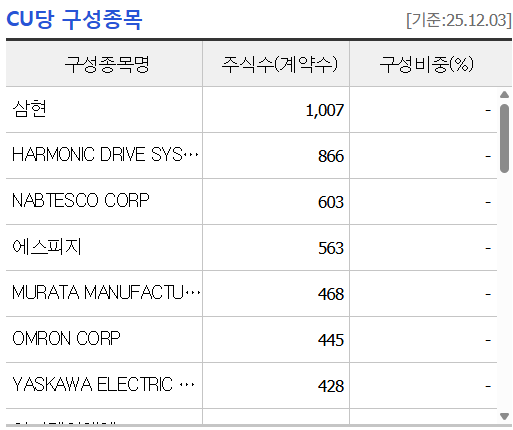
Complete robots and manufacturers account for about 30% of the entire market. This sector includes companies such as Tesla's Optimus project, Rainbow Robotics, ABB, Fanuc, and Yaskawa, which produce robots that are actually utilized in manufacturing, logistics, and services.
On the other hand, the parts, components, and sensor sector accounts for about 70% of the entire market. Companies like Harmonic Drive, Nabtesco, SPG, and Samhyun supply essential reducers and motors for robotic joints. Moreover, Cognex, Keyence, Murata, and LG Innotek offer cameras and various sensors that are responsible for the robot's vision and neurological functions. Companies like Ambarella and Omron act as the brain of robots with vision AI chips and controllers.
Various reports emphasize that demand for key components such as reducers and sensors is expected to increase more steadily and sustainably compared to complete robots. As humanoid technology commercializes, the growth potential of these platform component stocks is likely to increase even more. This trend is expected to positively impact the future outlook for the robotics industry.
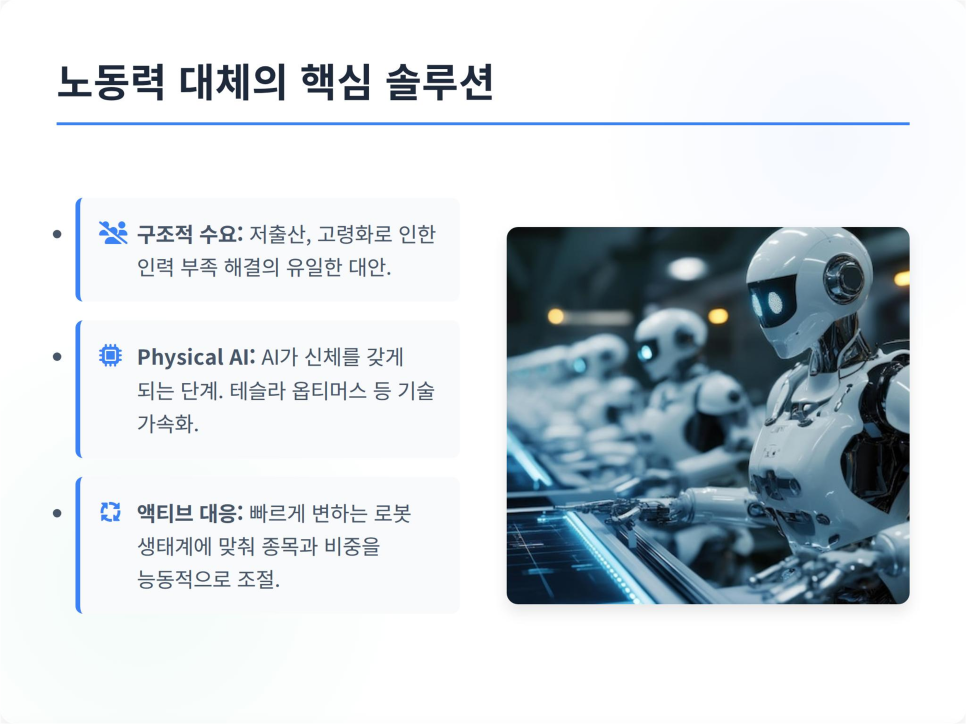
In long-term investing, it is crucial to note the increasing demand for robots due to low birth rates and aging populations. This is seen as a means to replace labor due to rising labor costs.
It is advisable to invest in essential component manufacturers such as reducers and sensors alongside key stocks like Tesla and Rainbow Robotics.
By actively adjusting the stocks and their proportions, one can effectively respond to the changing robotics industry.
Conclusion – How to Utilize the Four Major ETFs in Retirement and Child Gifting Portfolios
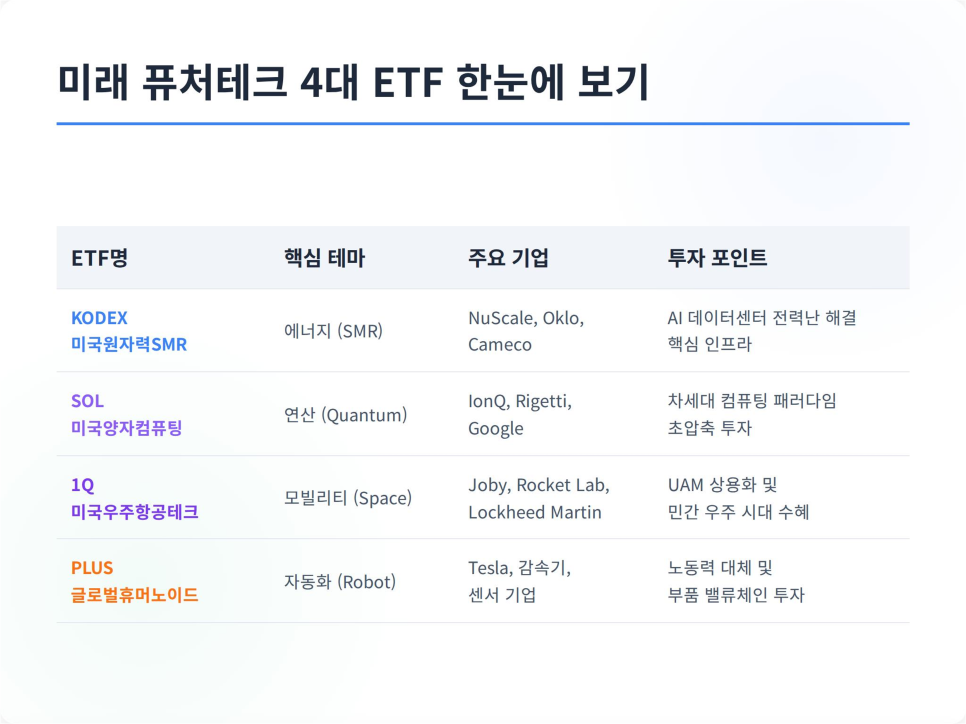
This article introduces the four major ETFs that will lead future technologies. Each ETF has a specific role and can be categorized as follows:
The first is KODEX US Nuclear SMR, which addresses the energy infrastructure needed for the AI era. The second is SOL US Quantum Computing TOP10, which presents the paradigm for next-generation computing. The third is 1Q US Aerospace Tech, a product that will lead UAM and space mobility revolutions. Finally, the PLUS Global Humanoid Robot Active ETF aims at automation innovations based on humanoid robots.
As a result, it can be said to be an ETF portfolio representing four axes: energy, computing, mobility, and automation. They are suitable products for systematic investment from a long-term perspective of over 10 years rather than for short-term profits.

Utilizing pension savings and IRP to invest a portion of your total assets evenly in the four ETFs brings significant synergy between future technologies and retirement assets.
Through gifting accounts for children, it is possible to compose a symbolic portfolio that directly invests in the technological environment they will live in.
Due to the high volatility, adjusting proportions and diversifying investments is essential, but it is a potential combination that can be sufficiently valuable as a "ticket to experience the entirety of the future technology revolution."
Summary Table of the Future Tech Four Major ETFs
| ETF Name | Main Themes | Examples of Key Holdings | Features & Strategy | Long-Term Investment Points |
| KODEX US Nuclear SMR | AI Datacenter SMR, Energy Infrastructure | NuScale, Oklo, Cameco, Uranium Energy, BWX, Centrus, etc. | High-purity nuclear-themed ETF investing only in 10 core stocks related to SMR fuel, design, and equipment. | Key satellite asset addressing energy shortages in the AI and electric vehicle era. |
| SOL US Quantum Computing TOP10 | Quantum Computing | IonQ, Rigetti, D-Wave, QCI, Alphabet, IBM, Nvidia, etc. | Concentrated investment in 10 stocks including pure quantum specialized companies and big tech. | Option for the next-generation computing paradigm expected to grow rapidly in the 2030s. |
| 1Q US Aerospace Tech | UAM + New Space | Joby, Archer, Rocket Lab, Intuitive Machines, AST SpaceMobile, Palantir, etc. | Aerospace theme covering flying cars, launch vehicles, satellite communications, and aerospace engines. | Beneficiary of the growth of the air taxi and private space era expected to accelerate after 2026. |
| PLUS Global Humanoid Robot Active | Humanoid Robots & Robot Component Value Chain | Tesla, Rainbow Robotics, ABB, Fanuc, Yaskawa, Harmonic Drive, Nabtesco, Cognex, Keyence, etc. | Active management structure with 30% complete robots and 70% parts such as reducers and sensors. | Core beneficiary theme for automation & Physical AI in the era of labor shortages and aging population. |
#FutureTechETFs, #KODEXUSANuclearSMR, #SOLUSQuantumComputing, #1QUSAerospaceTech, #PLUSGlobalHumanoidRobots, #SMRETF, #QuantumComputingETF, #AerospaceETF, #HumanoidRobotETF, #AIDatacenterPower, #NuclearInvestment, #UAMInvestment, #FlyingCars, #NewSpace, #RobotInvestment, #LongTermInvestmentStrategy, #PensionSavingsETF, #IRPPortfolio, #ChildGiftingInvestment, #ThematicETF, #USETF, #GrowthStockInvestment, #EnergyInfrastructure, #NextGenComputing, #SpaceIndustryGrowth, #RobotIndustryOutlook, #FutureTechInvestment, #InvestmentStudy, #ETFPortfolio
Frequently Asked Questions (FAQ)
Q. What industry themes do the four Future Tech ETFs invest in?
The four ETFs invest in core future industries of energy, computing, mobility, and automation.
The four Future Tech ETFs represent AI datacenter-specific nuclear SMR, next-generation computing technology like quantum computing, urban air mobility (UAM) and aerospace technologies, and humanoid robots and related component industries. These four fields are identified as important themes that will change the industry paradigm in the next 10 to 20 years, with each ETF focusing on specialized companies within these themes.
Q. Why is the KODEX US Nuclear SMR ETF gaining attention?
Because it focuses on SMR, a key infrastructure for solving power shortages in AI datacenters.
The KODEX US Nuclear SMR ETF has a structure that concentrates investments in 10 core stocks related to SMR, such as fuel, design, manufacturing, and equipment, unlike existing nuclear ETFs. SMR is an innovative technology aimed at environmentally supplying the massive power required by AI datacenters, with leading companies like NuScale and Oklo developing them for commercial operation aimed around 2027. It encompasses the entire value chain related to uranium fuel and parts suppliers, exhibiting substantial long-term growth potential.
Q. What are the investment targets and characteristics of the SOL US Quantum Computing TOP10 ETF?
It concentrates investment across the quantum computing field, including pure quantum companies and big tech.
This ETF invests in pivotal stocks within the quantum computing sector, featuring companies that develop quantum hardware and software such as IonQ, Rigetti, as well as large technology companies like Google, IBM, and Nvidia. By analyzing text data, it selects 10 companies with a strong quantum relevance, thus partially mitigating the high volatility of individual stocks with a stable big tech portfolio. Significant growth is anticipated in the 2030s, making it suitable for pensions and long-term investments.
Q. What companies does the 1Q US Aerospace Tech ETF invest in?
It includes UAM, private space, satellite communications, and traditional aerospace companies.
The 1Q US Aerospace Tech ETF comprises companies like Joby Aviation and Archer Aviation which focus on eVTOL aircraft, innovative launch vehicle developers like Rocket Lab and Firefly, satellite communication data companies such as AST SpaceMobile and Planet Labs, and traditional aerospace and defense companies like GE Aerospace, Lockheed Martin, and Northrop Grumman. It expects growth momentum through UAM commercialization, increased space launches, and expansion of satellite communications, seeking both high growth and stability.
Q. How is the PLUS Global Humanoid Robot ETF structured for investment?
It balances investments with 30% humanoid complete robots and 70% parts and materials.
This active ETF focuses on companies producing complete humanoid robots, like Tesla's Optimus project and Rainbow Robotics, as well as core parts manufacturers like reducers and sensor/camera providers. Parts and materials companies account for about 70% of the market and show stable growth. Increased demand for robots due to low birth rates and aging populations is expected to make this a long-term promising investment.
Q. What investment strategies are suitable for the four Future Tech ETFs?
They are appropriate for long-term diversified investments like pension savings, IRP, or child gifting for over ten years.
Considering the volatility and growth potential of future technologies, the four ETFs are suitable for systematic investments through long-term savings accounts like pension savings and IRP. They can also be utilized in child gifting investment portfolios, and adjusting proportions and implementing diversification strategies are crucial due to volatility. By balancing investments across the four core future industries, stability and growth potential can be pursued.
