Table of Contents
- The Revolution in Cancer Treatment: The Rise of ADC Technology
- Global ADC Market Outlook and Key Technology Trends
- Next-Generation ADC Future Strategies of Samsung and Celltrion
- Analysis of the Leading K-Biotech Trio with Unique Technologies
- Conclusion: Leap and Outlook of the K-Bio ADC Industry
- Frequently Asked Questions (FAQ)
The Revolution in Cancer Treatment: The Rise of ADC Technology
Modern medicine continues to evolve, particularly in the field of cancer treatment where new innovations are being developed. Among them, ADC (Antibody-Drug Conjugate) is an emerging therapy that has garnered attention. Previously, chemotherapeutic agents, targeted therapies, and immunotherapeutics were used, but now ADC is referred to as the 'fourth wave,' transforming the market. This change presents new possibilities for cancer treatment.

ADC is structured by connecting the precise targeting capabilities of antibodies with potent drugs (payloads), making it a so-called 'guided missile anticancer drug' that can accurately attack cancer cells. Especially following the clinical success of 'Enhyto,' global pharmaceutical companies are fiercely competing to secure this technology. The years 2024 and 2025 are expected to be pivotal moments when ADC transitions from a niche market to a mainstream treatment.
In this post, we will deeply analyze the growth prospects of the fast-growing ADC market and the strategies of five leading companies in the Korean bio industry.
Global ADC Market Outlook and Key Technology Trends
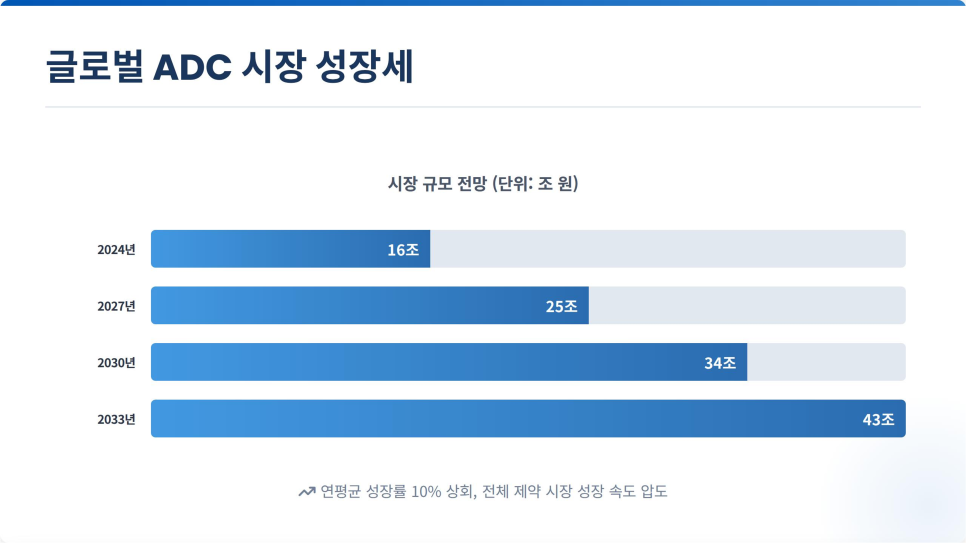
The global ADC market is experiencing rapid growth, establishing itself as a major treatment method in cancer therapy. Recent market analyses indicate that the market size will reach approximately 16 trillion won in 2024 and about 43 trillion won by 2033.
This indicates an annual growth rate of over 10%, significantly exceeding the growth rate of the overall pharmaceutical market. This trend is expected to persist as the ADC technology evolves and the importance of cancer treatment becomes more pronounced.

Recently, technologies that surpass existing single antibodies, such as bispecific antibodies and dual-payload technologies, have gained attention in the life sciences field. These innovations aim to address the issues of cancer cells hiding specific antigens and acquiring resistance by simultaneously blocking two pathways or combining drugs with different mechanisms of action.
Furthermore, the masking technology that works effectively only near tumors has also drawn attention to minimize side effects that can occur in normal cells. These advanced technologies are providing new business opportunities for latecomers and driving advancements in the life sciences industry. Such changes are expected to significantly impact future research and development.
Next-Generation ADC Future Strategies of Samsung and Celltrion
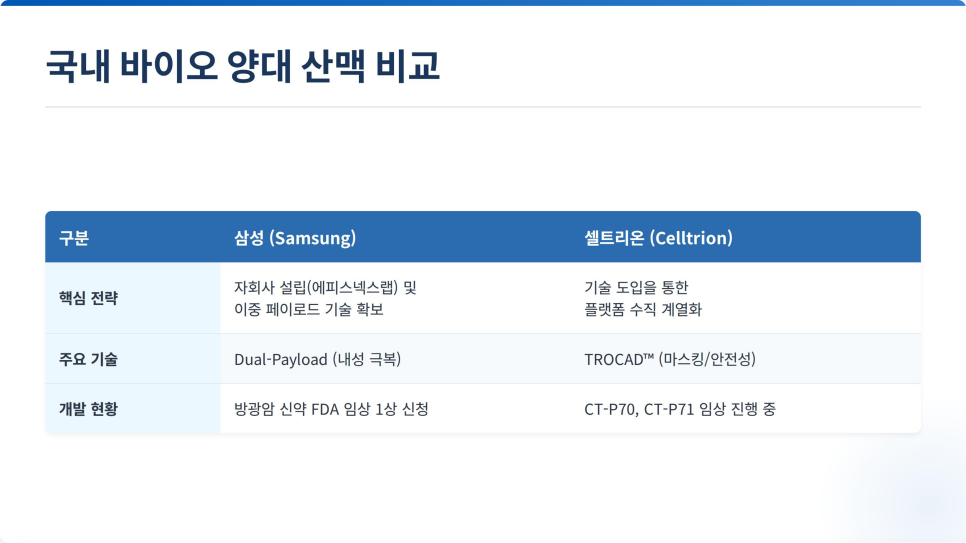
In the domestic bio sector, Samsung and Celltrion constitute two critical pillars. These companies are actively working to enhance their competitiveness in the ADC market based on strong capital and abundant development experience.

Samsung Biologics has announced a transition to a new drug development company through a large-scale organizational restructuring at the group level. In this process, it has established a subsidiary, 'Episnex Lab,' focusing on the development of biotechnology platforms. Notably, through collaboration with Frontline Biopharma, it has secured dual-payload technology.
This technology is an innovative approach that combines drugs with different mechanisms of action on a single linker, overcoming cancer cell resistance. Additionally, they applied for Phase 1 clinical trials for their candidate drug targeting bladder cancer to the FDA, entering a substantive development phase. These efforts showcase Samsung Biologics' strong commitment to new drug development.

Celltrion has adopted a 'vertical integration' strategy that actively incorporates innovative platform technologies beyond a simple 'fast follower' approach. In this process, it has utilized the payload technology from Finobiotics and the tumor microenvironment-responsive masking technology (TROCAD™) from TrioIR to build a pipeline that satisfies both safety and efficacy.
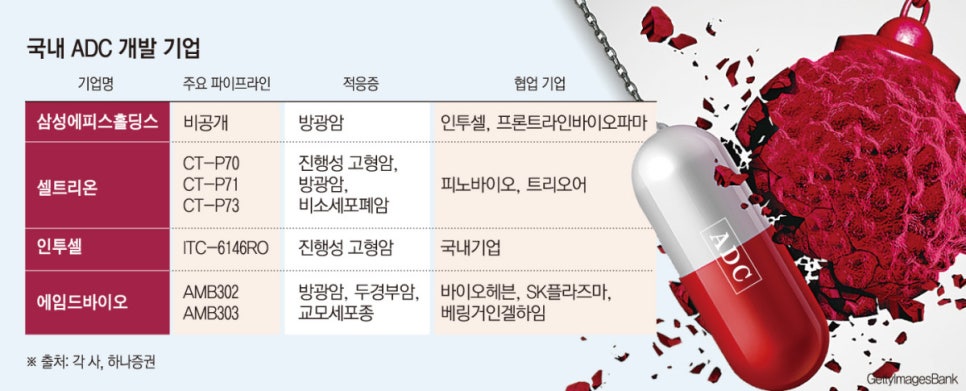
Currently, they are focusing on the development of competitive new drugs such as CT-P70 targeting cMET and CT-P71 aimed at Nectin-4, and they expect to release significant clinical data starting in 2025. Through these strategies, Celltrion is poised to strengthen its position in the market.
Analysis of the Leading K-Biotech Trio with Unique Technologies
Domestic biotech companies are showing remarkable competitiveness on par with large corporations. Ligand Chem Bio, Intocell, and Aimmed Bio are attracting the attention of global pharmaceutical companies due to their unique technological capabilities. The growth of these companies serves as a critical factor for the bright future of the bio industry.
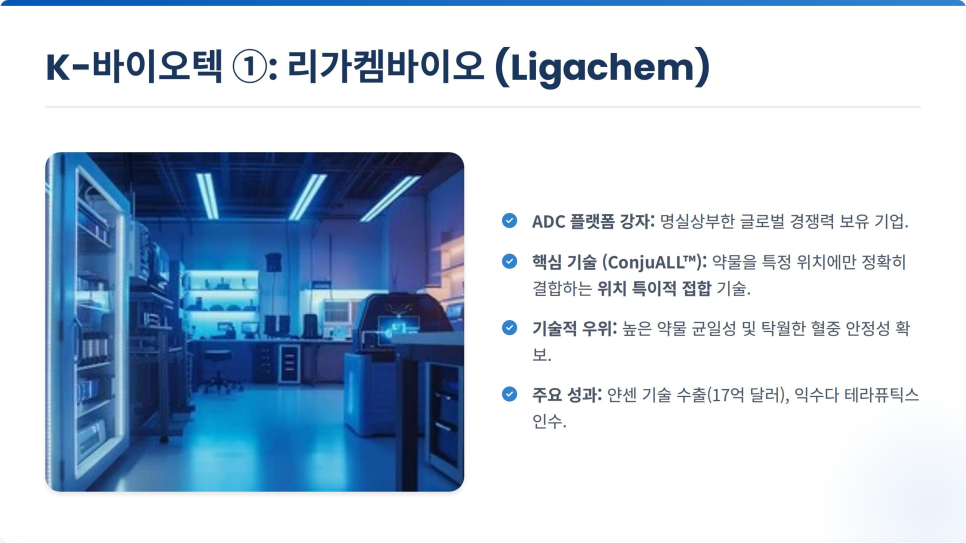
Ligand Chem Bio (formerly Legochem Bioscience) has stood out in the ADC platform field. Their core technology, ConjuALL™, allows precise drug coupling to specific regions of antibodies, thereby enhancing the drug's consistency and stability in the bloodstream.
The recently exported LCB84 to Janssen resulted in a notable contract worth 1.7 billion dollars. Additionally, by acquiring their partner, Ixuda Therapeutics, they have expanded their clinical development capabilities. Through these strategies, Ligand Chem Bio is continuously demonstrating the potential for growth.
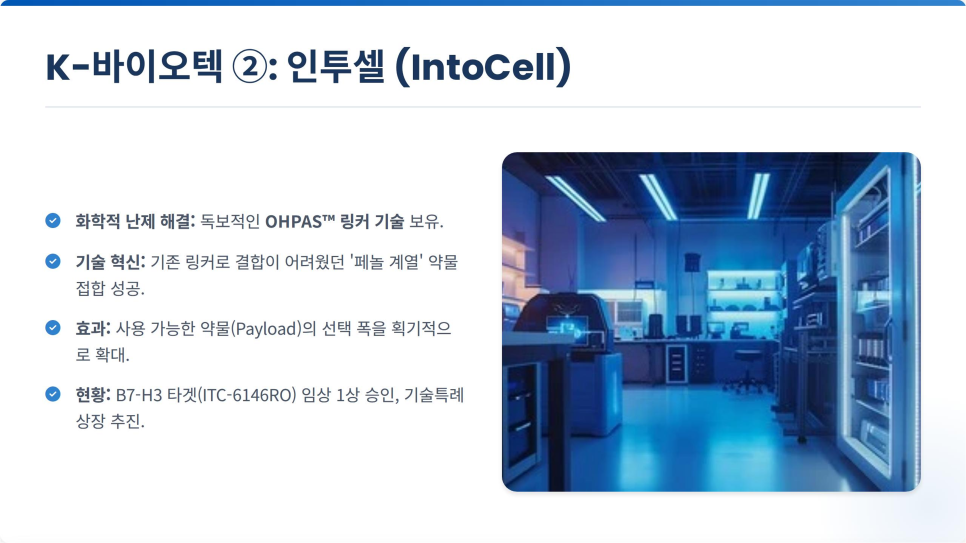
Intocell has developed the OHPAS™ linker technology, which chemically solves problems arising from existing ADC technologies. This innovative linker facilitates stable coupling with phenolic-based drugs, which were previously difficult to attach, significantly broadening the range of drug selection. Recently, their pipeline (ITC-6146RO) targeting B7-H3 has received Phase 1 clinical approval, further increasing the potential for value appreciation.
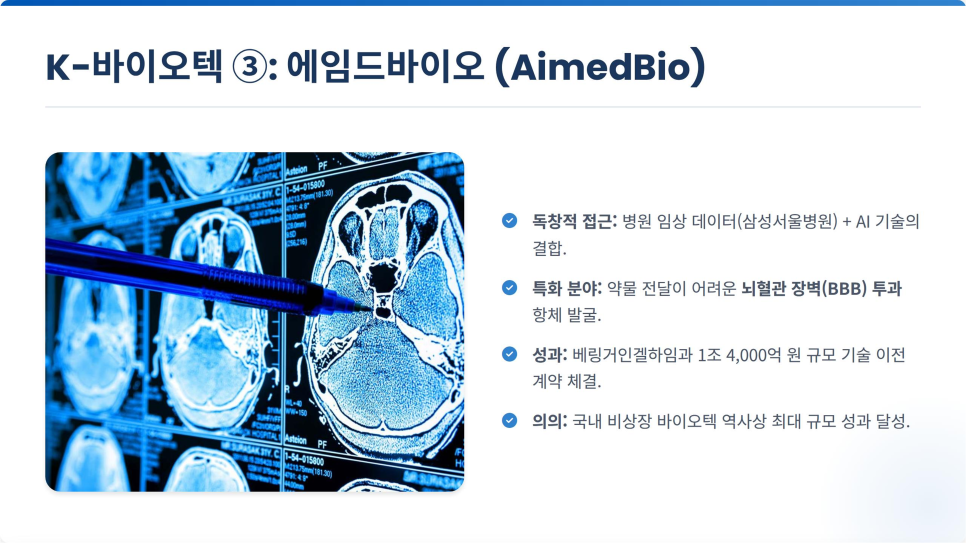
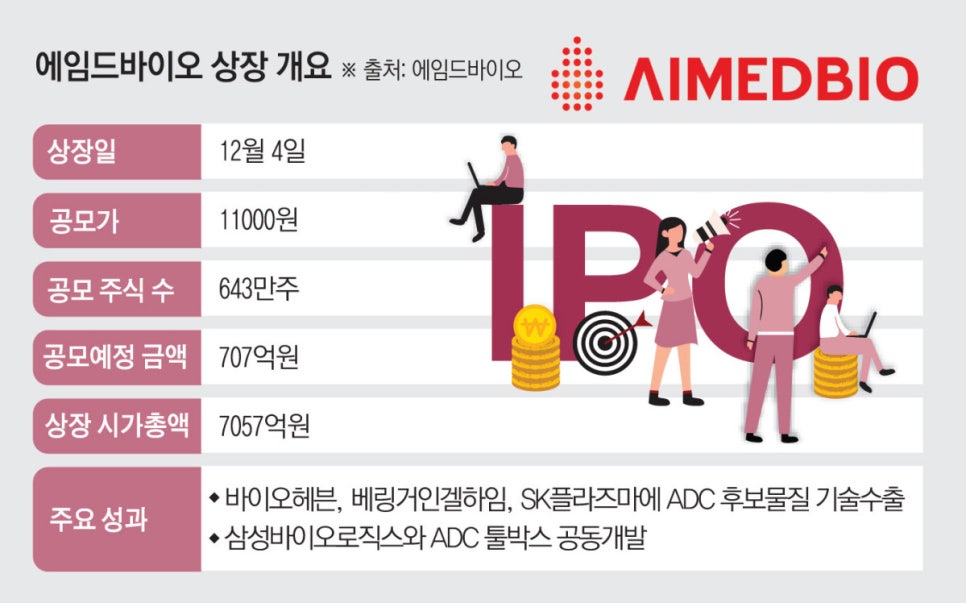
Aimmed Bio utilizes clinical data collected from hospitals and artificial intelligence in a unique manner. In particular, they are focusing on finding antibodies that can cross the blood-brain barrier (BBB) based on patient data from Samsung Medical Center. Recently, they achieved significant success by signing a technology transfer agreement with Boehringer Ingelheim worth 1.4 trillion won, the largest achievement among domestic unlisted biotech companies. As a result, Aimmed Bio is expected to secure capital through listing on December 4th, and its future growth looks promising. This process is anticipated to contribute to expanding possibilities in the bio field.
Conclusion: Leap and Outlook of the K-Bio ADC Industry

The year 2025 is expected to be a significant point for the Korean ADC industry to gain global attention. The capital strength of large corporations like Samsung and Celltrion, combined with the innovative technologies of biotech companies, is forming a positive ecosystem. In the past, reliance on technology exports was the norm, but now companies are leading their own clinical research and advancing platforms to boost competitiveness in the global market.
Investors should pay attention to the crucial elements of technology convergence and clinical data. Data validated in actual clinical settings, rather than mere expectations, will serve as a key indicator determining corporate value. Particularly, watching how Korean companies grow as 'first movers' in the global ADC market presents an intriguing point of observation. These changes are expected to provide new opportunities for investors, necessitating careful monitoring of market trends.
#ADC, #anticancer drug, #biotech stock, #pharmaceutical bio, #Samsung Biologics, #Celltrion, #Ligand Chem Bio, #Intocell, #Aimmed Bio, #Enhyto, #new drug development, #antibody-drug conjugate, #stock market, #investment strategy, #biotechnology, #healthcare, #K-biotech, #technology export, #clinical trials, #FDA approval, #bispecific antibodies, #cancer treatment, #targeted anticancer agents, #medical technology, #economic outlook, #industrial analysis, #growth stocks, #value investment, #global market, #biosimilars
Frequently Asked Questions (FAQ)
Q. Why is ADC technology gaining attention in cancer treatment?
ADC is an innovative treatment that combines precise targeting of antibodies with potent drugs to attack only cancer cells.
ADC (Antibody-Drug Conjugate) is referred to as a 'guided missile anticancer drug' that connects antibodies with potent drugs to accurately attack only cancer cells. Unlike existing chemotherapy drugs, it minimizes damage to normal cells, enabling efficient treatment. Especially following the clinical success of 'Enhyto,' global pharmaceutical companies are competitively entering developmental efforts, establishing it as a new standard of cancer treatment.
Q. What is the growth outlook for the global ADC market?
The global ADC market is expected to grow at an average annual rate of over 10%, from about 16 trillion won in 2024 to about 43 trillion won in 2033.
According to recent analysis, the global ADC market, estimated at around 16 trillion won in 2024, is expected to grow significantly to around 43 trillion won by 2033. This indicates a high annual growth rate of over 10%, outpacing the growth of the existing pharmaceutical market. The advancement of ADC technology and the increasing demand for cancer treatment are expected to drive this growth.
Q. What strategies are Samsung and Celltrion employing in the ADC field?
Samsung is focusing on dual-payload technology, while Celltrion is enhancing ADC competitiveness through vertical integration and masking technology.
Samsung Biologics has established Episnex Lab and secured dual-payload technology in collaboration with Frontline Biopharma, moving into Phase 1 clinical trials. Celltrion is developing a new drug pipeline that balances safety and efficacy by using Finobiotics payloads and TrioIR's masking technology, adopting an internalization strategy. Both companies are concentrating on securing market leadership with substantial capital and technology.
Q. What strengths do the three leading Korean biotech companies, Ligand Chem Bio, Intocell, and Aimmed Bio, possess?
Ligand Chem Bio excels in precise coupling technology, Intocell has an innovative linker, and Aimmed is notable for its AI-based drug development and large-scale technology transfer achievements.
Ligand Chem Bio enhances drug coupling precision and stability with its ConjuALL™ technology and is expanding clinical capabilities through technology export to Janssen and the acquisition of Ixuda Therapeutics. Intocell has broadened its drug scope with the OHPAS™ linker and received Phase 1 clinical approval. Aimmed Bio focuses on developing antibodies that can cross the BBB by utilizing clinical data and AI, recently signing a 1.4 trillion won contract with Boehringer Ingelheim, achieving the highest results among domestic unlisted biotech firms.
Q. What is the outlook for the Korean ADC industry in 2025, and what should investors focus on?
2025 is expected to be a time when the Korean ADC industry secures global competitiveness, with investors' attention on technology convergence and clinical data.
2025 is expected to be when the Korean ADC industry, through the technological convergence of large enterprises and biotech firms like Samsung and Celltrion, stands out in the global market. Investors should focus on actual clinical data results over mere expectations and monitoring the growth of Korean companies as 'first movers' is critical. During this process, new opportunities in the market and investment trends are expected to emerge.
